
The conflict in the Middle East has ushered in a period of significant international instability. The foremost priority of the ministry of foreign affairs has been to assist Italian citizens affected by the crisis, ensuring their safe return to Italy. However, every international crisis requires a broader assessment of its consequences. Alongside the tragedy of war, profound effects on global economic balances are emerging.
The tensions affecting the Gulf and the Strait of Hormuz clearly highlight the vulnerability of some of the world’s main arteries of international trade. The ongoing crisis is already exerting strong inflationary pressure on gas, oil and other strategic goods such as fertilisers, with knock-on effects on global food prices. When these critical hubs are exposed to geopolitical tensions, the urgency of strengthening the security and diversification of trade routes becomes clear.
In recent years, Europe has faced a similar challenge. Russia’s aggression against Ukraine necessitated a rapid diversification of energy supply sources. Within a few months, we re-evaluated infrastructure, supply chains and partnerships to ensure security and continuity for our economic systems.
Today, the crisis in the Middle East calls for a comparable reflection regarding trade routes. In this context, the India–Middle East–Europe Economic Corridor (IMEC) takes on particular importance. This is not merely a line on a map, but a potential reorganisation of logistics networks and industrial value chains connecting India, the Gulf and Europe — capable of reshaping trade flows and reinforcing the Mediterranean’s role as a strategic hub linking Asia and Europe, with potential benefits for Italy estimated at up to 26 billion euros.
When global trade routes change, economic geographies change as well. New commercial corridors create new logistical and productive hinterlands: Territories that attract investment, host distribution centres and develop industrial activities connected to international value chains. If one of the main European gateways for these routes is the Mediterranean — in particular the Northern Adriatic — its natural reach cannot be limited to Western European markets alone. It will inevitably extend to Central Europe and the Western Balkans, which serve as the geographical and infrastructural bridge between the Mediterranean and the heart of the continent.
Owing to their geographical position, proximity to European markets and progressive alignment with EU standards, the Western Balkans can become an integral part of this new logistics architecture — not merely a transit area, but a genuine economic hinterland for routes connecting Asia and Europe, capable of attracting investment and strengthening regional value chains. The region’s infrastructure will also benefit from this evolution, helping to manage and distribute a portion of the commercial flows arriving in Europe via the corridor.
Within this scenario, the Mediterranean once again assumes strategic centrality. Italy, due to its geographical position, naturally serves as a logistics platform connecting Europe, Asia and Africa. Our port system represents one of Europe’s major strategic infrastructures — an extensive network linking the Mediterranean to Europe’s main economic and industrial corridors.
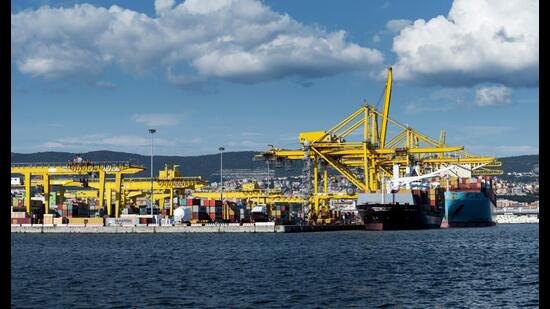
Within this system, the Northern Adriatic occupies a privileged position in connecting the Mediterranean with Central Europe. Trieste, by virtue of its history, location and infrastructure links, represents one of the most natural hubs within this network. It is, therefore, no coincidence that on March 17, Trieste will host two important events dedicated to regional cooperation and emerging economic routes: The celebrations marking the 30th anniversary of the Central European Initiative (CEI) and a forum on the IMEC.
These occasions will provide an opportunity to discuss the future of connectivity between the Mediterranean, the Balkans and Central Europe, with the participation of ministers from the Balkan countries, senior representatives of States involved in the IMEC and business leaders, highlighting the strategic role of this region in developing new logistics and industrial value chains between Asia and Europe.
Strengthening links between the Mediterranean, Europe and the Indo-Pacific enhances the economic security of our continent. In this new geography of global trade routes, Italy can and must play a leading role.
Antonio Tajani is deputy prime minister of Italy. The views expressed are personal


