
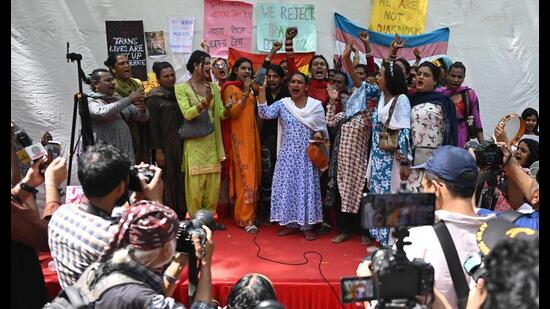
The post went out just hours after Parliament passed the bill. “I can’t be strong all the time,” it said. “It took me years to become the person I am today… And now it feels like everything is being taken away, my rights, my dignity, my privacy.” It was a call for help on social media. Fortunately, the person was located and counselled. Crisis defused — for now.
The anxiety is not isolated. Over 300 mental health professionals have signed up to provide discounted counselling sessions for transgender people in distress and isolation, Raj Mariwala, director of the Mariwala Health Initiative, said. “By invalidating lived realities and self-identification, the bill is causing anxiety and leading to suicidal ideation”, Mariwala said. “People are worried about the knock-on effects: ‘Am I going to be safe walking down the street’? These are very real questions.”
The amendment to the Transgender Persons Protection of Rights Act, 2019 removes its most crucial feature — the right to self-identify. By confining who is transgender to socio-cultural groups, hijras, kinnars, aravanis and jogtas, it opens a host of questions. What about those who don’t belong to these groups? What about non-binary people? What about those who have begun transitioning but haven’t yet completed the process? What happens to 35,000 identity certificates already issued?
No answers. The bill came without warning or consultation with the community, not even the National Council of Trans People. A Supreme Court committee on the rights of transgender persons headed by retired judge Asha Menon has asked the government to withdraw the amendment for denying “existential rights to those who do not align themselves with their gender assigned at birth”.
The amendment is flawed in other ways. By mandating a medical board, it not only undermines constitutional principles of dignity, autonomy and privacy, it creates an illogical layer of medical bureaucracy: What exactly will a doctor examine if gender is a question of identity and not anatomy? As Congress MP Renuka Choudhary points out: If men and women don’t have to convince a medical board about their gender, why should others have to?
The government claims the amendment will protect transgender people. Yet, it says nothing about natal family violence which is particularly egregious against queer and trans persons as documented in several reports including the 2023 Apnon Ka Bahut Lagta Hai (Our Own Hurt Us the Most). What happens to “chosen families”, a concept recognised in 2025 by the Madras High Court?
Most worrying is the creeping intrusion of the State, often aligned with parents and vigilante groups, into the private lives of individuals who do not conform to majoritarian ideas of the “good” citizen. This includes 14 states where individuals must justify personal choices about faith to a government official. It includes Gujarat where the assembly has proposed inserting parental consent into the registration of marriages of consenting adults. It includes Uttarakhand where cohabiting couples register with the government.
In the name of “protection”, we have an increasing requirement of State certification and the expansion of the powers of government officials into our most intimate concerns. These are not piecemeal decisions but part of a larger pattern of governance.
When the government decrees we may not make decisions about who we are, it reflects a shift in how it views citizens, not as autonomous beings but as subjects to be regulated and certified. The amendment does not strike only at one community, but at the heart of who we are as citizens. It must be withdrawn.
Namita Bhandare writes on gender. The views expressed are personal


