
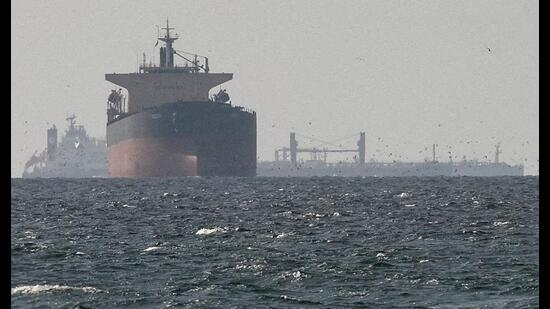
I have just been as close as I could get to the nerve-centre of the US-Israel war against Iran — the very edge of the Strait of Hormuz. This was in a fishing village called Al Jeer, which is in the northern-most part of the Ras Al Khaimah Emirate, next to the Musandam Peninsula, on Oman’s border with the United Arab Emirates (UAE). The Musandam Peninsula’s cliffs form the south wall of the Strait of Hormuz and, in the words of a mariner who accompanied me, where we stood was “the tip of Hormuz, as near to it as possible”.
We were tens of kilometres from Hormuz Island. Right in front of me, visible to the naked eye, was a line of ships stacked up along the horizon, stranded like thousands of others in the Persian Gulf. I also travelled and stayed at the eastern coast of the UAE in Fujairah and Dibba, no more than 70 nautical miles from the Strait of Hormuz.
“This is the lifeline of the world,” captain Pradeep Singh, a leading businessman with Master Mariner certification, said to me as we walked through the jagged sand of the shoreline. We were the only people there for miles on end. “And anyone thinking this is a regional conflict, think again, this is now a global war,” he said grimly, pointing out that the stranded seafarers ducking missiles and drones were no less than war heroes.
At the time of writing, US President Donald Trump had extended the US’s pause on direct attacks on Iran’s energy infrastructure by 10 days. But the war is still far from any tangible de-escalation. If anything, this could be the proverbial lull before a cataclysmic storm as the Pentagon war-games different military options. Trump is reportedly considering sending in an additional 10,000 troops to West Asia.
America’s goals in this war are befuddling. It bombed Iran right in the middle of negotiations when Tehran, according to Oman, which was the mediator, was ready to accept zero stockpiling of enriched uranium. Now, with the only country easily transiting oil through the Strait of Hormuz, Iran is earning $139 million a day, selling at the slimmest discount level in more than 10 months. And despite the devastation that US-Israel bombardments have inflicted on it, Iran remains emboldened — aware that it has the upper hand of a vintage guerrilla warrior. The attacks by both Iran and Israel on each other’s nuclear research facilities should be another reason for the world to be extremely wary.
But if there’s one thing I have discovered after nine days on the ground in the UAE, it’s this: The one under-told X factor of this war is the response of the Gulf countries. Iran had two points of battle leverage in this war — controlling the Strait and expanding the theatre of conflict to pull Gulf nations into the dragnet.
The UAE has been hit by Iran with more frequency than Israel, even though it was not a principal antagonist or even proponent of this war. Since the war, the UAE has engaged 1,826 UAVs and 372 ballistic missiles. You would imagine that Dubai, set up to be a shiny, insulated oasis in a desert of geopolitical storms, would do anything to halt the war. You would think that the UAE and other countries that have opened their territories to American military bases would be considering a dramatic reset.
Instead, the UAE and Saudi Arabia appear to be doubling down on the war. I was stunned by the assertive clarity of one of the UAE’s leading political analysts, Abdukhaeq Abdulla, who told me early on that the relationship with the US would only “deepen and expand” once the war was over. He went so far as to say that he would urge Trump not to walk away from war at this point. “Finish the job, Mr President,” he declared with a flourish. What could have been called the personal opinion of a private citizen has now been reinforced at the highest levels of the UAE government. The UAE ambassador to the US has said a simple ceasefire is no solution. And the country’s minister of industry and advanced technology is accusing Iran of “economic terrorism” for choking the Hormuz Strait.
In Dubai, the historic Iranian hospital has been closed, as have Iran-linked schools and social clubs. In the city’s spice market, a favourite with tourists, shops still urge you to buy saffron from Iran, but the shopkeepers, like other members of the 12,0000 strong Iranian diaspora, are terrified. The land of their origin is at war with the land of their present. “I will be in a lot of trouble if I talk to you on record,” whispered one Iranian to me, sitting behind mounds of dried apricots.
From the UAE’s perspective, the fear of an aggressive Iran is understandable. From Tehran’s perspective, allowing the US military to act against Iran from these countries makes them legitimate targets. Both the UAE and the Saudis are pushing the Americans not to leave the Gulf vulnerable to continued attacks long after the US has moved on from the war. The other countries are more wary.
Both Qatar and Oman are urging an end to the war. So the Gulf nations that never wanted Trump to start this war have been somewhat divided by the question of what should happen next.
In Abu Dhabi’s oldest fort — Qasr-Al-Hosn — history serves as a reminder of how centuries later, the fault lines remain the same. The fort, which was first built as a watch tower in the 18th century, was initially built to guard the island’s only freshwater well. Today, too, the war is over water — and who controls the oceans.
Trump’s reckless war will not just set the world back; it will transform it. And each one of us will feel the impact.
Barkha Dutt is an award-winning journalist and author. The views expressed are personal


