
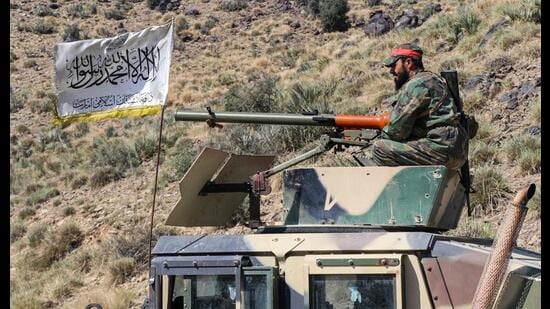
Pakistan’s conflict with Afghanistan has gone under the radar after the war in West Asia gained centre stage. The long-simmering conflict between the two neighbours had intensified on February 26 with the capture of Pakistani military outposts by Afghan forces. This followed artillery and missile exchanges and Pakistan resorted to aerial bombing of civilian targets in Kabul.
If the war in the Gulf region expands, the US might need Pakistan’s help to reopen bases and help support ground incursion through Afghan territory. Russia’s lurking presence will demand Pakistan piggy-back on American forces. Amid the conflict with Taliban and against the backdrop of the China-Pakistan Economic Corridor (CPEC) assets in the region, this may not be easy.
Memories of the US’s abrupt exit from its unsustainable campaign in Afghanistan (August 2021) are still fresh. The US left behind a huge military inventory, now under the Taliban’s control. That is military equipment worth close to $7 billion — almost equivalent to a year’s of Pakistan’s defence budget. This inventory was sufficient for the Taliban to raise or modernise up to 10-12 of its military divisions.
Pakistan has always considered Afghanistan as a key part of its strategic depth. Pakistan’s military planners have always been nervous about the narrow, ~300-km-long stretch — a straight line from the Durand Line to the Line of Control (LoC) — that, in the event of war with India, can be severed by the Indian military; in the 1980s, Pakistan was apprehensive of this being achieved if India joined forces with the Soviets, who were present in Afghanistan at the time. Pakistan’s generals and the Inter-Services Intelligence have worked overtime to give themselves strategic depth against India. In the late 1990s, the Pakistan Army sent regular forces into Afghanistan to fight alongside the Afghan Mujahideen to defeat the Northern alliance, in the wake of the Soviet withdrawal.
The clearing of Soviet and Soviet-allied forces was on the US agenda, and the US used Pakistan Army personnel as cannon fodder, triggering a takeover of Kabul by Taliban (an offshoot of the Afghanistan Mujahideen) in September 1996. It was an opportunity for Pakistan to be the Taliban’s patron and secure the desired strategic depth. Pakistan also looks at Kashmir as its “eastern flank strategic depth” vis-à-vis a belligerent Afghanistan. If Afghanistan were to capture areas it claims eastwards of the Durand, it would bring it closer to the Indian borders, narrowing the corridor further. Pakistan has brought China into this highly vulnerable sector — with the CPEC passing through it — making Beijing a stakeholder.
The US had hoped that, upon its exit from Afghanistan, the regime under Ashraf Ghani would hold onto power in Kabul, defended by the US-trained Afghan National Security Forces (ANSF). It had not expected that the Taliban would seize power after a quick, short offensive within days of the US exit. This led to the reinstatement of the Islamic Emirate of Afghanistan under the Taliban. For nearly two decades, the Pakistani policy on Afghanistan was based on maintaining strategic depth, through a friendly regime in Kabul. The doctrine was based on two key concerns — the threat of the militant Islamist outfit, Tehrik-e-Taliban Pakistan (TTP), and the Indo-Pak rivalry. An amicable Afghan Taliban was meant to contain both. Pakistan continued to maintain ties with the Afghan Taliban after 9/11, while aligning with Washington’s war on terror against the Taliban, the Haqqani network, and Al-Qaida. It was thus able to celebrate the return of the Taliban to power, hoping to maintain its twin objectives.
The second Taliban regime was more aggressive than the first. Emboldened by its victory over the Western powers, it positioned itself as an active defender of Afghanistan’s sovereignty, and wants to reclaim disputed areas under Pakistan’s control. Despite Islamabad’s pressing for action against the TTP, Kabul termed it an internal issue of Pakistan, allowing the TTP a free hand instead of reining it in. What Pakistan considered part of its strategic depth has now become a lethal liability.
In the meanwhile, the involvement of the Pakistan Army and the Taliban in the narco-trade in the region has made the new conflict more complicated. The Balochistan unrest and the Afghanistan issue are now serious threats. On top of this, the US and China can be expected to make contradictory demands on Pakistan, which is geostrategically important for both of them. In such a scenario, only a serious distraction will make Pakistan walk away from its conflict with Taliban-ruled Afghanistan. This distraction could either be India or Iran. With Pakistan involved in mediation in the US-Israel’s war on Iran, only time will tell which of the two distractions Islamabad must confront.
Lt Gen PJS Pannu (retired) is a former deputy chief of the Indian Integrated Defence Staff. The views expressed are personal


