
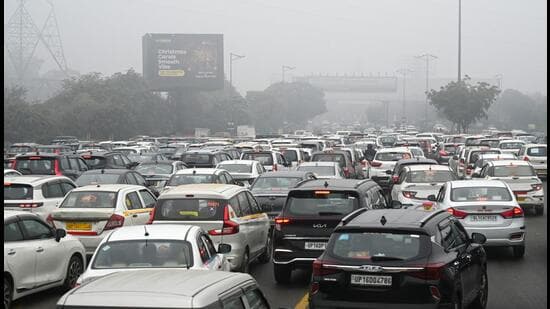
Air pollution in the National Capital Region (NCR) is largely driven by vehicular emissions. In January 2026, the Commission for Air Quality Management (CAQM) recommended a suite of urgent measures to the Supreme Court to combat this. The Court issued a directive and sought an action plan from the relevant stakeholders to immediately implement the recommendations. One of the recommendations is to use remote sensing devices to monitor on-road vehicle pollution. After five Supreme Court interventions between 2017 and 2026, India still awaits its implementation.
Delhi’s air pollution is driven by particulate matter, especially PM2.5. But the existing Pollution Under Control (PUC) system for vehicular emissions does not measure PM2.5 at all. How can we know what is actually coming out of vehicle tailpipes and in what quantities when our primary compliance mechanism does not capture the pollutant most relevant to public health?
Remote sensing is a compelling answer. It works on the principle of absorption spectroscopy. Ultraviolet and infrared light is beamed across a road to a sensor on the other side. As a vehicle drives through this invisible beam, the exhaust plume absorbs specific wavelengths of light. Because every pollutant absorbs light at a unique wavelength, the sensor instantly captures the levels of each pollutant in the exhaust. The technology is fast, non-intrusive, and measures vehicular pollution in on-road settings rather than the kerbside conditions of PUC testing.
The Indian Institute of Remote Sensing was established in 1966. The 1990s and 2000s saw new leaps when light and laser-based remote sensing devices (RSDs) for tracking on-road vehicular emissions were developed, respectively, by the University of Denver and NASA. The technology has been deployed in multiple geographies, including the US, Hong Kong, South Korea and the UK for monitoring vehicular pollution.
By 2016, around 70 cities in China had established such on-road screening, and as of 2021, Beijing alone has more than 100 sets of detection points. In London, it helped expose high real-world NOx emissions by the city’s iconic “black cabs”. Real-world RSD evidence empowered authorities to implement tough vehicle age limits and zero-emission licensing requirements.
In India, our government agencies, cities, and researchers have used this technology for over two decades now for independent testing, validation, and real-world deployment. The Automotive Research Association of India (ARAI) tested RSD systems in Delhi and Pune in 2004-06. It conducted rigorous second-by-second studies of raw vehicle emissions. The verdict? ARAI certified the system for accuracy and consistency. Kolkata has used RSD for nearly 15 years (2009-24), a testament to the technology’s operational viability in Indian conditions.
The International Centre for Automotive Technology carried out a comprehensive correlation study and real-world deployment in Delhi during 2017–19. Their findings were submitted to the Supreme Court, confirming a strong correlation between remote sensing and portable emissions measurement systems (PEMS).
In 2023-24, a study by the ICCT in Delhi and Gurugram demonstrated that RSD is not only useful for catching high emitters but can also be leveraged as a powerful tool for market surveillance by the authorities. The study also found that real-world vehicle emissions in Delhi and Gurugram were higher than limits set under artificial laboratory testing conditions.
And then, just last year, the National Physical Laboratory (CSIR-NPL) tested a device at its National Environmental Standard Laboratory, once again verifying the technology’s accuracy.
In 2015, the National Green Tribunal (NGT) directed the Central Pollution Control Board and Delhi Pollution Control Committee to deploy RSD; it was included as a measure in the National Clean Air Programme (NCAP) in 2019. While the ministry of road transport and highways (MoRTH) released draft RSD guidelines in 2020, these are yet to be finalised and implemented.
There is enough global evidence that remote sensing works for vehicular pollution monitoring, and studies by several Indian bodies have confirmed it works here as well. The Supreme Court has intervened repeatedly for its deployment, and CAQM has recommended it as a key measure for Delhi NCR. The evidence is clear, the technology is proven, and draft guidelines already exist. It is now time to act. MoRTH must finalise the guidelines without further delay and begin on-ground implementation. The residents of Delhi NCR should not have to wait for a sixth Supreme Court order to breathe cleaner air.
Lavnish Goyal is researcher, and Amit Bhatt is India managing director, ICCT. The views expressed are personal


