
The year is 1852. It is high noon of British rule in India. The East India Company has a chokehold over Bengal and is creeping up the Gangetic heartland — its mercantile impulses honed sharper by the tacit backing of the crown. The sepoy revolution is five years away.
That year, a Hijra named Bhoorah was found dead, her head nearly severed clean off her body, in the streets of a Mainpuri town. A guru within the intricate discipleship lineage of the Hijra community, Bhoorah lived with her two chelas, Dullah and Mathee. Like many other people from her community, Bhoorah performed and asked for badhai, a congratulatory gift following the birth of a child.
For two years, Bhoorah had lived with her lover, Ali Buksh, but shortly before she was murdered, she left him for another man. On August 17, 1852, Ali Buksh forced Bhoorah to return to him. Neighbours saw the couple arguing in the street before entering their house. Later, Bhoorah’s disciple Dullah ran out into the street, shouting that Ali Buksh had murdered Bhoorah. The Mainpuri Sessions Court, and subsequently the Nizamat Adalat — the highest provincial court at the time — considered two suspects: Ali Buksh and Dullah. In the end, the British judges were convinced that Ali Buksh had killed Bhoorah due to the “severance” of their “infamous connexion”. He was convicted of murder. The case, formally recorded as Government v. Ali Buksh in the erstwhile North Western Province (NWP), appeared, on the surface, settled.
In reality, it was anything but. As Jessica Hinchy noted in Governing Gender and Sexuality in Colonial India, the judges were alarmed at the presence of transgender people, variously describing them as “beggars” and “unnatural prostitutes”, seen as an “opprobrium” and a “reproach” to the British government. Unwin, the sessions court judge, opened his judgment with a statement of the “eunuch problem”: “The sickening details of this case involve the disgusting exposure of an abominable trade of unnatural prostitution regularly carried on by eunuchs dressed as women.”
In the grand sweep of India’s history, the micro realities of lives such as Bhoorah’s aren’t often more than grains of sand — indistinguishable from millions of peers, and inconsequential on their own. Yet, the flood of anxiety unlocked by Bhoorah’s murder fundamentally altered the colonial administration. After the crown took direct charge of the government in 1857, one of its first acts was to put in place a policy for the regulation and ultimately extermination of the transgender community. In 1865, the NWP declared a policy to “reduce the number of eunuchs” and “gradually lead to their extinction”. Within six years, the policy had been expanded nationally in scope and codified into the Criminal Tribes Act (CTA), whose little-studied Part II mandated police registers of “eunuchs”, expanded surveillance of these communities, banned “men” from wearing women’s clothing or performing in public, and asked authorities to remove children in transgender-populated households.
Hinchy noted that the explicit long-term ambition of the Act was “limiting and thus finally extinguishing the number of eunuchs”, as officials argued transgender people were “habitual sodomites”, “beggars”, “an obscene presence in public spaces” and “kidnappers and castrators of children”.
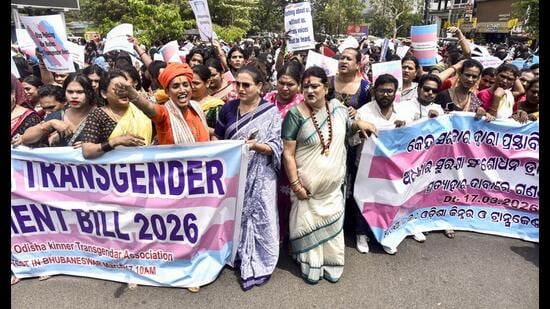
If some of these stereotypes sound familiar, it is because there is a straight line connecting the colonial moral panic underpinning the now-repealed CTA and the amendments to the Transgender Rights Bill that passed Parliament this week. The changes — restricting the definition of the word “transgender” to exclude multiple communities; inserting several layers of medical bureaucracy in the process to obtain a transgender certificate; and instituting broad but vague provisions that criminalise those who cause someone to “assume” a transgender identity main among them — reflect the same anxiety that the British government felt in their inability to understand or govern a population that sat outside the colonial understanding of gender.
When India transitioned from a colony to a republic in 1950, it attempted to eschew — at least on paper — the impulse to govern private lives in the pursuit of public morality. Both the legislature and the judiciary worked to liberalise laws around women, lower castes, and LGBTQIA+ people. Whether it be in the banning of dowry and untouchability, the protections for inter-caste and interfaith unions, the upholding of the right to privacy or the decriminalisation of homosexuality, the republic established a framework that moved away from colonial obsessions about private behaviour and identity, towards rights and dignity.
How do the new amendments fare on this touchstone? The government has argued that the definition needed to be narrowed to avoid misuse. By whom? Reservations mandated under the NALSA judgment are patchily implemented; government data shows 1,400 transgender people among 43 million college and university students; only 20 criminal cases of violence against transpeople have been filed in the whole country since the 2019 Act was passed; and only 6% in formal employment, according to the National Human Rights Commission. Are people rushing to falsely identify as transgender for some imaginary handout, while braving the avalanche of social stigma and violence that the tag carries?
Similarly, the increased scrutiny on issuing transgender certificates and conducting gender-affirmative care belies logic. Practically, the transgender certificate does little beyond allowing a person to apply for documents, jobs and education in the gender of their choice. Making hospitals inform officials before carrying out a procedure not only increases friction and delays in the process, but also puts transgender citizens at an unequal footing compared to their counterparts. If all citizens don’t have to convince a government authority about their gender, or whether they deserve to receive medical care, why should some?
The broad criminalisation provisions not only penalise transpersons — importing the same CTA stereotype that transgender people are kidnappers who lure children — without a word on natal family violence that forces many transpersons to flee homes, but it also holds the scope to punish almost anyone by using vague words such as “allurement” or “deception”.
Fundamentally, it appears that the amendments stem from a mindset that seeks to regulate a community not on its own terms, but based on what someone believes is the correct idea about gender. This unease around ideas of gender unfamiliar to the government is not only reflected across the globe — including in the US or UK, where it is now a cultural lightning-rod — but also in attitudes of India’s colonial masters 150 years ago. For a country that once took the lead in recognising diverse identities and has historically been more tolerant of non-normative expressions of gender, the amendments represent a step backwards. They are the opposite of decolonial.
The views expressed are personal


