
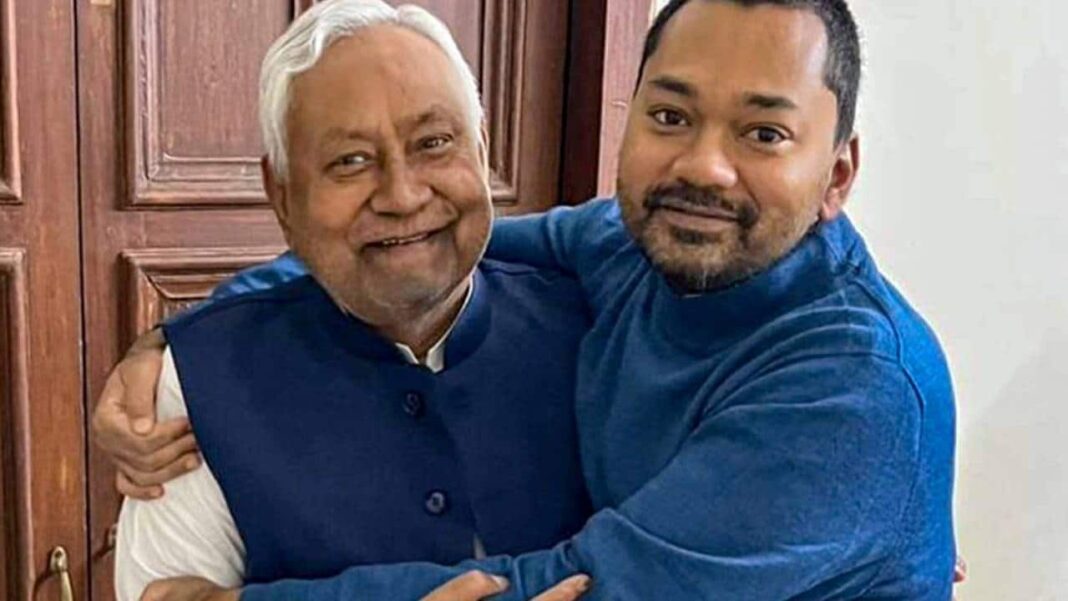
It is an incessant stream. There have been ‘son rises’ again and again in Indian politics. This time, Nitish Kumar, boasting of being a committed socialist, has brought his son into the rough and tumble of politics of Bihar at a time when he desired to become a member of the Rajya Sabha.
East or west, it’s the same
Nishant Kumar is the latest entrant, and no one in the ruling JD-U in the key state till the other day had found him political material. Parth Pawar, son of the late Ajit Pawar, will be entering the Rajya Sabha soon, replacing his mother, Sunetra, who has taken over as the Deputy CM in Maharashtra.
It is not that Parth is the best candidate in the NCP to go to the Upper House, but being the son of a ‘dada’ politician matters, much more so when the leader has met a tragic end.
Milking the sympathy factor
Related Stories
- T20 World Cup winning India receive Rs 25 crore as prize money
- Panel bans entry of non-Hindus in Kedarnath, Badrinath temples ahead of Char Dham yatra
- T20 World Cup: Pakistan cricketer reacts to ‘umpires help India’, ‘rigged pitches’ claims with b…
Every party wants to run on the sympathy factor and exploit it to the hilt. An inexperienced Rajiv Gandhi was brought in by the Congress as the PM in the wake of the assassination of Indira Gandhi, and the rest is history. Congress has never got such a landslide in the Lok Sabha polls since independence.
Interestingly, Tejaswi Yadav, son of Lalu Prasad, who has been a phenomenon in the politics of Bihar, is also shifting his base to Delhi after one more unsuccessful attempt at capturing power in Bihar.
BJP is no exception
BJP, boasting to be the world’s largest political party and attacking the hold of the Nehru-Gandhi family over the opposition Congress, too had to fall back upon a dynast as the new national President. Though Nitin Nabin is not new to politics, having been a competent minister in Bihar, the dynasty tag sticks.
K T Rama Rao and K Kavitha in Telangana, Nara Lokesh and YSR Jagan Mohan Reddy in Andhra Pradesh, Udayanidhi Stalin in Tamil Nadu, and B S Vijayendra in Karnataka are examples of ‘son rises’ in the ruling and opposition spaces in recent years. Haryana has been famous/notorious for ‘choron ki rajniti,’ as sons of CMs have generally remained a power to reckon with. Choran means boy but in political context it is son,
Uddhav and Aditya Thackeray, Shrikant Shinde, and Nitesh and Nilesh Rane show that ‘son rises’ are there in Maharashtra, which calls itself a progressive state, as also in backward UP where Mulayam Singh Yadav and his family are a perfect example of nepotism personified.
Walking in your footsteps
‘What else will the son of a sweet-meat seller/chef do other than take up his father’s trade? (Halwai ka beta halwai nahi banega to aur kya banega?) This rustic wisdom has taken the centrestage in the psyche of the politician/leader in independent India.
Regardless of whether the assumption might be right or wrong in a democratic polity, a leader, when he/she crosses seventy, seeks to pass on the mantle to the son/daughter, bypassing all his eligible followers, irrespective of the party he belongs to.
The Left parties are a notable exception in this regard
It is said that ‘a father’s love is the foundation on which the son builds his future.’ This is being taken too seriously by those in power, as politics has become a paying profession, and so the father wants to keep it all in the family.
What needs to be underlined is that ‘son rises’ have brought serious distortions in the polity and politics of the world’s largest democracy, which a foreign analyst had once dismissed as a ‘functioning anarchy.’
Congress and the price of dynasty
One major reason for the crisis being faced by the Congress for more than a decade is a result of the perennial dependence on the dynasty factor. The Gandhi family has been an asset but is also a liability as it fails to throw up a leader through the rough and tumble of politics.
It is not that Rahul Gandhi is not a leader, but he has taken too much time to emerge as a leader. A leader continuously on the learning curve is especially worrisome when the Congress detractors are so well entrenched and endowed in the electoral game.
One should not forget that Mamata Banerjee became a streetfighter while being in Congress.
Regional parties are the worst hit by keeping it in the family
Supriya Sule is more a darling daughter of her father than the one who could take forward the legacy of Sharad Pawar, the Maratha strongman of yesteryears. She could be an effective Parliamentarian but to be a mass leader is a different ball game altogether.
The regional parties are the worst hit given the fact that most of them have turned into family parties that have obviously reduced their punch and bite.
(Sunil Gatade and Venkatesh Kesari are journalists.)
Views are personal, and do not represent the stand of this publication.


