

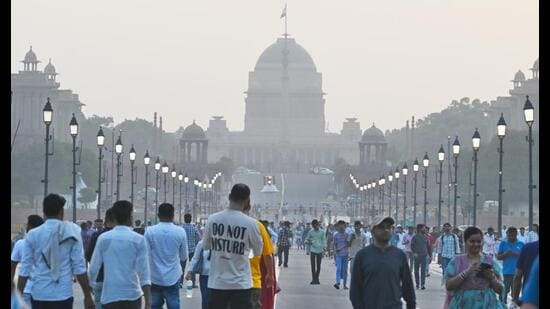
Edwin Lutyens has been expelled from Rashtrapati Bhavan, the iconic structure he designed. His bust has been cast into one of our substandard museums, and its place has been taken by a bust of C Rajagopalachari. The exchange, we are told, signals India’s “freedom from the mentality of slavery”. Is this “decolonisation”?
The idea behind decolonisation is that British rule was so dominating that it “denationalised” Indians, leaving them unaware or even ashamed of their heritage, and turned them into “mimic men” who slavishly imitated their colonial masters. Thus, to truly be “free”, the theory goes, Indians need to “shed the vestiges of the colonial mindset”. But even the slightest reflection shows that this idea is deeply flawed: It underestimates our forefathers and overestimates the British.
Consider our forefathers. They were told by many a Britisher, including Lutyens, that their civilisation was “backward”. They were aware that Thomas Babington Macaulay had written that “a single shelf of a good European library was worth the whole native literature of India and Arabia”. But, unlike the vocal band of decolonisers today, they also knew that Macaulay had been sent out to India because, in what he considered the “best speech” of his career, he memorably warned Parliament: “We are free, we are civilised, to little purpose, if we grudge to any portion of the human race an equal measure of freedom and civilisation. Are we to keep the people of India ignorant in order that we may keep them submissive? Or, do we think that we can give them knowledge without awakening ambition? Or, do we mean to awaken ambition and to provide it with no legitimate vent?”
Still, assume that Macaulay was the inglorious figure that decolonisers say he is. Why should we believe that our forefathers admired “European literature” merely because he prescribed it? Consider this: The first English-medium school opened in Thanjavur in 1784, half a century before Macaulay set foot in India. It emerged because the rajas Tuljaji and Serfoji wanted to understand what was allowing the British “to terminate every event in their favour”. Were these rajas, who were renowned scholars of Hindu classics, deracinated fools — or were they far-sighted statesmen that valiantly tried to keep up with “modern learning”, which was, they correctly surmised, “locked away” in English-language books?
Consider as well what happened in Madras in 1839, when over 70,000 “native inhabitants” signed a “monster petition” urging the British to establish “collegiate institutions” for their “mental improvement”. This petition, secretly drafted by George Norton, whom Christian missionaries berated as an “infidel” because he wanted to provide Indians with secular education, led to the creation of Presidency College in 1840. Guess who passed through those halls a half century later — none other than Rajagopalachari. Did this training in British common law make Rajaji a “slave” to colonial ideals — or did it help him craft the Constitution we revere?
There is more. The very first batch to graduate from Presidency College were known as “Powell’s boys”, because they were personally educated by the founding principal, Eyre Burton Powell. A wrangler from Cambridge who considered educating Indians his “sacred duty”, Powell would take students up to the roof of his house so that they could use his expensive equipment to study the stars. These experiments made them revere “demonstrated truths”, and most went on to specialise in the sciences. Encouraged by Powell, who paid out of his own pocket for books and newspapers for them to read, they subsequently fanned out across the Native States, becoming dewans of principalities such as Travancore and Mysore. Helmed by these worldly dewans, by 1900, these Native States were outperforming British India in terms of human development. Now ask, who had taken advantage of whom?
One of these Native States was Baroda, where the dewan, T Madhava Rao, so transformed the principality that The Times urged that he be appointed the finance minister of British India. Having rooted out mismanagement in Baroda, Rao condensed all that he had learned — which was a marriage of East and West — into a series of lectures that he delivered to Sayaji Rao Gaekwad, the Maharaja of Baroda. Guess who was born in the Gaekwad’s erstwhile dominion of Mehsana and, by word of mouth, became aware of Rao’s lectures, which he then proceeded to distribute to his officers? It was Narendra Modi, who went on to write a foreword for Rama Jois’s edition of Rao’s lectures, in which he urged the “political class to spare a little thought and time” for the “teachings of the great administrator”. There are, it turns out, more “Powell’s boys” than we realise.
The point of these observations is not to deny that colonial rule was extractive and inequitable. It undoubtedly was. But every nation is a collection of scars; the question is what pattern we trace on them, what sense we make of our past. If we want to overcome a past that shames us, we can only do so by building something that outshines it. We ought to restore temples and monuments, invest in classical education, revive ancient universities, build iconic museums, and better preserve historic records. This is the way forward for our civilisation.
A slave does not become free by pretending he never had a master; he becomes free by outdoing his former master, by proving that his servitude should never have been. In Singapore, the statue of Stamford Raffles still stands, but now in Lee Kuan Yew’s shadow. This is how it should be.
None of “Powell’s boys” forgot where they began. Toward the end of his life, Madhava Rao delivered a convocation address at Presidency College. His eyes misting over, he told the audience that every time he looked up at the night sky and saw the stars radiating their light, he remembered “Mr Powell” who had made him what he was. Rao had accomplished more than most men ever will.
Even in the grudging estimation of the British, he had outdone his teacher, which is why Powell, the maker of the Madras University, was made only a Companion of the Order of the British Empire, while Rao was elevated to Sir and Raja. Still, the honourable dewan did not hesitate to give credit where credit was due. Nor should we.
Rahul Sagar is Global Network associate professor at NYU Abu Dhabi. His recent books include The Progressive Maharaja and To Raise A Fallen People. The views expressed are personal