
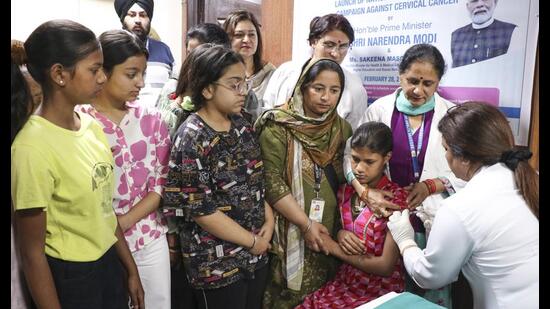
The recent launch of the human papilloma virus (HPV) vaccine programme by the Prime Minister in Ajmer is a cherished milestone in India’s public health approach to cervical cancer prevention.
India has a long history of eradicating and eliminating serious disease burdens through well-planned and well-executed campaigns. From the eradication of smallpox in the 1950s to the more recent Pulse Polio drives, these campaigns were designed for success. That same discipline and public trust will now determine the success of HPV vaccination.
The Indian Cancer Society has long been concerned about the devastation caused by cervical cancer. The statistics on files represent real women to the Society. Families fall apart with the death of a mother. We are aware of the pain women bear silently. Most women are taken to treatment centres only when the disease has progressed beyond cure.
Women do not speak easily about pain in their private parts. When “visual inspection” is recommended because it is inexpensive, we feel it compromises a woman’s dignity. When better and more scientific tests such as the Pap smear were known since the 1950s to have transformed screening, diagnosis, and outcomes in Europe and America, why did we continue relying on less effective methods simply because they were cheaper? Are the lives of Indian women less valuable?
The Indian Cancer Society raised funds to support Pap testing and now HPV DNA screening tests. We conduct secondary screening to identify and treat lesions with thermal ablation. We also provide financial support to women whose cancer has progressed beyond these simple measures.
But why allow a treatable infection to develop into such a devastating disease?
The HPV vaccine has been known since 2008 and was launched in India in 2010. Campaigns were initiated in Gujarat and Andhra Pradesh, where the three-dose schedule was introduced. Several thousand girls between the ages of nine and 14 were vaccinated.
Then, the anti-vaccine movement intervened. Lurid stories of suicide, drowning, and train accidents spread widely. How these tragic events were in any way related to the vaccine remains unclear. Earlier, opportunity to scale up had to be postponed as abundant precaution. However, there was a silver lining — research was not banned. With hundreds of girls having received incomplete doses, researchers had a valuable opportunity for long-term follow-up. Girls who received a single dose grew up as healthy as those who received two or three, laying the groundwork for today’s simplified schedule.
According to Dr Partha Basu, who is with the World Health Organization’s International Agency for Research on Cancer, India’s introduction of HPV vaccination could prevent nearly one million future cervical cancer cases. Long-term Indian research following 17,729 girls for over 15 years has shown the vaccine to be extremely safe, with a single dose providing strong protection. With simplified delivery and high coverage, Dr Basu notes, India can substantially reduce its future cervical cancer burden.
The late Dr Shankar Narayan conducted research over the years, which has now borne fruit, and Dr Basu has persisted with these long-term studies. Their work, along with that of PATH and other international collaborators and Indian researchers, has strengthened confidence in both efficacy and safety.
Global experience reinforces this confidence. In Australia, publicly funded HPV vaccination began in 2007, later expanded to boys, and transitioned to a single-dose schedule in 2023. As Professor Deborah Bateson, from the University of Sydney, has pointed out, in 2021, no cervical cancer cases were diagnosed in women under 25 for the first time since such recording began — attributable to sustained high vaccination coverage.
In Hong Kong, through school-based vaccination, catch-up programmes, and innovative self-sampling screening initiatives, coverage has steadily improved. Katharina Reimer and Dr Karen Chan have described how free vaccination for primary school girls, strong implementation research, and expanded screening access have aligned Hong Kong with WHO elimination targets.
India must add to such success stories. With planning, coverage, and public trust, we can answer the WHO’s call for the elimination of cervical cancer as a major public health threat. The introduction of vaccines into national immunisation systems in India is often time-consuming because of the scientific scrutiny, supply guarantee and programmatic readiness. However, the necessary building blocks are well thought out.
To prevent cancer before it begins is an extraordinary act of foresight and the government of India has to be commended for its moral clarity. Now, the vaccination complement should not replace screening and awareness even as this moment gets marked in history as one in which India chose prevention.
Jyotsna Govil is chairperson, Indian Cancer Society, Delhi branch. The views expressed are personal


