
Iran was always an existential threat to Israel. Still is. The war meant to remove that threat has, with magnificent irony, sharpened it. If the objective was to make Israel safer, the mission has failed spectacularly. Tick that box.
Yes, Iran took a beating. The US Department of Defence estimated Iran’s nuclear programme had been set back by two years after the June 2025 strikes. The 2026 strikes may have added a few more years to that tally. Or not. As a report from the US Defence Intelligence Agency assessed, Iran had moved much of its enriched uranium stockpile before the strikes, and the attacks set back its nuclear weapons capability by only a matter of months. Months. That’s the payoff for a war that has rattled the global economy to its foundations.
Patience is not in short supply in Tehran. They have been waiting for a vanished leader for over 1,200 years. A year or two, and the uranium will be on the tip of a missile. Military force cannot eliminate Tehran’s proliferation risk. At the end of the conflict, Iran will retain the nuclear expertise and likely the key materials necessary for building a nuclear bomb. What’s worse, elite opinion as well as public opinion in Iran has shifted dramatically on pursuing a bomb. That shouldn’t be surprising since Iran has been bombed twice in the middle of negotiations by two nuclear states. The nuclear fatwa that Khamenei once issued is dead. Killed, fittingly, alongside him.
Now consider what this means for Israel. The threat was supposed to diminish. Instead, it has metastasised. Before the war, Iran was constrained: weakened by sanctions, its proxies battered, its nuclear programme under surveillance and periodic attack. A wounded adversary behind a fence.
Now the fence is gone. The fatwa against the bomb is gone. The restraint born of fear of escalation is gone. Iran has been bombed twice while negotiating in good faith. Its Supreme Leader was assassinated. What incentive does Tehran have to remain non-nuclear? The strategic logic has inverted completely. Israel wanted to eliminate an existential threat. It has instead handed Iran every moral and strategic justification to become a nuclear-armed state. The very outcome Israel went to war to prevent is now more likely than it has ever been. That is not just a failure. That is a catastrophic self-goal.
Now the proxies. The spin was that Iran’s axis of resistance was broken. Hezbollah was diminished. The Houthis were battered. The war cries would fade. And yet, Hezbollah launched rocket attacks against Israel within two days of the opening salvo. Two Iran-backed groups in Iraq readily rushed to defend Iran. On March 28, the Houthis resumed their attacks on Israel. The obituary for Iran’s proxy network was premature. Embarrassingly so. The Houthis now stand as the most resilient Iranian proxy. They survived American bombing campaigns under two successive US administrations. They are still standing, still shooting. You don’t run out of ideological proxies the way you run out of missiles. You run out of missiles. They run on something older and cheaper.
Now for the masterstroke. The real genius of what Iran has pulled off.
Hormuz was just a waterway. Now it’s a weapon. Twenty percent of the world’s liquefied natural gas and 25% of seaborne oil trade passes through the Strait. Iran controls the northern coastline, the islands, the chokepoint. With the longest coastline along the northern side of the strait and strategic control over islands including Greater Tunb, Lesser Tunb, Abu Musa, Lark, Qeshm and Hormuz, Iran can assert both power and oversight over maritime traffic. Geography is the one advantage nobody can bomb away. And Iran has it.
Tanker traffic through the Strait dropped first by approximately 70%, and then over 150 ships anchored outside the strait to avoid risks. Soon afterwards traffic dropped to about zero. Maersk suspended crossings. Insurers charged six to 10 times their standard rates. The world’s largest shipping route became a parking lot.
An estimated 84% of crude oil and condensate shipments through the Strait were destined for Asia. Mainly India, China, Japan, South Korea, the growth engines of the world. All of them watching their energy supply slowly strangle. Iran didn’t just threaten Israel. It threatened Asia’s entire economic trajectory. That’s leverage of a different order. That’s not a military move. That’s economic warfare, executed with a precision that no missile could achieve.
The decades of unilateral American pressure in the name of sanctions, meant to bring Tehran to its knees, have eased suddenly. As oil prices soared, the US Treasury lifted sanctions on 140 million barrels of Iranian crude already loaded onto vessels. Here’s the punchline: Iran’s war effort got a boost. The Americans lifted sanctions on Iranian oil. While fighting Iran. The optics are discomfiting: as the US tries to decimate the Iranian regime militarily, it is simultaneously allowing the regime to benefit financially. Trump, who spent years attacking Obama for “sending cash to Iran”, is now effectively writing Tehran a cheque with one hand while bombing it with the other. You may laugh.
What we are seeing is a flawed campaign. Not in terms of operational size, but in strategic preparation. The oil price is becoming much more important than eliminating this regime.
The economic consequences are not theoretical. They are here. Brent crude oil prices jumped about 15% in the opening days of the conflict, then surged to $120 a barrel as it deepened and the market began pricing in the risk of sustained disruption. The European Central Bank has raised its 2026 inflation forecast and cutting GDP growth projections, with economists warning that energy-intensive economies face high risks of recession if the maritime blockade persists through the summer. If global oil prices average around $140 per barrel for two months, it would be enough to push parts of the global economy into a mild recession. Mild recession is a polite word for “winter is coming”. Governments fall in mild recessions. Democracies fracture.
But unlike the 2022 global inflation peak, when the global economy kept growing through the price shock, the severity of the latest disruption could tip the world into outright contraction. Oxford Economics put a number on it. World GDP growth for 2026 could slow to 1.4 per cent. The US and most major advanced economies slide into recession. The US can try to wash its hands of the crisis it created. No Iranian missile could touch the American mainland. But the economic meltdown will singe Americans too. The Americans are very sensitive to gas prices.
Iran knows this. Has known this. Which is exactly why it is not rushing to the negotiating table. It’s prolonging the agony. Every week of closed Hormuz is another week of economic pain for the side that can bomb Tehran into rubble but cannot bomb geography. Iran, unable to match the US and Israel militarily, is internationalising the costs of war by targeting energy, shipping, and commercial infrastructure across the Gulf. The logic is simple: raise the price of escalation while absorbing the pressure for de-escalation. Let everything reach the breaking point.
This is Economic Warfare 101. And the professor didn’t go to Harvard. He went to Qom.
The original US-Israeli calculation was clean. Kill the Supreme Leader; the regime falls; the people rise. Given Iran’s weakened position, the US and Israel calculated they had greater opportunity to advance their objectives through military means than by diplomatic means. That calculation, it turns out, was spectacularly wrong. The regime didn’t fall. Mojtaba Khamenei, the dead leader’s son, now occupies that position, a position of strength by a tragic quirk of fate. The IRGC didn’t crumble. Death to Israel, Death to America; the war cries are unaltered. What is altered is everything else.
The crucial Trucial states of the Gulf, the rich finance and trade hubs, are caught between American firepower and Iranian obstinacy. Abu Dhabi or Riyadh no longer care who rules Iran. They care about oil revenues, trade routes, and not getting hit by drones.
Hormuz was once a pass. Now it’s a passport to regional power, stamped with the seal of American strategic miscalculation.
As for the claim that this war was really about weakening a surging China, consider what has actually happened. Iran is authorising tankers to pass through the Strait, provided their oil cargo is traded in Chinese yuan. A yuan-denominated transit regime at the world’s most critical energy chokepoint. That is the exact opposite of weakening China. That is handing China the keys to the region’s financial architecture. The Petrodollar is Washington’s jugular vein. Iran has a chokehold on it. They said Trump had a plan. Well. The plan has gone for a toss.
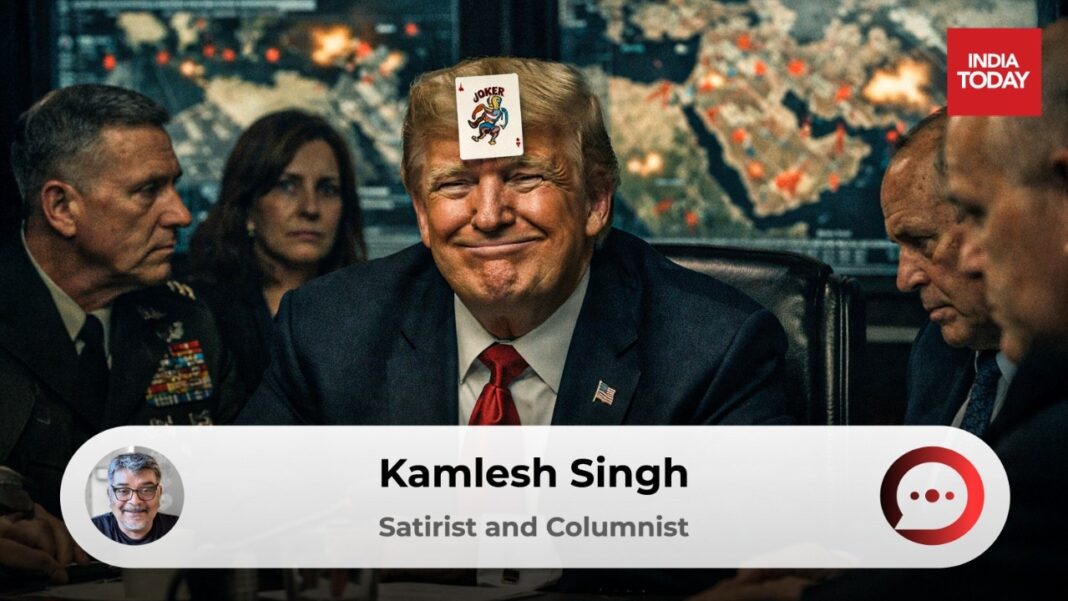
Iran has the Trump card. Trump has no card.


