
Sometimes, hunters end up being the hunted. The adage aptly fits the US and Israel today. US President Donald Trump trumpeting victory in the war on Iran every other day conveniently bypasses queries about why the war is still on if he has “won” it? Evidence suggests that neither did he have any justification to start the war nor does he have a concrete plan to wriggle out of it.
Iran has amply proved the point that 5,000-year-old civilisations don’t fold up in a few days of bombing. On the war’s opening day, Iran’s Supreme Leader, Ayatollah Ali Hosseini Khamenei, was killed along with 44 of the regime’s top leaders. The US and Israel thought that, like Iraq, people would come out on the streets in big numbers to overthrow the regime.
But the reverse happened.
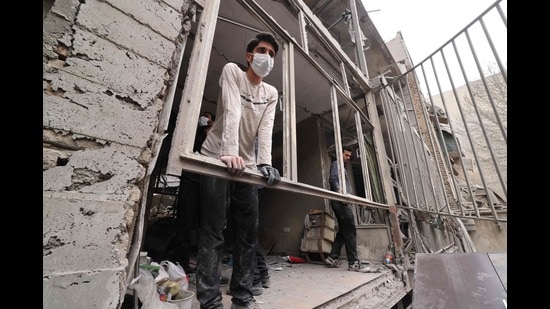
Hundreds of thousands of people took to the streets to mourn his death. Then, Iran retaliated against the US, West Asian nations and Israel with its drones and missiles. It happened because with Khamenei’s demise, the administrative command got decentralised. Now, every area commander is free to make independent decisions according to their assessment of the situation on the ground. A visibly irritated US and Israel increased the intensity of their bombing barrage. It was done in such an irresponsible manner that on February 28, two missiles were fired at a girls’ school in south Iran, killing 170 students and 14 teachers.
The new Ayatollah, Mojtaba Khamenei, vowed to avenge the deaths of these girls in his first address. He has said that he intends to punish Trump and seek reparation from him. Earlier, Iran named three conditions to end the war. One is free to term it a boast of a rank novice, but it’s clear that Washington hasn’t encountered such a fierce counterattack in years. This has severely dented the US’s aura of invincibility.
Under the US tutelage, rulers of the Gulf States created an oasis of peace and prosperity by filling their own coffers as well as that of the western nations. The hollowness of the arrangement is clearly visible today. The image of the Gulf States is taking a beating, while the US and Israel are bleeding economically. According to a CNN report, $11 billion have been lost in the initial six days of the conflict.
The Iranian attack has severely damaged US bases in West Asia. Till now, they have exhausted one-third of the entire global stockpile of missiles. It would take years to compensate for the loss as reconstruction ability is also limited. Meanwhile, the US’s competitor, China, is sitting pretty with its resources and forces intact. The situation is so dire that the US has had to summon its missile batteries stationed in South Korea and Japan. Questions are being raised now: How will the US defend South Korea or Japan against any aggressive move by China? The current conflict has established a fact that became visible during the Russia-Ukraine conflict. Today’s wars can’t be won by heavy weapons and armed units alone. Even the smallest of countries can employ drones and new technologies to deny the powerful a clear-cut victory.
To neutralise a $20,000-Iranian drone, the Pentagon has to employ a $4-million missile. If the war continues, Israel can be devastated and the US can spiral into an economic downturn. Both the countries are facing a diplomatic backlash too. Spain has “permanently closed” its embassy in Tel Aviv. More countries could follow.
This is the reason that, with each passing day of war, global diplomatic and economic temperatures are on the boil. Trump and Israeli Prime Minister (PM) Benjamin Netanyahu’s ill-conceived act has given a rude jolt to the global economy. On Saturday, global oil prices were hovering around $100 per barrel. Share markets around the world are in a tizzy and energy supplies in many countries are on the brink of collapse. Even within the US, anti-Trump sentiments are on the rise. Close to 70% of the people are unhappy with this unnecessary war.
Some experts look at the war as the beginning of the end of US dominance on the global stage. That may not be far-fetched. Since the 9/11 terror attack, the US has constantly been engaged in costly and detrimental wars. After destroying Iraq, its forces left Afghanistan only to have the Taliban replace the Taliban after two decades of futile military operations. Even in Syria, Somalia, and Libya, the US didn’t get desired results. Long wars are not the US’s cup of tea. Meanwhile, every protracted US military venture is a blessing in disguise for China. Beijing hasn’t fought a war since 1979 and has focussed its energies on trade and commerce.
Now let’s talk about India. Close to 50% of our oil imports, 60% of liquified natural gas (LNG) and 90% of liquified petroleum gas (LPG) pass through the Strait of Hormuz. Iran had closed the Strait to all but China. But after PM Narendra Modi’s and foreign minister S Jaishankar’s diplomatic efforts, vessels with Indian flags have been given special concessions.
This offers confidence, but the situation is still tense. If the Gulf region remains closed for some more days, we would start facing fresh challenges. The government is already moving cautiously. Restriction on the commercial use of gas and delays in LPG bookings are in place.
Many countries in Europe, Asia and Africa are facing similar problems. If the current conflict continues for long, it will be a second shockwave after Covid-19, affecting the vulnerable sections of society the most. The blame lies squarely with Trump and Netanyahu. However, it’s not them but the world that’s suffering due to their misdeeds.
Shashi Shekhar is editor-in-chief, Hindustan. The views expressed are personal


