

Three days into the war, many previously held assumptions are already being proved wrong.
The US and Israel’s military campaign was expected to pulverise Iran in a matter of days — destroy its military industrial complex including the massive ballistic missiles inventory, decapitate its entire political and military leadership, bring people out on the streets, and as a result of all this, orchestrate a change of regime in Iran.
But what has happened is, to use a colloquialism, clearly out of the American and Israeli generals’ syllabus.
Iran’s counterattack, both in ferocity and spread, shocked everyone. Iran not only attacked Israel but delivered on its threat by targeting US bases in almost every Gulf country, exposing inadequacies of the American security umbrella in the region.
American defence systems are being overwhelmed. Gulf nations are shouting for help and protection. US bases and embassies are being vacated. Energy supplies across the Persian Gulf have come to a halt. And there is fear that if the conflict prolongs, the tables could turn rapidly — leaving no “safe exit” for the US and Israel.
How did this happen? Why is what’s unfolding so different from earlier projections? How is Iran, a nation under severe sanctions for almost three decades, fighting a lone battle against the mightiest armies on the planet across more than 12 countries? The answer lies in a remarkable military strategy forged by Iran, which expected and prepared for a war of this kind for over a decade!
WAR OF ASYMMETRIC STRENGTHS
In pure military capabilities, Iran simply can’t compete with the Israel-US combine. Israel and the US have the most modern, lethal weapon systems that no other nation on the planet has. Their air power assets have unmatched range, lethality and stealth that gives them virtually unrestricted capability to operate unhindered in any theatre of war. Iran on the other hand has a virtually non-existent Airforce and a very weak and depleted air and missile defense system
Air Force: Israel and the US possess the most modern fighter aircraft, like the F-35, the F-22 Raptor, and the F-16. Adding to these capabilities are integrated electronic warfare systems and precision- and long-range targeting weapons. The longer-range missions are ably assisted by air-to-air refuelling, and the B-1 and the B-2 stealth bombers can have devastating effects on the battlefield, as witnessed during the Twelve-Day War in 2025.
Iran, on the other hand, has a poorly equipped and ageing fleet. Its air force comprises a wide array of aircraft, ranging from US-made F-14s, Chinese F-4s, F-5s, and F-7s, and Russian Sukhois and MIG-29s, most of them decades old.
Air Defence: Here, too, Israel and the US have an overwhelming superiority. The Patriot and the Arrow Anti-Missile Systems are designed to intercept long-range missiles. The Iron Dome system, the Iron Beam, and the David’s Sling System have an interception success rate of over 90 per cent for short-range rockets and missiles. And the American Terminal High Altitude Area Defence System is capable of intercepting missiles at longer ranges. Plus, the Aegis missile system mounted on ships provides additional coverage and redundancy.
In comparison, Iran has an old S-300 Air Defence System coupled with other older Russian-origin anti-aircraft missiles. It has developed the Bawar 373, which is touted to be almost as good as the Russian S-400 system. But it is yet to prove its worth. Reportedly, Iran has acquired a Chinese HQ-9B missile defence system, but it is yet to be seen.
Satellite and intelligence: With its advanced satellite systems, modern long-range radars, and airborne warning and control system, Israel and the US are way ahead of Iran in terms of satellite coverage and real-time data links. And in terms of intelligence, Israel has proved more than once how effective it is in penetrating enemy lines and carrying out targeted strikes. The elimination of Hamas chief Ismail Haniyeh in Tehran and Hezbollah leader Hasan Nasrullah in 2024, and the top Iranian leadership, including the Supreme Leader Ayatollah Ali Khamenei, in the current conflict, are cases in point.
Missile systems: In the missile systems department, Iran has the upper hand. Iran’s array is the largest and most modern in the region. Many Iranian missiles are inherently capable of carrying nuclear payloads. In its medium and long-range category are the Khorramshahr-1, 2, and 3, medium-range ballistic missiles with ranges of 2,000–3,000 km, the Fatah-1 with a range of 1,400–1,700 km, and many others like the Sejjil (2,000 km), the Paveh (1,650 km), etc. Iran has also developed hypersonic glide missiles that fly at five to eight times the speed of sound and are beyond the interception capability of most anti-missile systems.
Israel, on the other hand, has more short-range missiles with ranges up to 500 km, which cannot target Iran directly. However, it has Jericho-2, with a range of 1,500–3,000 km and Jericho-3, an intermediate-range ballistic missile with a range of 4,800–6,500 km. Plus, the US provides additional teeth with Tomahawk missiles.
Drones: Iran possesses a large variety of drones and has mastered developing low-cost ones. It has exported its drones to Russia as well. Prominent among its arsenal are the Shahed drones, which are suicide or Kamikaze drones meant to explode on targets. The Shahed-136 has a range of over 2,300 km and can carry 20–40 kg of explosives, enough to cause significant damage in a non-hardened structure. The Shahed-238 drones also have jet propulsion, making them faster and capable of carrying far more payload. There are also the Samad-1, 2, and 3 drones, which have an effective range of 1,800 km and can carry a sufficient payload to inflict damage.
In comparison, Israeli and American drones are more modern and costlier. The major ones are the famous Heron and Hermes 900 armed drones that have a range of over 1,000 km. The American drones LUKAS (Kamikaze drones) and the famous MQ-9 Reaper add to the firepower. However, going by sheer numbers, Iran may hold an edge.
ASYMMETRIC OBJECTIVES AND STRATEGY
The US bombed Iran’s nuclear sites in June 2025, eliminating a nuclear threat at least for the time being. Plus, talks being mediated by Oman were promising a nuclear deal where it would make it virtually impossible for Iran to develop nuclear weapons — ever.
For Israel, however, the “existential threat” it claimed came from the Iranian regime and Iran’s powerful ballistic missile programme. The US merely joined in, compelled to support Israel.
The politico-military objective for the US-Israel combine was therefore very clear: take out top leadership, destroy completely all military capability and key infrastructure, and force regime change.
Iran, on the other hand, knew from the very beginning that there was no way that it could fight back against American and Israeli air and missile strikes. It has therefore adopted a “disperse, absorb, and fight back” strategy.
Blessed by a huge landmass, a long coastline, and rugged mountain ranges, it dispersed its assets not only widely but also deeply into the mountains. The military response led by the Islamic Revolutionary Guard Corps, too, has been dispersed into 31 independent units in a ‘decentralised mosaic defence’. Each unit is completely cut off from any communication from central command, and each commander is given full autonomy to plan and strike at will, making it very difficult for modern technology to pick up any chatter and plan any counter to it.
Iran is also fighting a well-calibrated battle based on a mathematical calculation and the probability of success. It knows that the Patriot missiles, which are available in the war zone, total only 600–800. Also, for any incoming missile from Iran, 4–6 interceptors are fired. With an estimate of 150-200 missile interceptors already fired, it is feared that Israel and the US may run out of interceptors in the next 7–10 days. There are reports that the US is contemplating shifting some Patriot missiles from Japan and Korea to augment the inventory.
Iran, on the other hand, is keeping the American air defence occupied by steadily firing old and new missiles and drones, knowing fully well that its inventory could last months if not longer.
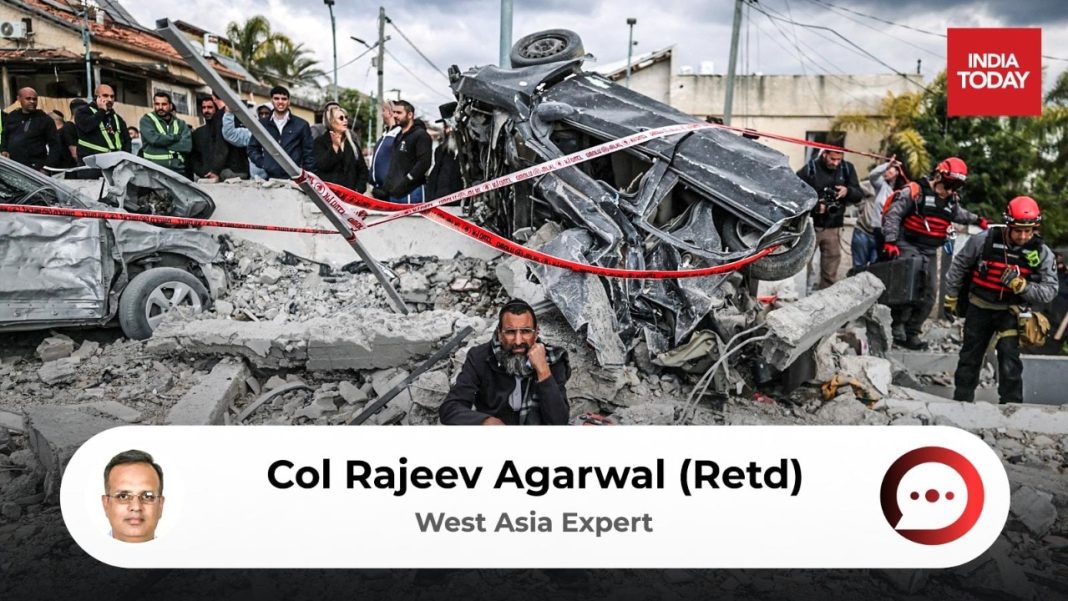
Secondly, while Israel and the US are banking on intercepting almost all incoming missiles, Iran is banking on the destruction from the few that can escape the defence and reach its targets. The strikes on Tel Aviv, Haifa port, and the Beit Shemesh area near Jerusalem, the destruction of crucial long-range AN/FPS-132 Radars in Bahrain and Qatar, as well as successful strikes on over 10 American military bases and targets, are testament to the success of its strategy.
The third part of this asymmetric strategy is targeting almost every Gulf country that houses American troops or bases. The fact that Iran could trace American soldiers to hotels in Dubai, Manama, etc., has added a layer to its strategy. Iran knows that these countries don’t have the wherewithal to protect themselves, and that the American security umbrella, which is focused on Israel and itself, will find it difficult to do that as well.
The additional decision of announcing the closing of the Strait of Hormuz, the lifeline to global oil supplies, has sent shockwaves, as this is the first time that Iran has actually done it despite many previous threats. All this is banking on a strategy that ultimately the weight of losses and pressure from the Gulf countries, as well as nations around the world, will force the US-Israel combine to seek an end to the war.
The American strategy of taking out leaders to change regimes may have worked in Libya or Iraq. But in a complex political structure and a strong military force like Iran, it is proving counterproductive. As the war is progressing, it is quite evident that Iran’s asymmetric approach is not only compensating for the deficiencies in military capabilities, but is also creating circumstances where the war may soon become untenable for the US and Israel.
(Col Rajeev Agarwal is a Foreign Policy Expert and a Senior Research Consultant at Chintan Research Foundation, New Delhi)
(Views expressed in this opinion piece are those of the author)


