
In November 2012, then National Security Advisor (NSA) Shivshankar Menon and I met President Barack Obama’s NSA Tom Donilon in Phnom Penh on the margins of the East Asia Summit. With the Arab Spring raging and Syria descending into internal conflict, Menon asked Donilon how Sunni fighters from Afghanistan and Pakistan were reaching Syria, with land access across Iran and Iraq denied, warning that a destabilised Syria would turn into a worse terrorist sanctuary than Afghanistan.
Donilon replied that the US would first get rid of (Syrian President) Bashar al-Assad, then deal with terrorism. Assad would last until December 2024, but a devastated Syria became a sanctuary for virulent terrorist groups such as ISIS and Al Nusra Front. That was just one example of the US’s sequential approach that disregards secondary consequences.
The US use of Islamist insurgency with Pakistan’s help against the erstwhile Soviet Union in Afghanistan in the 1980s made Pakistan a hub of terrorism and transformed the security environment in South Asia, with a lethal rise in terrorism in Jammu and Kashmir after the Soviets left Afghanistan. The US invasion of Afghanistan after 9/11 temporarily uprooted Al Qaeda and the Taliban. But the US outsourced the Afghanistan project to Pakistan and turned its attention to Iraq, with disastrous consequences. After invading Iraq on March 20, 2003, the US declared victory on May 1, but was trapped by a massive insurgency for years, and left Iraq in shambles and with increased Iranian influence. The elimination of Gaddafi in the wake of the Arab Spring fractured Libya and turned the Sahel region of Africa into an ungovernable theatre of terrorism, coups and external competition.
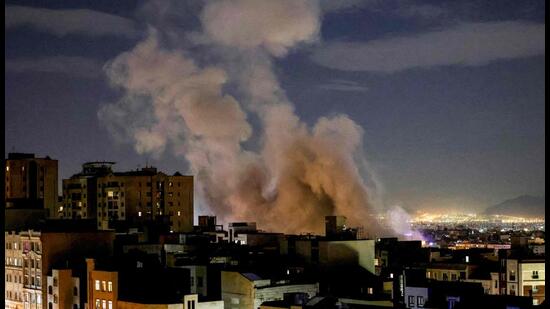
The doctrine of regime change was formalised by the Neo-Conservative Project for a New American Century in the late 1990s. Over a period of time, the pretence of consultations with the UN and allies has disappeared. All this is now on display in the war initiated by the US and Israel on February 28. In April 2025, I listened to a high-level bipartisan panel in a Washington DC conference describe in chilling detail plans for an Israel-US attack on Iran, a script followed in the June 2025 attack and the recent one. More than incompetence, poor intelligence is due to human bias and pre-determined decisions. It is amplified through complicit media and willing partners. And, as the US discovered in Vietnam, the outcome of a contest between power and will, technology and strategy, is uncertain.
The US and Israel are surprised and unsettled by the Iranian response. As the war nears a month, it is seeing vertical escalation and horizontal spread. An unsettled region that does more than just fuel the global economy could collapse. For long, the Arab/Ottoman and the Turko-Iranian spheres were two relatively distinct Islamic worlds. Much changed in the century after the Ottoman Empire’s collapse in 1924: The emergence of new political geography; the rise of the House of Saud on Wahabi power and its conquest of Mecca and Medina; the discovery of oil; the establishment of the State of Israel; the unresolved Palestinian question; post-colonial Arab nationalism; the contest between different strains of Islam; the shadow of the Cold War and the enduring US presence; and, the Islamic Revolution in Iran in 1979, which turned Sunni-Shia differences from religious to geopolitical. In the shifting sands of West Asia, equations change. Israel once cooperated with the Shah’s Iran and later the Islamic Republic, including through weapons supply, against Nasser’s Arab nationalism and later, Saddam Hussein. Ambition, wealth and insecurity generate rivalry among Gulf countries and external alignments.
For the vast majority that chose silence or sides, there are lessons. This is not a one-off effort, but part of a serial effort at regime change by force. It accelerates the demise of the collapsing world order, which, although held together by an illusion of its sanctity, did provide a modest shield to the weak against the strong. It sets a new norm that all heads of government are fair game in a world of long-range precision strikes. And, for the misadventure of the two, the world must pay a heavy economic price.
There are also long-term geostrategic consequences. The war will add to West Asia’s continuing churn. While Iran may not be defeated and its resistance resonates quietly around the world, it will be devastated. Israel and the Gulf States, too, will suffer incalculable loss. It is uncertain whether the region remains caught in a forever war that will imperil the future of the region and Israel, or it emulates Southeast Asia that forged a regional compact and balanced relations with the major powers after the brutal wars from the 1950s to the 1970s.
And shredding alliances, shared economic stakes, soft power, diplomatic instruments and restraint will ultimately shrink US power, presence and influence. Across Asia, from the east to the west, external powers are engaged to balance regional power asymmetry in unsettled disputes. As this conflict shows, war has doubtful efficacy as a deterrent, but strong incentives for escalation. From the Pacific to Europe, calculations will change, alliances re-evaluated, strategies re-appraised, and war-fighting capabilities reworked.
Analysts tend to frame choices on the balance sheet of numbers on energy, trade and diaspora and the weight of the relationship with warring parties. That calculation is altered by the relative strength of coercive power on the Strait of Hormuz. There are also enduring geostrategic interests. The Gulf, the region’s southern tier, is India’s maritime bridge and sphere. Iran, in the northern tier, links us to continental Eurasia. Both influenced our history and will remain important in the future.
Further, our interests can collide with any close partner. In the past, too, as India began transforming its relations with the US, it ignored a demarche in 2002 to not open consulates in Afghanistan to mollify Pakistan, resisted pressure to send peacekeeping troops to Iraq in 2003, defied sanctions on Iran in 2012 through a special account in UCO Bank to purchase oil, and persisted with S-400 purchase from Russia despite CAATSA sanctions threats in 2018-19. India’s strength lies in pursuing its relations with major powers while protecting its own interests.
While it is early, India must start building alternative scenarios of West Asia, the influence of major powers, and the broader geostrategic and geoeconomic futures. At the moment, though, as Prime Minister Narendra Modi outlined in Parliament, our task should be to minimise the economic impact and seek an early end to the war.
India must now seek to use its historical equities with all participants in this war, as also its current role as BRICS Chair, and also consider convening a broader global meet on this and the global future.
Jawed Ashraf, a former ambassador, currently chairs ITPO. The views expressed are personal


