
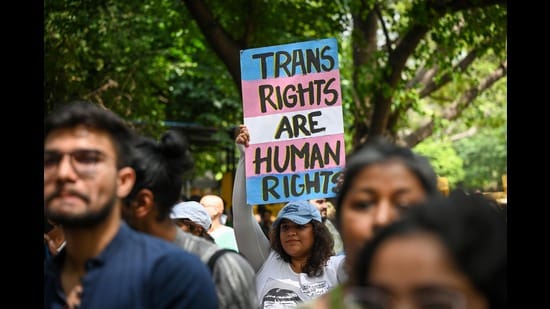
For over a decade, the courts, the Centre, and the states have expanded the rights of transgender persons. The Centre is now turning back the clock, excluding large sections of transpersons who were earlier protected by the Transgender Persons (Protection of Rights) Act, 2019. An amendment bill, passed by Parliament in the ongoing budget session, has led to widespread fear and confusion in the transgender community. The only step left before the bill becomes law is for the President to assent. In this case, the President should decline.
In 2014, in the National Legal Services Authority v. Union of India, the Supreme Court held that transgender persons have the right to equality and dignity. Most people are told they are male or female when they are born, based on their genitalia. The Supreme Court recognised that for some people, their innate sense of their gender does not conform to the sex assigned to them at birth. The Supreme Court directed the government to recognise a “third gender” and held that the Constitution protects self-perceived gender identity.
In 2019, the Centre passed the Transgender Persons (Protection of Rights) Act. The 2019 act defined “transgender person” broadly, to include traditional identities such as hijras, kinnars, aravanis and jogtas, and also other identities such as non-binary persons, genderqueers, and transgender men and women. Section 4(2) protected self-perceived gender identity. This made sense: We all declare our gender identity ourselves, on our official documents, and by the way we dress and behave. We don’t need the government’s approval to say who we are.
The 2019 act did not mandate surgery. This made sense too: Surgery to change gender is not easily available in India, and not all transgender people want to change their bodies surgically. Transgender people could get a transgender identity certificate without medical intervention and a change in gender certificate after undergoing surgery.
The act brought in protections that we would want any transgender person to have, if they were our loved ones. The government must ensure their social inclusion and provide medical facilities; employers and educational institutions cannot discriminate against them. It established a National Council for Transgender Persons (NCTP).
While the US was attacking transgender rights, India became a leader on this issue. In Uttar Pradesh, transgender children and spouses can inherit agricultural land. Karnataka gave transgender persons reservation in government employment. Transgender persons have become civil servants, police officers, and college principals. In my own profession, there are transgender students in the country’s top law schools and trans lawyers practicing in the courts and in leading law firms.
In Shanavi Ponnusamy v. Ministry of Civil Aviation (2022), the Supreme Court called the 2019 act a “watershed moment” and directed the Union to frame a policy to protect transgender persons in private employment. In Jane Kaushik v. Union of India (2025), the apex court held that both public and private employers should make reasonable accommodations to protect transgender persons, such as providing unisex toilets and confidentiality about gender identity.
Instead of expanding these rights, the Centre is now restricting them. The amendment bill — passed without consulting the NCTP — says only hijras, kinnars, jogtas and aravanis are transgender persons. A northeastern delegation that informed Union minister Kiren Rijiju that traditional northeastern identities were excluded was told to raise the issue in court. Two members of the NCTP have resigned following a meeting that was called after the bill was tabled, and where the Union minister for social justice and inclusion was not present.
The amendment bill deletes Section 4(2), which protected the right of transgender persons to self-identify. It excludes sexual minorities and self-perceived sexual identities. The changes are retrospective, so people who obtained transgender identity cards under the 2019 act and changed their Aadhaar and other documents without surgery don’t know their legal status. If a person undergoes surgery, the medical institution must now inform the district magistrate. This violates the right to privacy. The bill makes it an offence to force someone to dress as a transgender person without their consent, and to cause a person to engage in begging. Gharanas, where traditional transgender communities often live, are fearful of false cases being filed against them by family members of the transgender people who they are supporting.
The ostensible purpose of the amendment is to restrict protections under the 2019 act to only those transpersons who face “severe social exclusion” due to biological reasons “for no fault of their own and no choice of their own”. The Statement of Objects and Reasons says that the current definition makes it difficult to identify “genuine oppressed persons” so that the benefits go to those “in actual need of such protection”. The amendments do not cite any data to show misuse of government schemes. For some trans people, their gender identity may not be biological, but a psychological and social need. To express their gender identity is a very brave choice. If the government wants to limit schemes to people from a certain background, it can set suitable conditions and rationales in the scheme. If terms such as nonbinary were unclear, a circular or office memorandum could clarify definitions for local authorities.
The last census estimated the transgender population at 487,000. Even assuming numbers have increased in the last 15 years — how many undue beneficiaries can be there in a country of 1.4 billion? If some transgender persons have entered the mainstream after overcoming great obstacles, the Centre should laud them. Instead, it is taking away their rights.
Arundhati Katju is a senior advocate. The views expressed are personal


