
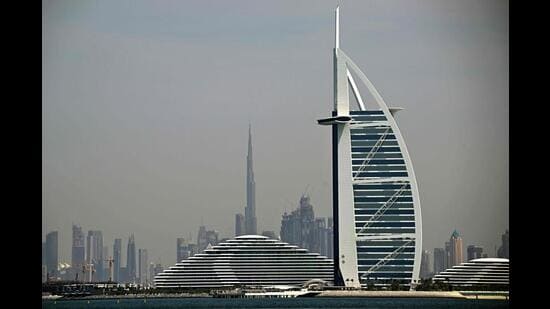
Dubai is often described, particularly in moments of regional uncertainty, as an experiment or a spectacle — at times even as a mirage. Such characterisations tend to re-emerge whenever the region faces disruption. Yet they overlook a more durable reality: Dubai is not an illusion. It has become a structural feature of West Asia’s economic and social landscape.
Its significance lies less in its skyline than in its function. Dubai has evolved into a reference point — especially for younger generations across the region seeking opportunity, stability and a degree of predictability often absent elsewhere.
At its core is a model that produces outcomes.
The United Arab Emirates (UAE)’s non-oil economy now accounts for more than 70% of GDP, marking a notable shift in a region historically dependent on hydrocarbons. Dubai has played a central role in that transition. Its economy expanded by approximately 3.3% in 2023, with growth driven by trade, logistics, tourism and financial services.
Foreign investment offers a further indicator. Dubai consistently ranks among the leading global destinations for greenfield foreign direct investment (FDI), attracting over $10 billion annually in recent years. In 2023, it was ranked first worldwide for new FDI projects, ahead of London and Singapore.
This performance reflects policy continuity rather than short-term stimulus.
More than 90% of businesses in Dubai are small- and medium-sized enterprises, underlining its function as a platform for entrepreneurship. Tourism figures point in the same direction: Over 17 million international visitors in 2023, suggesting sustained confidence in infrastructure, security and service delivery.
The city’s demographic composition is equally consequential. Expatriates account for close to 90% of the UAE’s population, spanning roughly 200 nationalities. This diversity is not incidental. It is integral to Dubai’s ability to attract, absorb and retain talent at scale.
It also shapes a less quantifiable, but important, outcome: A sense of immediate inclusion. For many arrivals, integration is rapid.
Dubai’s social fabric — formed by individuals from different systems and cultures — tends to reduce the friction of entry. The result is a city where participation in economic life is relatively accessible.
For professionals and entrepreneurs across the region, Dubai functions less as an exception than as a benchmark. The comparison it invites is often implicit but persistent: Why does this work here, and not elsewhere?
This comparison exerts pressure on governance. It raises expectations around service delivery, regulatory clarity and institutional efficiency. The UAE’s strong performance in measures of government effectiveness and digital competitiveness reflects this broader orientation.
One of Dubai’s more significant contributions, therefore, is competitive governance. Reform in the region has frequently been reactive, driven by crisis. Dubai offers an alternative: Reform driven by competition and integration into the global economy.
Its record during periods of disruption reinforces this point. The city has navigated the 2007–08 financial crisis, the Covid-19 pandemic and subsequent geopolitical tensions with a degree of continuity that is not easily replicated.
The explanation lies in structure.
Dubai has, over time, developed what can be described as a low-friction economic environment. Administrative processes are streamlined, regulation is relatively predictable and public services are increasingly digitised. Business formation is comparatively rapid. Logistics systems operate with a high degree of reliability across air, sea and land. In economic terms, this reduces transaction costs. In practical terms, it allows capital, labour and information to move with fewer impediments.
The consequence is not simply efficiency, but adaptability. Systems that minimise friction tend to adjust more quickly under stress. Dubai’s response to successive shocks has followed a consistent pattern: Maintain openness, preserve operational continuity and accelerate recovery.
Resilience, in this context, is less a reactive quality than a by-product of design. Infrastructure further reinforces this model. Dubai International Airport remains one of the busiest globally for international passenger traffic, while Jebel Ali port continues to serve as the region’s primary logistics hub. Together, they anchor flows of trade, capital and mobility that extend well beyond the UAE.
Dubai’s broader significance may ultimately be conceptual. It has demonstrated that governance in the region can be both functional and competitive, and that economic diversification is achievable within a relatively short timeframe when supported by coherent policy.
In a region often defined by its constraints, Dubai provides a working alternative.
It is not without vulnerabilities, nor is it universally replicable. But its trajectory has altered expectations — within the Gulf and beyond — about what can be delivered. That, more than its architecture or scale, explains its endurance. Dubai is no longer best understood as an outlier. It is increasingly a standard of comparison.
Sulaiman Al Hattlan, a former Nieman fellow at Harvard and former editor of Forbes Arabia, is a writer and commentator from the UAE. Currently, he is the CEO of Hattlan Media, and the host of the weekly TV talk show “The Arab Talks” on Sky News Arabia, based in Abu Dhabi. The views expressed are personal


