
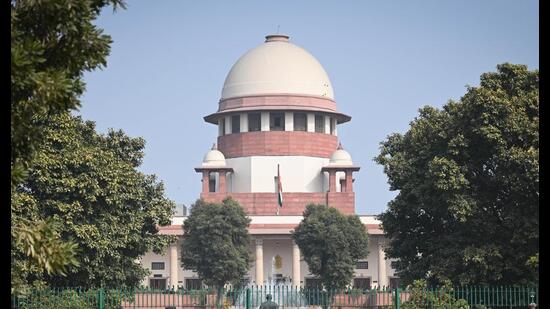
Opposing counsels who are constantly at loggerheads in the Supreme Court were aligned late last month. The suo motu case taken up by the Supreme Court, regarding a school textbook chapter, brought them together. Later, the government too agreed with them. In that rare moment, they collectively chastised the National Council for Education Research and Training (NCERT) for a section in a chapter titled The Role of Judiciary in our Society in the Class VIII social science textbook. One of the portions in this dealt with corruption in the judiciary, mentioned the code of conduct that governs judges, the accountability mechanisms, and went on to say that, despite these systems, corruption did exist and that those who are most affected are the marginalised. It ended by saying, “Hence, efforts are constantly being made at the state and Union levels to build faith and increase transparency in the judicial system, including through the use of technology, and to take swift and decisive action against instances of corruption wherever they may arise.”
A box highlighted a quote by BR Gavai, former Chief Justice of India, that corruption in the judiciary leads to the erosion of public confidence in the system, and there is a need for quick and transparent action and corrective measures. This entire section is a description of a complex reality. Yet, the Court said it had been written in a reckless, irresponsible, contemptuous, and motivated manner. The Court seemed to have been even more offended that the NCERT director defended the contents.
The Court claimed that the chapter did not say enough about the history of the courts, their contribution to upholding the democratic fabric of India, the many reformative measures taken by them to ensure that justice was served to every citizen, and the actions the judicial system has taken against corruption. The Court could have asked that these aspects of our constitutional history and development be included in the textbook.
Instead, it banned the book, asked for names of the people who had prepared the chapter, minutes of all meetings, and later ordered that those involved in the preparation of this chapter should not be included in any curriculum creation for the Union government, state governments, Union territories, universities, and public institutions receiving government funds. The authors have not even been given a hearing, something that would be a basic requirement for fairness.
The Court was also worried about the age of readers: “Young students in their formative years are only beginning to navigate the nuances of public life and the constitutional architecture that sustains it. It is fundamentally improper to expose them to a biased narrative that may engender permanent misconceptions at an age when they lack the perspicacity to appreciate the manifold and onerous responsibilities that are discharged by the judiciary on a day-to-day basis.”
This age-related stance is tricky. Conservatives use similar arguments of “appropriateness” to argue against sex education in schools. They claim students are not old enough to understand sexuality and, consequently, the culture of not discussing such things in a classroom is normalised, and the issue is brushed under the carpet. The adverse effects of this unawareness are well studied and documented.
Treating a textbook as the only source of information for a student is myopic. A textbook is only a learning tool. What we should worry about is educating the educator. We live in the era of the internet. Learning does not start or stop in the classroom. Students read and view videos about cases, judgments, and corruption on digital platforms. What is written in a textbook is not going to make this issue go away or stop students from being aware of it.
We should not underestimate students; they observe and recognise our contradictions. When a textbook states such a reality frontally, trust is established, and students engage robustly with questions about change and the measures the courts have taken. Including these conversations in the class environment will also help dispel the falsities perpetrated on social media.
In this particular case, the fact that the person who heads the entire judicial architecture has been open is a welcome change. This empowers the courts and does not stigmatise it. If the Court wants the Constitution of India and its judicial processes to be in touch with citizens, young students need to develop a personal bond with our judiciary, and that only happens when we are honest about its weaknesses.
While the Court was hyper-sensitive about how it was portrayed, it did not seem to worry that every mythological example for justice given in that same chapter came from the Mahabharata. In its order, the Court mentioned the Basic Structure Doctrine in which our secularity is enshrined. The Indian sensibility of secularism is in embracing a multi-faith society and ensuring equality between them. Isn’t it important that a chapter on the judiciary, written for the “impressionable” Class VIII students, provide examples of good jurisprudence in the stories and myths from multiple religions?
In its order, the Court said, “…we remain of the firm conviction that dissent, deliberation and rigorous discourse constitute the very vitality of a living democracy and serve as essential instruments of institutional accountability.” But its reaction will have a chilling effect. From now on, textbook writers will not dare criticise the courts. The Court has, by default, stifled critical thinking, which is what we must inculcate in young people.
The apex court being upset about the way it is portrayed and demanding that corrections be made is fair and part of the process. But for it to attribute motives, order a blanket ban, and ostracise the authors sends the wrong message. The Supreme Court is our last refuge. If it begins to behave like the State and censures us, we will have nowhere to go.
TM Krishna is a musician and author of the book We, the People of India: Decoding a Nation’s Symbols. The views expressed are personal


