A surprising fashion comparison recently stirred conversation online after the Maharani of the Baroda royal family, Radhikaraje, pointed out an uncanny resemblance between the visionary Maharaja of Baroda, Sayajirao Gaekwad III, and South superstar Vijay Deverakonda. The claim sparked curiosity among history and fashion buffs, as one of his ensembles echoed the same sartorial elegance as that of the legendary Baroda ruler.
Vijay Deverakonda recently tied the knot with actress Rashmika Mandanna in dual Telugu and Kodava ceremonies. Since their union, the couple has been gradually unveiling their ensembles worn during the pre-wedding festivities. Throughout the wedding festivities, the groom turned more heads than the bride, and his sangeet ensemble captured the eyes of the Baroda royals.
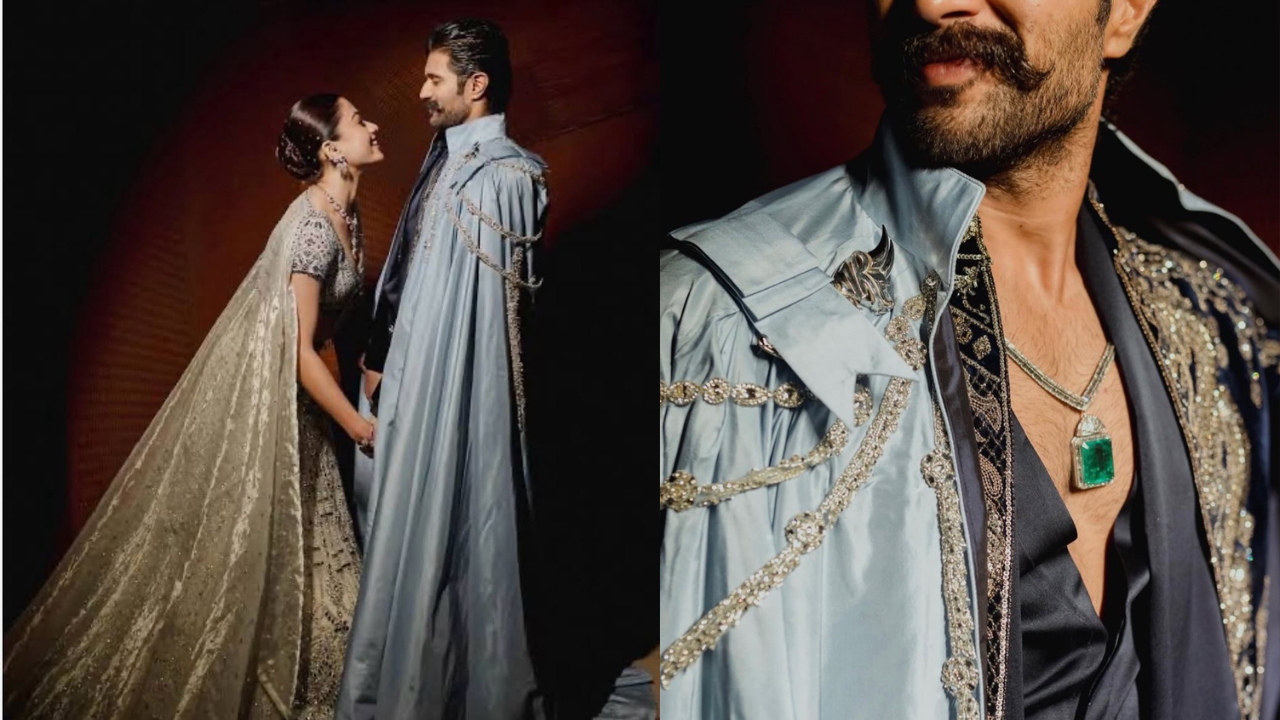
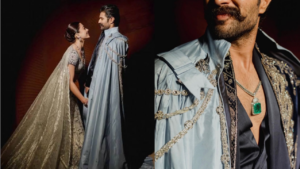
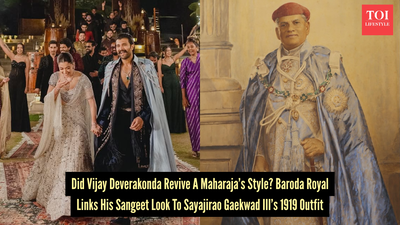
For his sangeet fit, Vijay Deverakonda wore a customised Torani ensemble, which took around 4,000 hours to complete. He wore this with royal blue satin bottoms and a loose V-neck shirt. But what amplified his look was a dramatic sky-blue silk cape, which made him look like Indian royalty from the 19th century. Decked up with a stunning emerald necklace, the silver hand embroidery on his sherwani could not steal the show like the cape did.
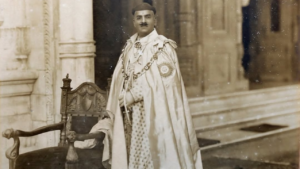
This detailing caught the attention of Maharani Radhikaraje, who compared the look to that of the late Maharaja Sayajirao Gaekwad III, the former ruler of Baroda. Vijay Deverakonda’s cape looked reminiscent of a cloak worn by the late Maharaja. He wore this piece when he received the Most Exalted Order of the Star of India. It was an order of chivalry given by the British Empire during the colonial period. He later wore the same cape in 1930, when he marked his 60-year reign.
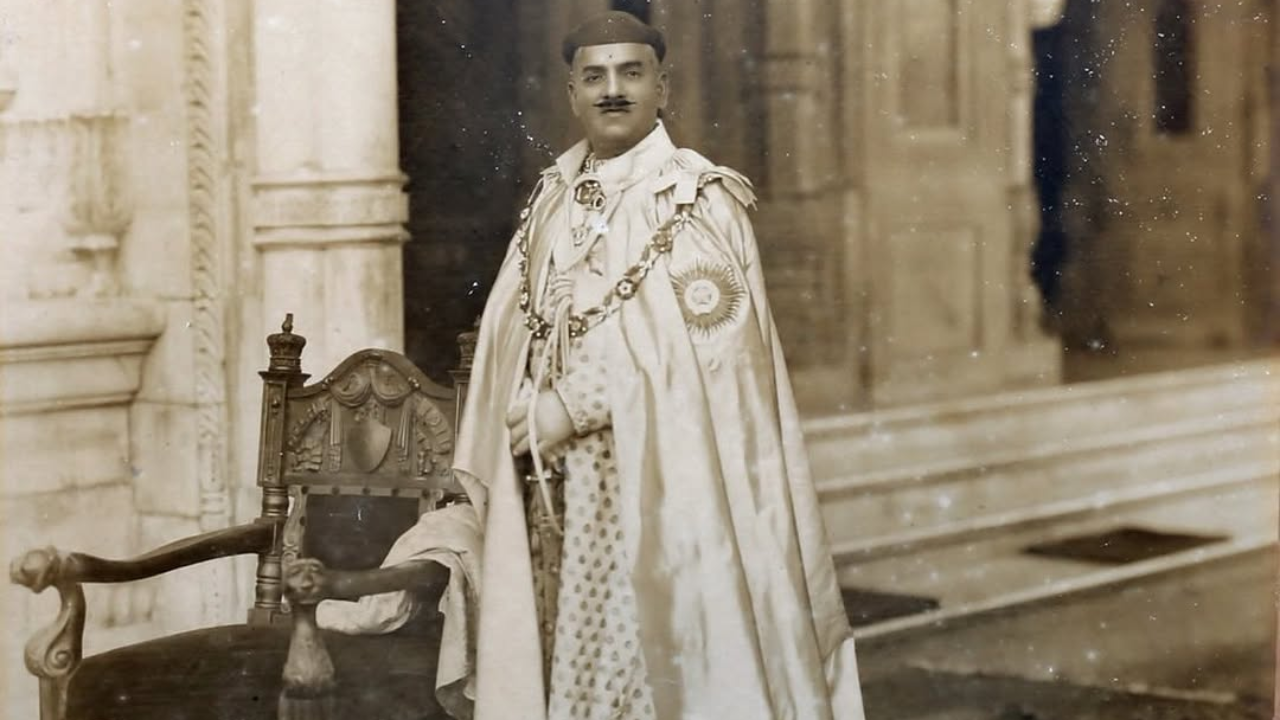
Sharing a series of pictures on her Instagram, Maharani Radhikaraje wrote, ‘South star Vijay Deverakonda @thedeverakonda is being hailed as one of the best-dressed bridegrooms of recent years, honouring his heritage, swishing in and out of dhotis and veshtis, and channelling ‘Mythology Core’ with a generous drizzle of Southern sass.
Fabulously styled by @stylebyami in an array of designers ranging from Anamika Khanna to Jade and Torani, what piqued my interest was the sky-blue silk cloak by @falgunishanepeacockindia.”
She continued, “Reminiscent of a cloak worn by Maharaja Sayajirao in 1919 (painted photograph, image 4) when he received the Most Exalted Order of the Star of India, an order of chivalry bestowed by the British Empire (image 3), and later in 1930 during his 60-year reign celebrations (image 2). Flashback to 1911, when the Maharaja had arrived at the Delhi Durbar to greet the Emperor and Empress of India, dressed in the simplest garment of a plain, unembellished angarkha; his reluctance and diffidence were more than apparent as he twirled his walking stick, curtly nodded at them, and then swirled away. (Last image)”
Maharani Radhikaraje concluded the post by saying, ‘Coming back to the blue cloak, Sayajirao is seen in this robe of imperial symbolism only twice, and by what we know of him, it was a perfect camouflage for his deep commitment and support for the Indian Nationalist Movement. A lesson learnt from 1911, perhaps. Remembering the Maharaja on his 163rd birth anniversary. The original main character, who knew the power of dressing for the part.”
Ananya Panday reinvents the concept of saree in Tarun Tahiliani’s cace-and-sequin masterpiece
As the comparison gained traction, the moment turned into more than just another celebrity look and opened doors to fascinating fashion conversations about royal styling, which now inspires modern-day celebrity wardrobes. So, can you see the similarities between the two? Let us know your opinion in the comments below.