

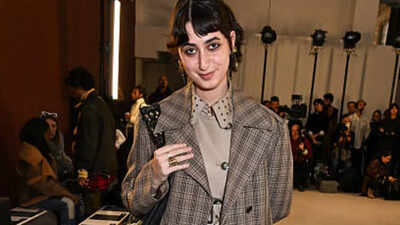
New York City mayor Zohran Mamdani’s wife Rama Duwaji debuted at her first high-profile event as the first lady of America’s financial capital, the prestigious New York Fashion Week. While her front-row presence generated buzz for its aesthetic appeal, it also carried a deeper message, one that spoke less about fashion fandom and more about political identity and intention.
This was not the first time an NYC politician has attended a fashion show. Mayor Eric Adams was spotted at a Michael Kors and Ralph Lauren show during his term, Chirlane McCray also showed up at a Ralph Lauren show during her husband Bill de Blasio’s administration. But Duwaji made a statement that any of them are yet to make.
Rather than opting for the city’s biggest and most established names, she took a front row seat at Diotoma, a small, independent fashion label founded by Rachel Scott, a black, queer, immigrant woman in New York.
The politics of fashion
Over the period of her husband’s term, Duwaji, a Syrian-American illustrator and animator, has turned into a Gen Z fashion icon in her own right. From her kohl-rimmed eyes to her messy bob and sleek boots, every aspect of her fashion has set a trend, one that is being followed by youth across the globe.
At the fashion show, she donned a knee-length cream and brown check coat with a polka dot shirt and a mini coordination trench underneath.
She completed the fit with her iconic black knee-length leather boots and a grommet-studded black handbag.
Art and fashion have been two vital intersections of the 28-year-old’s life. Much like her illustrations, her clothing choices appear deliberate, visual statements that invite interpretation without overt declaration.
Instead of showing up for a bigger label and getting a ready-made photo op with some celebrities, she supported one of the industry’s most upcoming and intersectional names.
The move reinforced her image as both an artist and a political spouse who communicates through symbolism rather than speeches.
Unlike most feminine figures in politics, she is rarely one to hold a mic and call for action. She draws it out in her caricatures and moulds it through her clay. If her husband represents inclusion, justice, equality and other ideals, her art and illustrations visualise the statement and tell you just what the first couple of New York stands for.
Her support for Palestine finds shape in the image of a boat with its flag, her ideals of female independence and dignity find place in a woman cruising through a bookshop and a mother taking her children to school.
She supports all, every country, every kind, especially those overlooked by the system she and her husband have bravely stood against. And interestingly, her statements haven’t changed. She was also present at Diotima’s 2026 Spring runway front row, representing her politics and priorities, in life and work.
She has only ever given one interview after transitioning into the role of a first lady and that too coincided fashion with upcoming labels, small brands and loaned fits.
Affordability and circular fashion
Zohran Mamdani, Duwaji’s eccentric husband, won the mayoral elections on one of the most publicised and politically vital aspects of NYC life, affordability. But when his wife was spotted donning $630 boots in his swearing-in ceremony, it was enough for the world to go gaga.
While White House Press Secretary Karoline Leavitt called the couple, ‘Classic Communists’ with rules for others and not themselves, the New York Post, quipped that their ‘affordability agenda got off on the wrong foot’.
However, what many fail to understand about Duwaji is that she is a woman of the now. While she does not face the camera to make bold statements, her silence has more hooked than any leading lady’s words could.
Her entire outfit for the ceremony was a bold seal on the lips of many. Her boots were rented from Miista, the vintage Balenciaga coat was loaned from one of “the city’s best small, circular fashion businesses” and her inaugural coat was custom-made by Cynthia Merhej, the Palestinian Lebanese designer of Renaissance Renaissance. According to Merhej, the Renaissance Renaissance designer gained about 11,000 followers in the week after the inauguration. Irene Albright, founder of Albright Fashion Library said her “social media spiked” with inquiries from a younger audience.
As a ‘first lady’, a title passed down from the centre to the states, her nod for democratic socialism has been clear all along. While this comes as a politically intelligent choice, it also coincides with her own character depth. As an artist, Duwaji has found life most beautiful when it has been lived, whether in art or clothes.
Thus, renting or thrifting isn’t just a decision, it is a choice, one she propagates.
For her, renting and sourcing from circular fashion businesses is not merely symbolic, it aligns with a broader ethos. In a city where housing and living costs remain persistent concerns, her styling choices mirror themes of reuse, sustainability and financial pragmatism.
Not because she doesn’t have the bills, but because reality remains the same everywhere.
Expression is conveyed only when it carries the truth, and Duwaji isn’t one to shy away from it. Her truth comes in the form of freedom, to dress and style, on her own whim. It comes from not being pushed to fit a certain mould but carving out one from her own hands, as an artist who knows that all kinds of art can create its own space, only if the message is strong.
A rose in a bush
Rama Duwaji is a leading Democrat’s wife in a world full of MAGA Republicans. If that is not enough to make her stand out in a room, her presence does the rest of the work.
Leavitt, who claimed Duwaji’s “designer boots” were “worth your weekly paycheck,” is a leading example of how words do not match the worth in the MAGA household. The youngest press secretary’s closet is filled with designer bags from brands including Louis Vuitton, Chanel, Gucci and more. Her wardrobe is majorly sourced from Tuckernuck, a Washington, D.C.
brand that dresses the who’s and who’s of MAGA, along with the second lady Usha Vance.
The leading Republican ladies even match in their facial features, puckered lips, swollen cheeks and snatched skin. Their brand of fashion is all about optics and aspirations. About brands and figures that help them grab all the attention in the room.
But as an influential figure, Rama Duwaji makes a sharp statement, power doesn’t come from price tags, it comes from expression.
And she is one of the few first ladies in the country to not have been impacted by the power and pressure of politics. Her boots were not replaced for heels, her kohl was not hidden behind glasses and her thrifting finds were not swapped for polished suits. Her skin remains natural, hair still messy and love for NYC still clear in her monthly social media roundups. It’s not effortless, it’s strategical.
Her fashion goes deeper than just the fabric, it speaks of a future. One she is creating with her husband for the people they represent. She brings attention to labels, money to small businesses and true wokeness- of affordability and fashion, to her followers. She positions herself, not only as the mayor’s wife, but as a cultural participant shaping how political identity is visually expressed.


