
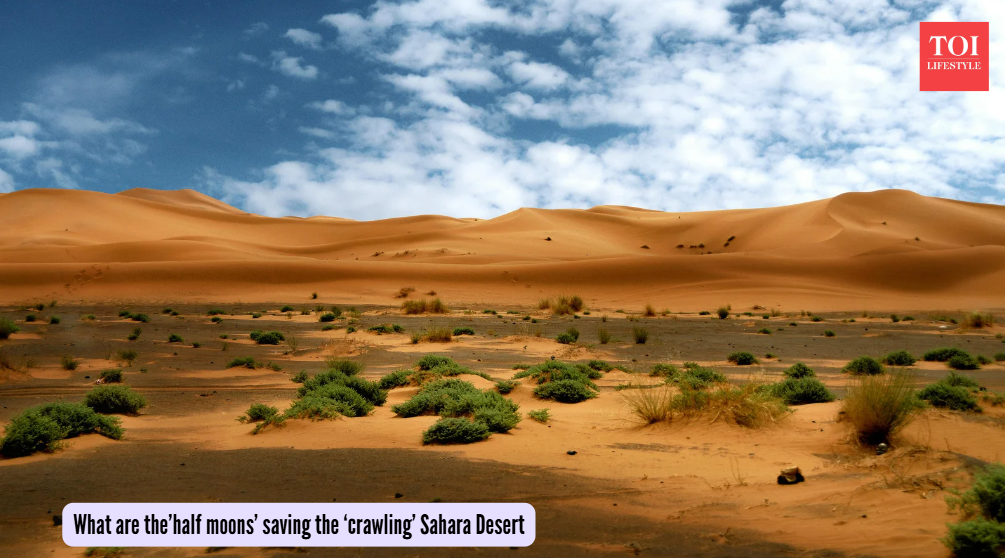
The Sahara Desert is crawling forward like a silent invader, swallowing farmland and forcing families in the Sahel to fight for every drop of life.
However, many new projects have put in all efforts to get this under control, including vast tree belts and imported bee hives chilled against the blaze, with the goal of a green barrier to halt the sands.
Previously, China completed a massive 3,000-km green belt surrounding the Taklamakan Desert by planting billions of trees, creating a “Great Green Wall” to fight desertification but this time, amid other procedural failures, a humble and simple solution has stood out that has helped control desertification in Sahara.
Failed attempts with trees and bees to control the desert expansion
Big ideas like the Great Green Wall aimed to plant tree belts across the Sahel, but many seedlings died quickly. Surface sand hit over 50°C, forming a hard crust that repelled rain instead of soaking it up.
The bee project faced the same challenge. Hives introduced to help “re-green the desert” failed as wax combs melted, structures collapsed, and whole colonies overheated. Zoologists reviewing the effort noted it prompted a major shift from past approaches that added life to soil unable to retain water.
What are the ‘half Moon pits’ that controlled the desert?
The “half moons” or “demi-lunes” are crescent-shaped basins dug 2-4 meters wide and tens of centimeters deep, with the open side uphill to catch runoff. Farmers add manure inside, breaking the crust so water seeps in.
The Food and Agriculture Organization calls them “a quick and easy method of improving rangelands in semi-arid areas”. The UN Convention to Combat Desertification recommends them for crusted soils.
These pits cool soil by several degrees, slashing evaporation and creating spots for grasses, insects, birds, and trees to rebound.
Proven results on the ground
Data from Burkina Faso, Niger, and Mali show half moons boost water infiltration up to 70% and halve erosion versus untreated land. They’ve revived grazing and spurred natural tree growth on once-dead plots.
A 2025 northern Nigeria study published in the International Journal of Agriculture and Earth Science found bare land with 4-meter half moons held more moisture and greened up post-rainy season. Authors deemed it “a viable, community adaptable approach” for drylands, urging its inclusion in national policies