
India’s oil story did not begin offshore in the Arabian Sea or with the discovery of Bombay High. It began much earlier, in the years after Independence, when the country was still trying to understand its own natural resources and reduce dependence on foreign companies.
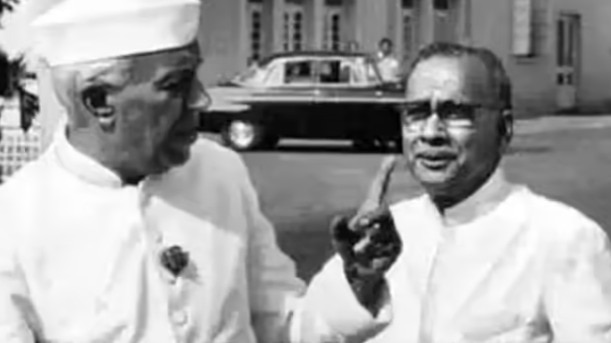
At the centre of that effort was Keshav Dev Malaviya, a freedom fighter, a leader, and later Union minister, who is often remembered as the father of India’s petroleum industry.
He was not a geologist in the conventional sense. But he had something equally important, the political will to push India towards energy self-reliance when very few believed it was possible.
FROM FREEDOM MOVEMENT TO PUBLIC LIFE
K D Malaviya was born on June 10, 1903. He received his early education in Gorakhpur and later studied at Allahabad University, where he completed an M.Sc. in Chemistry.
He also earned a diploma in Oil Technology from the Harcourt Butler Institute in Kanpur.
From a young age, he was drawn into the national movement. Inspired by his uncle, Pandit Madan Mohan Malaviya, he joined the Indian National Congress and became part of the freedom struggle under leaders such as Jawaharlal Nehru.
Like many political workers of that generation, he also spent time in jail during the Independence movement.
After Independence, Malaviya entered government and gradually rose through the ranks. He first served in Uttar Pradesh, and later joined the Central Government. In 1955, he was appointed minister in charge of Mines and Oil, a role that would define his legacy.
WHEN INDIA DECIDED TO SEARCH FOR OIL
In the mid-1950s, India had limited domestic oil production. Most of the country’s known reserves were in Assam, and the broader belief at the time was that the chances of finding oil elsewhere in India were low.
In 1955, the Government of India decided to step up the search for oil and natural gas and created the Oil and Natural Gas Directorate under the Ministry of Natural Resources and Scientific Research. The department was built with scientists from the Geological Survey of India.
Malaviya was deeply involved in this shift. He travelled to several countries to study their oil industries and worked to ensure that Indian professionals received proper training in oil exploration.
A year later, in 1956, he helped establish the Oil and Natural Gas Commission (ONGC) and became its first Chairman, while also continuing as minister.
At the time, many criticised the move. Some argued that the government was taking an unnecessary risk and wasting public money on oil exploration. But Malaviya continued.
THE DISCOVERIES THAT CHANGED EVERYTHING
Under ONGC, geological and geophysical surveys began on a large scale in several sedimentary basins across the country. Technical help was also sought from the Soviet Union and Romania.
The first deep drilling efforts began at Jwalamukhi in Punjab and Cambay in Gujarat.
At Jwalamukhi, only gas was found. But in Cambay, oil was discovered in 1958.
That changed the conversation.
The Cambay find was followed by the discovery of a major oil field at Ankleshwar, and later more fields in Gujarat and Assam, including Rudrasagar and Lakwa. These discoveries helped prove that India had more hydrocarbon potential than previously believed.
Exploration was also extended offshore, especially on the western coast. These early efforts later laid the groundwork for the discovery of Bombay High, one of India’s most important oil and gas fields.
BEYOND EXPLORATION: BUILDING INDIA’S OIL SYSTEM
Malaviya’s contribution was not limited to oil exploration.
He also helped expand India’s refining capacity. During his time as minister, refineries were set up at Gauhati in Assam, Barauni in Bihar, and Koyali near Baroda.
These were major steps. Until then, the refining and marketing of petroleum products in India had largely been controlled by foreign companies.
By building domestic capacity in production, refining, and marketing, Malaviya helped India begin taking control of its own petroleum sector.
He also looked beyond India. In 1963, ONGC obtained an oil lease from Iran in the Persian Gulf, which later contributed to India’s oil supply. In the same year, he resigned after allegations that he had asked a private company to help raise funds for elections.
K D Malaviya died on May 27, 1981, in New Delhi.
Today, he is remembered not just for starting ONGC, but for asking a basic question at a crucial time: Why should India depend entirely on others for its energy?


