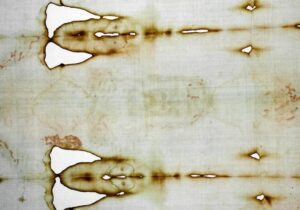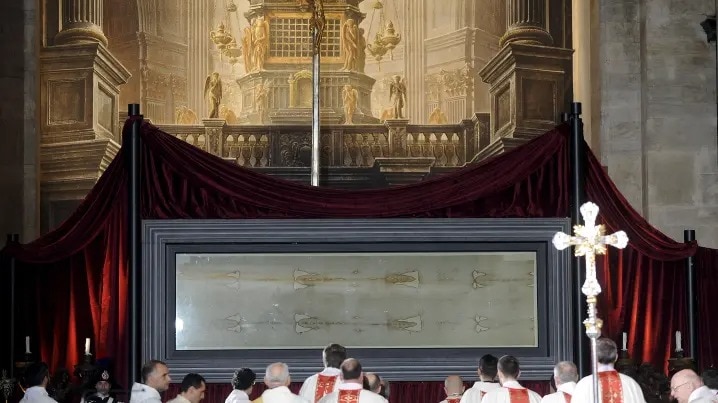
The Shroud of Turin, one of Christianity’s most debated and closely examined relics, has taken yet another turn in its long and contested history. A new study has claimed that the 4.4-metre-long linen cloth, which carries the faint image of a man whose wounds appear consistent with crucifixion and is regarded by many believers as the burial cloth of Jesus Christ, contains DNA traces linked to people of Indian ancestry, along with genetic material from plants, animals and multiple human handlers, suggesting that it may have had connections with both the Indian and European regions over the centuries.
The most striking finding was that around 40% of the DNA showed links to Indian ancestry. This has led researchers to suggest that the linen may have come from the Indus Valley, or that the cloth was linked in some way to the Indian subcontinent.
The findings, published in the preprint journal bioRxiv, are likely to reopen an old debate around the relic’s origin, movement and authenticity.
For believers, the shroud has long stood as a sacred object believed by many to have wrapped the body of Jesus after the crucifixion.
For historians and scientists, it remains a medieval object layered with unanswered questions.
WHAT THE NEW STUDY FOUND
A team led by researchers including Gianni Barcaccia of the University of Padova examined biological material collected from the shroud in 1978. Their goal was not to prove faith claims, but to study the different DNA traces preserved on the linen.
“The DNA traces found on the Shroud of Turin suggest the potentially extensive exposure of the cloth in the Mediterranean region and the possibility that the yarn was produced in India,” the team mentioned.
What emerged was a complex biological record.
The researchers found DNA from several sources, including humans, domestic animals, wild animals, insects and plants.
Among the most discussed findings was the claim that a significant portion of the human genetic material showed links to lineages from the Indian subcontinent.
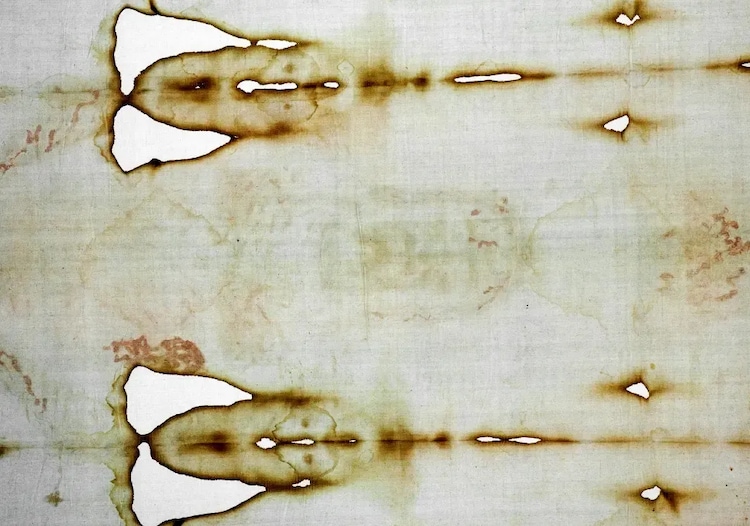
That observation has prompted a fresh theory: that the linen, or at least the yarn used to make it, may have had some connection with India, or that the cloth came into contact with people from the region at some stage in its long journey.
The study notes that the shroud appears to have been exposed to different environments and populations over time.
THE SHROUD OF TURIN’S HISTORY: WHERE THE MYSTERY BEGAN
Long before DNA studies and forensic debates, the Shroud of Turin had already built a reputation as one of the most contested objects in Christian history.
The cloth is a long linen sheet bearing the faint front-and-back image of a man who appears to show wounds resembling crucifixion injuries. Many believers have regarded it as the burial cloth of Jesus Christ.
Its documented history, however, begins much later.
The shroud first appears clearly in the historical record in 14th-century France, around 1354, when it was displayed in the small town of Lirey. From the start, it stirred both devotion and suspicion. Some treated it as sacred. Others within the Church itself raised doubts.
By the 16th century, the cloth had come into the possession of the House of Savoy, one of Europe’s major ruling dynasties.
It was later moved to Turin, Italy, where it has remained for centuries and from which it takes its modern name.
It is now housed in the Cathedral of Saint John the Baptist in Turin.
WHY THE ‘INDIAN DNA’ CLAIM MATTERS
This is the part of the study that has drawn the most attention.
If the genetic traces are interpreted cautiously, they do not mean the shroud was “made in India” in any final or proven sense.
DNA on an object can arrive through contact, transport, trade, display, repair or contamination. That is especially true for a relic that has been handled and studied repeatedly.
Still, the finding matters because it pushes the discussion beyond Europe alone.
For years, most debates around the Shroud of Turin focused on whether it was a relic from first-century Judea or a medieval creation from Europe.
The new study introduces another possibility: that the cloth, its fibres, or the people who handled it may have been connected to wider trade and cultural routes stretching far beyond the continent.
The study is yet to be peer reviewed, which means it has not gone through the full scrutiny of independent experts that usually precedes wider scientific acceptance.
NOT EVERYONE IS CONVINCED
As expected, the study has already met with scepticism.
Some scholars remain unconvinced that the new genetic material changes the broader historical picture. One outside expert cited in reports said there is still little reason to move away from the long-held view that the shroud is likely a medieval European object.
That scepticism is not new. Almost every major claim around the Shroud of Turin, whether religious, historical or scientific, has been followed by counterclaims, rebuttals and fresh reinterpretations.
The study also found DNA from a wide range of non-human sources.
These included domestic animals such as cats, dogs, chickens and cattle, as well as traces linked to wildlife such as deer, rabbits, fish and insects. Plant DNA was also present, including traces associated with crops and common flora.
A NEW CHAPTER IN AN OLD DISPUTE
The latest DNA study comes on top of years of scientific dispute around the shroud.
In 1988, one of the most widely cited tests on the relic, radiocarbon dating, concluded that the linen was made sometime between 1260 and 1390 CE. That result placed the cloth in the medieval period, not in the time of Jesus.
For many historians, that became the strongest evidence against the shroud’s authenticity as a first-century burial cloth.
Yet supporters of the relic have long challenged that test. Some argued that the sample used in the carbon dating may have come from a repaired section rather than the original fabric.
Others said contamination from fire, smoke, handling or restoration may have affected the result.
The latest claim about Indian DNA does not rewrite the shroud’s story overnight.
But it does add another layer to an already crowded record, one that now points not just to medieval Europe and Christian devotion, but perhaps also to wider routes of movement, contact and exchange.