
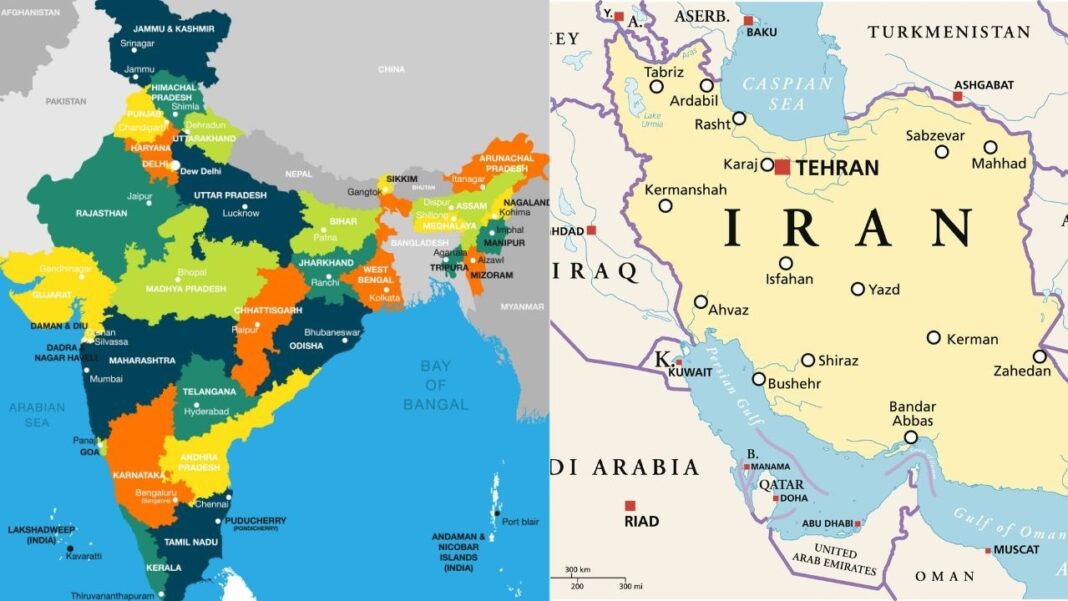
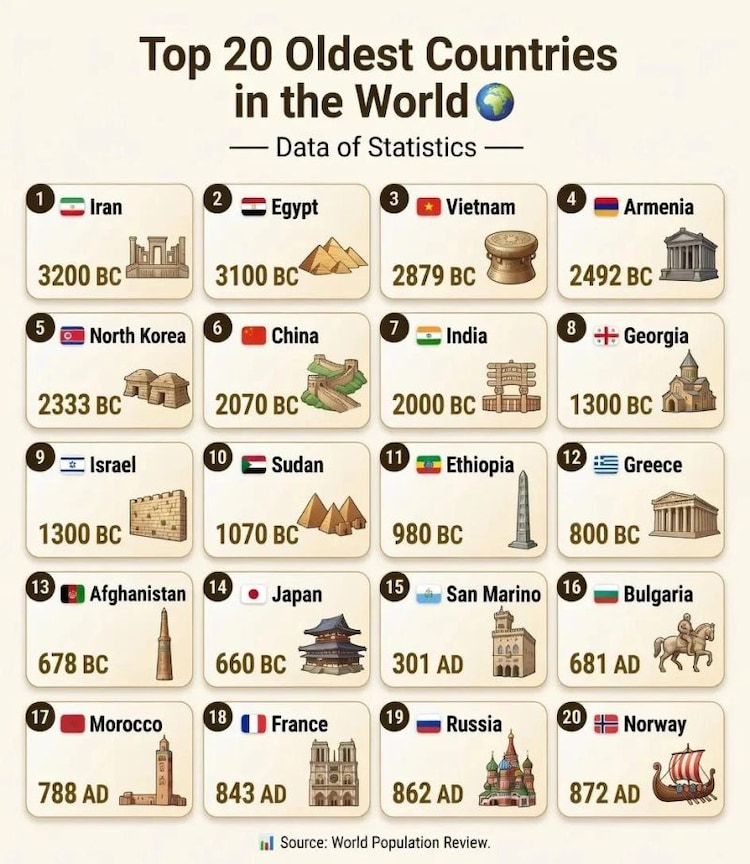
A social media post, featuring a chart attributed to World Population Review, has reignited a fresh debate over whether Iran (3200 BCE) is older than India (2000 BCE), reviving a long-standing question: can the age of a civilisation really be defined by a single date?
The widely shared graphic presents a seemingly data-backed comparison, placing Iran ahead based on early timelines of organised societies.
However, historians caution that such claims rely on selective interpretations of history and overlook the broader complexity of how civilisations evolve over time.
WHAT THE VIRAL CLAIM SUGGESTS
The widely circulated post ranks Iran ahead of India based on early markers of organised civilisation, particularly pointing to developments like the Elamite civilisation around 3200 BCE.
Archaeological sites on the Iranian plateau, such as Susa, indicate early urban settlements, administrative systems, and proto-state structures.
By this measure focused on urbanisation and governance, Iran is often placed among the earliest centres of civilisation.
However, experts argue that this approach highlights only one dimension of history.
CIVILISATION IS MORE THAN JUST A TIMELINE
Historians stress that defining a civilisation goes far beyond assigning dates.
“Ancient civilisations cannot be compared using exact timelines, as their origins are based on broad archaeological estimates, not fixed dates. While early civilisations like the Sumerian, Egyptian and Indus Valley developed around similar periods, defining which is ‘older’ depends on multiple factors beyond just time. That is why such debates are often oversimplified and not historically meaningful,” said Dr Gaurav Gadgil, Associate Professor (History) & I/c Director,Somaiya School of Civilization Studies, Somaiya Vidyavihar University.
Civilisations are typically assessed through a combination of factors, including:
- Settlement patterns and urban development
- Social and political organisation
- Knowledge systems and philosophy
- Cultural continuity and value structures
Depending on which criteria is prioritised, the answer to “which is older” can change significantly.
WHY EXPERTS CALL THE DEBATE MISLEADING
According to Pankaj Jha, Professor of History at Lady Shri Ram College, the question itself may be flawed.
He explains that comparing “India” and “Iran” as civilisations is problematic because they are modern nation-states, not ancient, continuous entities.
In earlier periods, these regions were fluid cultural zones, not clearly defined countries.
He further points out several issues with such comparisons:
- Undefined terms: Civilisation, culture, state, and society are often used interchangeably without clarity.
- No fixed starting point: Human habitation in both regions goes back thousands of years, making small timeline differences insignificant.
- Modern borders vs ancient realities: Present-day boundaries do not reflect ancient connections, where populations often overlapped.
- Limited evidence: There is no conclusive data to pinpoint when distinct “Indian” or “Iranian” civilisations began.
For historians, the debate is less about facts and more about how those facts are interpreted.
SO, IS IRAN OLDER THAN INDIA?
The answer depends entirely on how “civilisation” is defined:
- If measured by early urban centres and proto-state systems, Iranian sites may appear earlier.
- If measured by long-term cultural continuity and early settlements, the Indian subcontinent shows evidence stretching back several millennia.
- There is no universally accepted answer, and no official position declaring one civilisation older than the other.
Experts emphasise that such debates often reflect modern identity and pride, rather than rigorous historical analysis.
Both India and Iran are recognised as among the world’s oldest centres of civilisation, with rich, overlapping histories that cannot be reduced to a single timeline.



Conversation