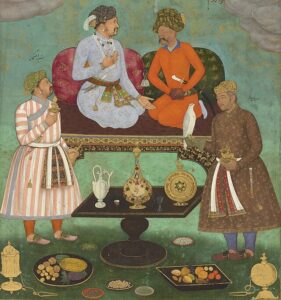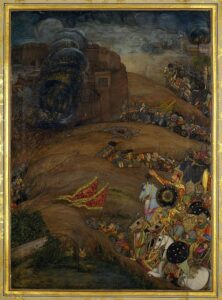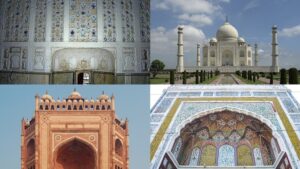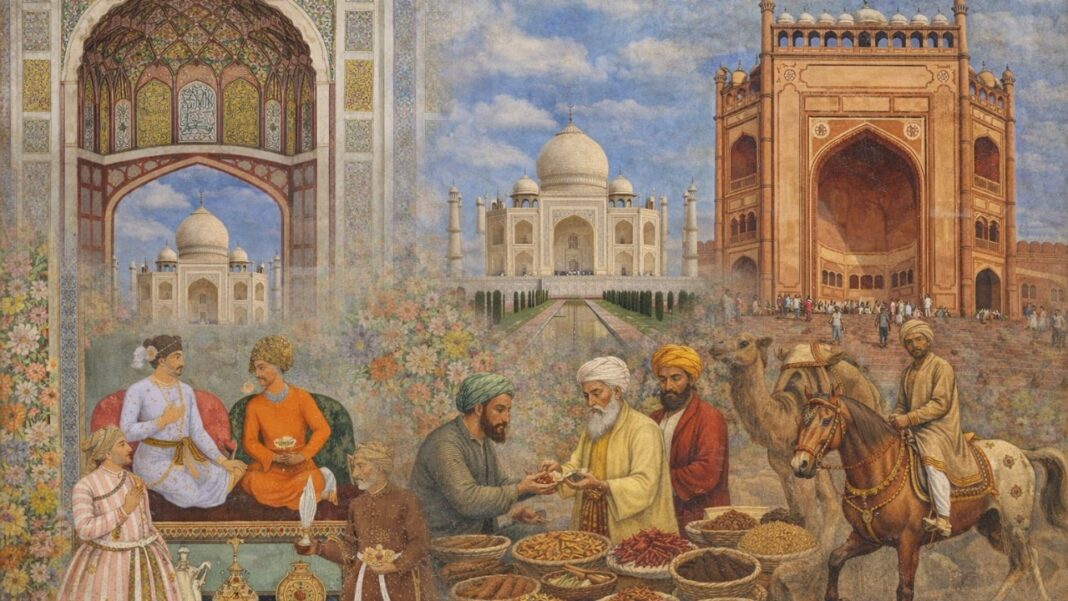
Four centuries ago, Persian culture had already taken a front seat in India’s political and artistic life. By the time the Mughal Empire had settled into power, Persia was no longer a distant civilisation to be admired from afar; it had entered the empire’s everyday language, taste, and imagination.
Mughal rulers absorbed Persian art, courtly etiquette, architecture, literature, and administrative practice so deeply that it became difficult to separate what was “Mughal” from what had first travelled in from the Persian world.
Horses from Iran strengthened imperial cavalry, Persian arms and craftsmanship entered military life, Persian carpets furnished palaces and courts, and scholars, theologians, physicians, painters, and spiritual figures from the Persianate world found patronage under Mughal emperors.
Yet Persia’s imprint in India was not confined to royal courts alone. It appeared in the curve of an arch, in the geometry of a charbagh garden, in the Persian line of a Mughal farman, in the horse that carried imperial cavalry, and in the caravans that moved spices, dried fruits, metalware, silk, and books between India and Iran.
The connection, of course, did not begin with the Mughals. But it deepened under them. By the time the Mughal rulers established themselves in India, the Persianate world had already become one of the great civilisational zones of Eurasia.
The Mughals came from Central Asia, but the political language they inherited, and later refined in India, was deeply Persian. Persian became the language of administration, diplomacy, literature, taxation, and imperial memory.
In many ways, the Mughal Empire did not merely use Persian; it thought through it.
Persian scholars, calligraphers, painters, secretaries, theologians, physicians, and men of letters crossed into India and found patronage in imperial service.
Persian books on poetry, ethics, history, Sufism, and governance circulated widely, shaping elite education and political imagination.
To study the Mughal world without Persia is to read it only in outline.
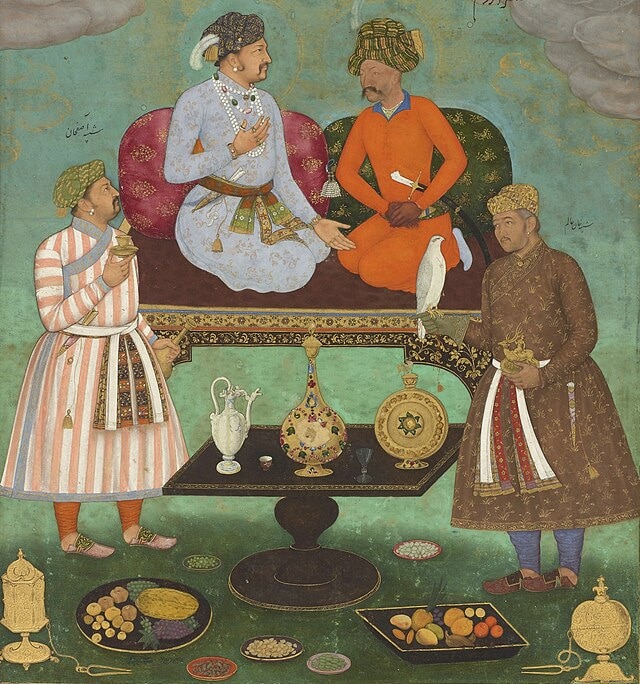
By the late 16th century, Persian had become the language of administration, diplomacy, chronicling, and refinement in the Mughal court. Court histories, imperial orders, literary culture, and statecraft all moved through Persian.
Historians such as Muzaffar Alam and others have long argued that Persian was not simply a language of convenience; it was the medium through which the Mughals held together a vast and diverse empire.
This mattered because Iran, particularly under the Safavids, was one of the great centres of that Persianate world.
THE HORSE THAT CARRIED EMPIRE
If there was one thing without which the Mughal Empire would have looked far less formidable, it was the horse. Strip the empire of its cavalry and much of its speed, reach, and battlefield confidence begins to fade. The Mughals were, in the clearest military sense, a cavalry power.
Their wars were fought on horseback, their nobles measured status through mounted contingents, and their empire moved as much on hooves as on orders.
Take the Deccan campaigns, for instance. When Mughal armies marched south into the plateau, they did not arrive as slow columns of infantry alone. They came as moving cavalry formations, swift, disciplined, and expensive to maintain. And many of the horses beneath Mughal soldiers were not bred in the plains of Hindustan.
They had travelled from the west, from Persia, Arabia, and Central Asia, crossing harsh terrain before ever reaching an imperial stable.
Historians of the Mughal military system have long pointed out that good warhorses were always in demand because Indian breeds often did not meet the demands of sustained imperial warfare. The best horses needed for campaigns, courier networks, noble contingents, and royal movement often came from Iran and adjoining regions.
Even the state understood how crucial this trade was. Under Akbar, the empire did not leave horse supply entirely to chance.
Historical studies note that the Mughal administration took active interest in regulating and supporting the trade, including the use of sarais and the monitoring of trusted horse dealers. In other words, the empire did not merely buy horses. It built systems around them.
WHY KANDHAR MATTERED MORE THAN A BORDER CITY
Few cities tell the story of Mughal-Iranian relations as sharply as Kandahar.
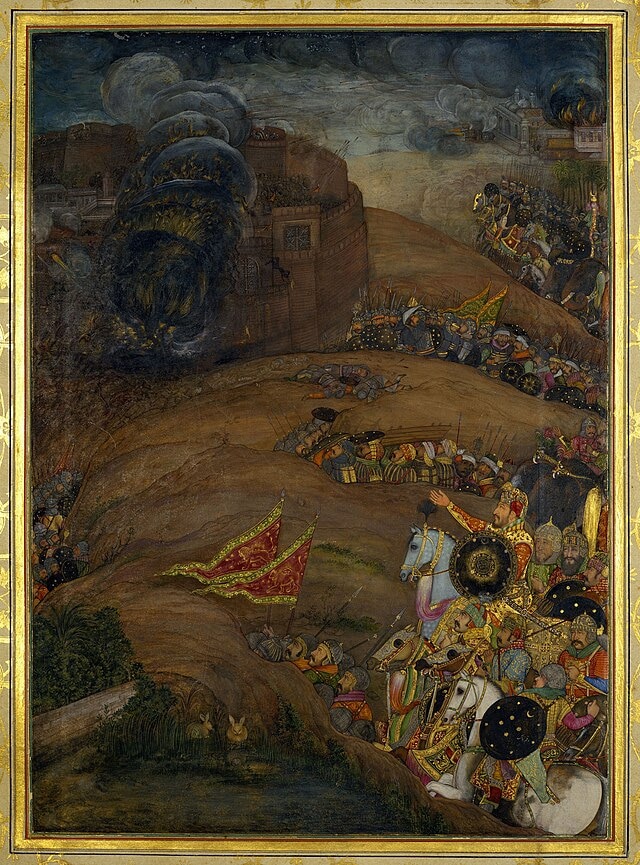
Modern readers often encounter Kandahar only through the lens of war. But in the 16th and 17th centuries, it was also one of the great hinges of overland commerce.
Historians describe it as both a strategic fortress and a commercial artery. Whoever controlled Kandahar controlled a key route linking India with Iran and Central Asia. Caravans moved through it carrying horses, textiles, precious goods, manuscripts, and military material.
That is why the city changed hands so often between the Mughals and the Safavids. It was not merely a frontier possession. It was a customs gate, a military threshold, and a statement of regional power.
In early modern Asia, trade routes were political arguments made in stone and dust.
Iranian scholars, administrators, physicians, calligraphers, painters, metalworkers, and theologians travelled east and found patronage in Mughal India.
The Mughal court, particularly under Humayun, Akbar, Jahangir and Shah Jahan, became a magnet for Persianate talent.
This migration helped shape imperial workshops, literary production, manuscript culture, and visual style. Historians of textile and art history have shown how even luxury silks and court design in Mughal India bore strong Safavid techniques and motifs, often carried by migrant craftsmen themselves.
Carpets from regions such as Qom, Isfahan, and Tabriz were woven from the finest wool and silk.
WEAPONS, ARMOUR, BOOKS, CARPETS – AND PRESTIGE
The flow of goods between the two regions was extensive.
India exported cotton textiles, spices, sugar, indigo, and precious stones westward.
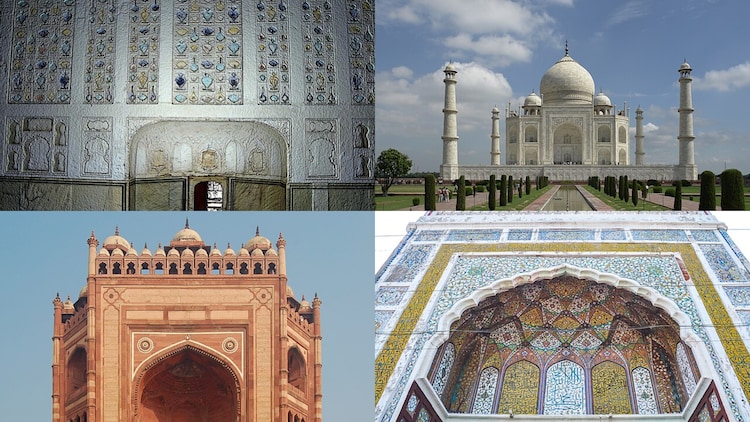
In return came horses, metals, dried fruits, silk, luxury cloth, glassware, arms, and decorative objects. Persian books—on poetry, ethics, history, philosophy, and Sufism, also moved into India.
So did fine Qurans and calligraphic works. Persian carpets and textile designs, meanwhile, influenced the visual grammar of elite Mughal interiors and workshops.
M Athle Meryak’s book, The Mughal Empire, notes that the Mughal artillery was profoundly influenced by the Turco-Iranian tradition.
Iran was also the source of bakhtar (armor/mail), specialised swords and daggers, decorative shields, and intricately engraved helmets. These items were distinguished by their exceptionally fine craftsmanship.
They featured kalamkari work, gold and silver inlay, and inscriptions in Persian script.
This is why Iran keeps returning to the centre of history. Not because it is always at war, but because it has long occupied a position larger than the map alone suggests.
It has historically been a military corridor, an intellectual workshop, a commercial hinge, and a cultural power.
There is a civilisational connection between India and Persia that has existed for centuries. It shaped dynasties, altered artistic traditions, and opened pathways between two of the world’s oldest civilisations. The Mughals and Persia shared a long legacy of art, culture, language, and trade.
There came a time, however, when the Iranian ruler Nadir Shah marched into Delhi in the 18th century and sacked the city.
The bloodshed continued for days, and treasures such as the Koh-i-Noor were taken during that invasion. Yet that violent episode did not erase the larger legacy of what had been exchanged between Persia and Mughal India in the centuries before it.