
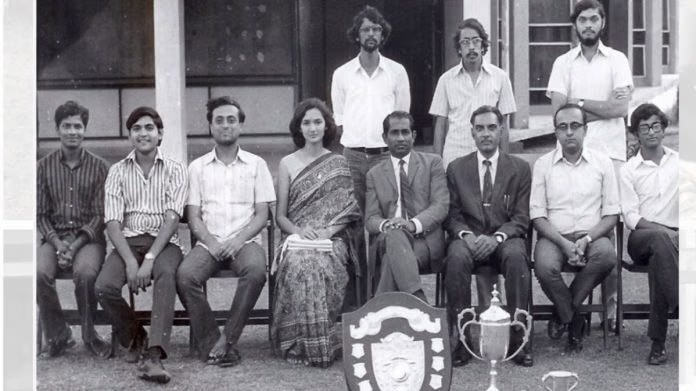
The winter of 1974 looked different at Delhi University. On the lawns of Miranda House, a group of students from IIT Bombay stood with a trophy that few on their campus had expected them to win. They had travelled across the country in a third-class train, paid their own way, and entered competitions that had little to do with engineering in the formal sense. They came for quizzes, debates, theatre and argument, and returned with something larger than a trophy.
In that team were names that would later enter public life and corporate history, Nandan Nilekani and Jairam Ramesh among them. But in that moment, they were not yet public figures.
That photograph resurfaced recently through a post on X by Joy Bhattacharjya, and with it came the memory of a campus culture that once held a central place in Indian student life.
The post was first made public on Facebook, where on March 21, the IIT Bombay Alumni Association shared two black-and-white images featuring Jairam Ramesh, Amarnath Bhide and Nandan Nilekani.
Joy’s post did not stop with IIT Bombay. It mapped an entire generation of campus competitors whose names now sit in politics, business, diplomacy and media.
He recalled how Shashi Tharoor and Ramu Damodaran, former diplomat, ambassador and former UN Communications Director, represented St Stephen’s College with distinction in the 1970s.
He noted that historian Ramachandra Guha too may have teamed up with Tharoor in that period.
The same memory line runs through other institutions. For IIT Bombay, Nandan Nilekani and Jairam Ramesh were, as Joy put it, “a star turn”.
A decade later, when Quiz Time began on Indian television in 1985, another generation entered the frame. In one of the earliest seasons hosted by Siddhartha Basu, Raghuram Rajan and Jayant Sinha represented IIT Delhi, while Rajdeep Sardesai appeared from St Xavier’s College, Mumbai.
Before the internet, before Google searches and before information became instant, quiz and debate platforms were also sites of knowledge exchange.
WHEN KNOWLEDGE WAS A PUBLIC PERFORMANCE
Long before hackathons, coding contests became the currency of campus prestige, knowledge had a stage, and that stage was often a quiz hall or a debate podium.
In the decades following Independence, especially through the 1960s and 1970s, colleges in cities like Delhi, Kolkata, Mumbai and Chennai saw a surge in inter-college competitions.
India’s organised quizzing culture is widely traced to 1967, when Neil O’Brien conducted one of the first open quizzes in Kolkata.
Shashi Tharoor, while recalling the days, wrote: “Yes those were the days. We at St Stephen’s were the pioneers of these festivals and similarly suffered from under-funding and minimal institutional support for travel. In 1973-74 Ramu Damodaran and I did to IIT Kharagpur what these IITans did to Miranda House, winning the debates and the quizzes, sweeping Best Speaker, Best Play, Best Team and the lot. We repeated the exercise at IIT Bombay’s first-ever cultural festival that winter!
He was replying to the comment added by senior Congress leader Jairam Ramesh.
What began as a niche intellectual exercise soon grew into a campus phenomenon, especially in English-medium institutions and elite colleges.
Debates, meanwhile, had an even older lineage, rooted in colonial-era debating societies, literary clubs and student unions.
Institutions like Delhi University and Presidency College Kolkata nurtured generations of students who saw debating not merely as competition.
IITs, DU AND THE MAKING OF A CULTURE
The 1974 IIT Bombay story captures a moment when even technically focused institutions began embracing this culture.
At Indian Institute of Technology Bombay, extracurricular life was still evolving. There was little institutional funding for cultural participation. Students paid their own way.
That same period saw Delhi University colleges, Miranda House, St Stephen’s, Hindu College, turn debates and quizzes into intellectual spectacles.
Rajya Sabha MP Jairam Ramesh would later recall how those circuits brought together future public figures, Shashi Tharoor, Ramachandra Guha, Pavan Varma, long before they became household names.
THE TELEVISION MOMENT: QUIZZES ENTER INDIAN HOMES
If campuses gave quizzes their early momentum, television gave them national reach.
In 1985, Siddhartha Basu brought quizzing into Indian living rooms with Quiz Time on Doordarshan. For many Indians, this was their first exposure to structured, competitive quizzing.
The show turned quizmasters into recognisable figures and contestants into local celebrities. It also reinforced the idea that knowledge could be both serious and entertaining.
Through the late 1980s and 1990s, figures like Derek O’Brien expanded the circuit, taking quizzes into schools, corporate spaces and mass events. What had begun in halls and auditoriums became a national intellectual culture.
Debating, for instance, has deep roots in institutions like the Oxford Union and the Cambridge Union, where students engaged in structured argumentation on politics, philosophy and society.
Quizzing, in its modern form, grew alongside the rise of trivia competitions, academic bowls and broadcast formats in the West.
Yet, in India, it took on a distinctive character, often blending history, current affairs, literature and general knowledge into a single format.
MEMORY, NOSTALGIA AND WHAT REMAINS
The recent post by Joy Bhattacharjya resonated because it reminded many of a time when intellectual culture was visible and collective.
Comments from alumni spoke of recognition, friendships, and a sense of belonging built around shared curiosity. Old photographs turned into archives of not just people, but of a way of learning.
Even today, pockets of that culture survive, in school quiz circuits, debating societies, Model United Nations forums. But they often exist alongside, rather than at the centre of, campus life.
Quiz and debate culture in India once thrived on that spirit.
It created individuals who could think, argue, connect ideas, and stand before an audience with clarity. It made knowledge visible. It made it aspirational.


