
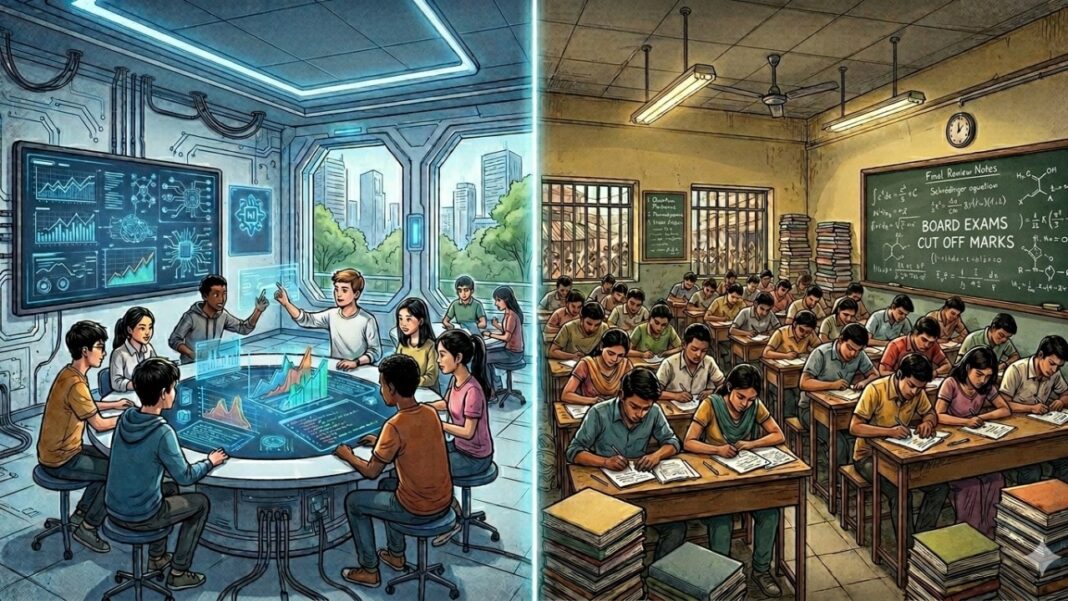
When China introduced its “Double Reduction” policy in 2021 (dramatically restricted private tutoring to ease student homework burdens and excessive off-campus academic training), it was seen as a crackdown on homework and the country’s booming private tutoring industry. But the move signalled something deeper. It was a complete reset in how learning itself was being approached in the country.
The idea was a simple one to start with. Reduce pressure, move away from excessive memorisation, and bring the focus back to classrooms. Since then, China has been steadily pushing for more application-based learning, integrating technology into teaching, and aligning education with long-term national priorities.
“China is trying to move from a system that selects toppers to one that builds capabilities at scale,” Rohan Dua, a research fellow at BHU, says about the global education policy based in Beijing. “The emphasis is increasingly on what students can do, not just what they can recall.”
India, by contrast, is dealing with a very different challenge. We are looking at scale and inertia. With one of the largest student populations in the world, any structural shift takes time. But the result is a system where change often feels slower than the world outside it.
THE EMPLOYABILITY QUESTION THAT INDIA CANNOT IGNORE
The consequences of this gap are already visible in the job market. India produces close to nine lakh engineers every year, yet a significant number struggle to find roles that match their qualifications. Employers often point to the same issue as graduates who are academically qualified, but not job-ready.
“Degrees are no longer enough. We have to ask whether our students are being trained to solve problems or simply to pass exams,” says Sekar Viswanathan, a senior faculty at the Vellore Institute of Technology.
This disconnect between education and employability has been discussed for years, but it is becoming sharper at a time when the nature of work itself is changing rapidly. A recent ‘State of Working India 2026’ report released by Azim Premji University revealed that about four in ten young students in India are struggling to find jobs. This is despite rising access to higher education.
The problem is manifold because technology is already reshaping industries. Entry-level roles are evolving, and skills are shifting faster than curricula. This is where China seems to have a head start. It has already begun introducing technology into classrooms not just as a subject, but as a tool to improve learning and expose students to real-world applications early.
India, on the other hand, has signalled intent. Policy discussions about introducing emerging technologies into school education are underway, but the implementation remains uneven, often limited to better-resourced schools and institutions. “There is a clear recognition in India that the system needs to change,” says Dr Pankaj Agarwal, a former Secretary, Higher Education. “The challenge is translating policy into practice across such a large and diverse system.”
THE COACHING ECONOMY THAT REFUSES TO FADE
If China’s education system is increasingly shaped by state intervention, India’s is driven by the market. From Kota to Hyderabad to Delhi, coaching centres continue to define the academic journey. Here success is still measured by ranks, cut-offs, and entrance exams. For many students, this creates a narrow definition of achievement.
“In my city, everything still feels like a race. Marks decide our college, our options, even how people judge us,” a class 12 student from Noida, opines.
Education policy analyst Vikas Gupta, former School Education Secretary, also believes this approach is becoming outdated.
“India’s system still rewards memory more than adaptability. That may have worked in an earlier era, but it is not enough going forward.”
China has attempted to dismantle a similar ecosystem by restricting large parts of its tutoring industry in an effort to reduce pressure and inequality. India, so far, has not taken that route.
TWO VERSIONS OF SUCCESS?
At its core, the difference between the two systems is deeply philosophical as it is nuanced. While in India, success is still closely tied to performance in standardised exams, in China, there is a gradual attempt to move towards application, problem-solving, and integration with industry needs. The former rewards accuracy, speed, and the ability to reproduce knowledge.
Neither system is without flaws. China’s model is often criticised for being overly controlled, while India’s is seen as overly competitive. It is the direction of change that stands out; one system is trying to move beyond exams, the other is still defined by them.
China’s education reforms are increasingly aligned with sectors it wants to grow, including technology, manufacturing, and advanced research. India risks producing graduates for roles that are evolving or disappearing. The gap between what students learn and what the job market demands continues to widen.
There is also the question of access. The digital divide means that exposure to new skills and technologies is still uneven across regions and socio-economic groups.
India is not standing still. Policy frameworks are pushing for multidisciplinary learning, skill development, and greater flexibility. There is growing recognition that the system needs to adapt. The only problem is that this change is slow, and the pace of change in the real world is much faster.
THE QUESTION THAT LINGERS…
The India-China comparison is not about choosing one system over the other, it is about recognising where education is headed. China is beginning to prepare students for what comes next, India is still testing them on what came before.
And as the nature of work continues to evolve, the question becomes harder to ignore. Are Indian students being prepared for the future, or for a system that is already being left behind?


