
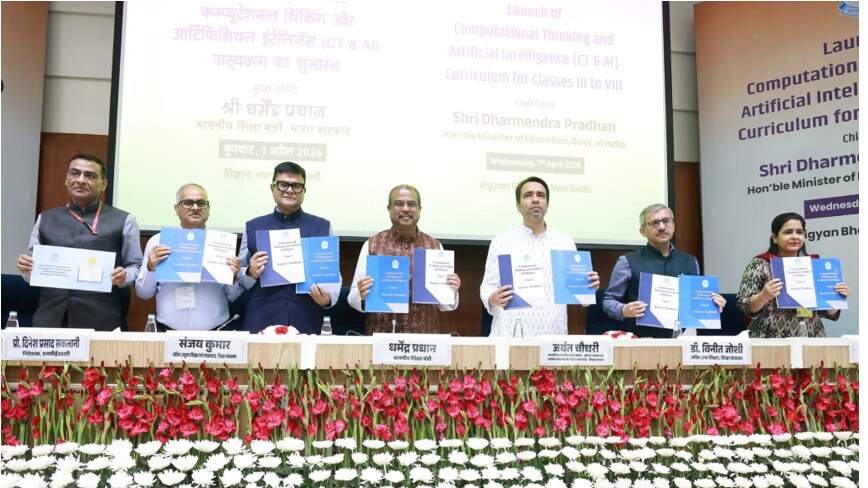
The Central Board of Secondary Education has launched a new curriculum on Computational Thinking and Artificial Intelligence for Classes 3 to 8, bringing structured AI learning into schools from the 2026-27 session.
Union Education Minister Dharmendra Pradhan introduced the framework at Vigyan Bhawan in New Delhi, calling it a transformative step towards future-ready education.
The new curriculum is meant to give young students early exposure to emerging technologies in a planned and systematic way. It will be supported by structured learning modules, detailed teacher handbooks and student assessment tools so that the subject can be introduced with clarity from the beginning.
At the launch, the minister said the initiative was closely linked to the idea of “AI for Education, AI in Education”.
He said the curriculum would help children develop critical thinking, a design-based approach and a stronger culture of innovation. He also said it would help students engage meaningfully with the digital future as India’s role in technology continues to grow.
AI FROM THE EARLY YEARS
The curriculum is designed to build AI-readiness through computational thinking. That means students will learn skills such as logical thinking, problem-solving, pattern recognition and the ability to understand how AI is used in daily life.
The framework aims to create AI-ready learners who can work with technology responsibly rather than simply consume it. It also seeks to strengthen digital literacy while encouraging ethical decision-making and innovation.
Officials said the curriculum is not only about learning a new subject. It is about preparing children for a world where technology will shape work, learning and communication in new ways.
ALIGNED WITH NEP AND NEW EDUCATION GOALS
The new programme is directly linked to the National Education Policy 2020 and the National Curriculum Framework for School Education 2023. The learning goals, competencies and outcomes have been drawn from that framework.
The rollout follows a phased approach. Computational Thinking has been introduced first so that children can build the right foundation before moving into more advanced AI concepts in higher classes.
Jayant Chaudhary said education must prepare young minds not only for a changing world, but also for one that may change in ways nobody can yet predict. He said artificial intelligence is already reshaping the way knowledge is created and decisions are made.
He added that students must not remain passive users of technology. Instead, they should become thoughtful creators and responsible leaders of it.
He said computational thinking from an early stage will help children learn, unlearn and relearn with confidence.
PLAYFUL LEARNING, PRACTICAL ASSESSMENT
The teaching method will be activity-based and experiential. Students will learn through games, puzzles, worksheets and hands-on exercises. Teachers will guide them to break large problems into smaller parts and understand charts and diagrams more easily.
Assessment will also move away from memorisation. Instead, students will be evaluated through written tests, CT puzzles, group activities and a Teacher Observation Journal that will track progress in a more practical way.
The curriculum is expected to help children connect mathematics, science and the humanities, while building strong foundations in digital literacy, innovation and responsible use of technology.


