Raja Dharma Tej Maddala, a 13-year-old Grade 7 student at Oakridge International School in Hyderabad, isn’t your typical teenager.
While many of his peers tinker with games or social media apps, Raja has created Raja MagRex AI, an artificial intelligence framework that thinks before it answers.
“I wanted AI to think more like humans,” he says.
“Most AI tools today generate responses directly from a single large model. I wanted to explore a different approach where multiple reasoning modules examine a question from different perspectives before producing a final response,” he adds.
The young inventor’s goal is simple but ambitious: to make AI more thoughtful, transparent and easier for humans to understand.
His system is designed to mirror how humans solve complex problems, not with one perspective, but by combining multiple viewpoints, like a council deliberating before making a decision.
A SYSTEM THAT THINKS IN COUNCILS
Raja calls his system Artificial Civilisation Intelligence, inspired by how societies make important decisions.
“Major decisions are rarely made by a single person or a single perspective,” he explains.
He further adds, “They usually involve discussion between different disciplines, such as science, ethics, economics, and environmental thinking. I wanted to explore whether AI could be designed to reflect that kind of structured collaboration.”
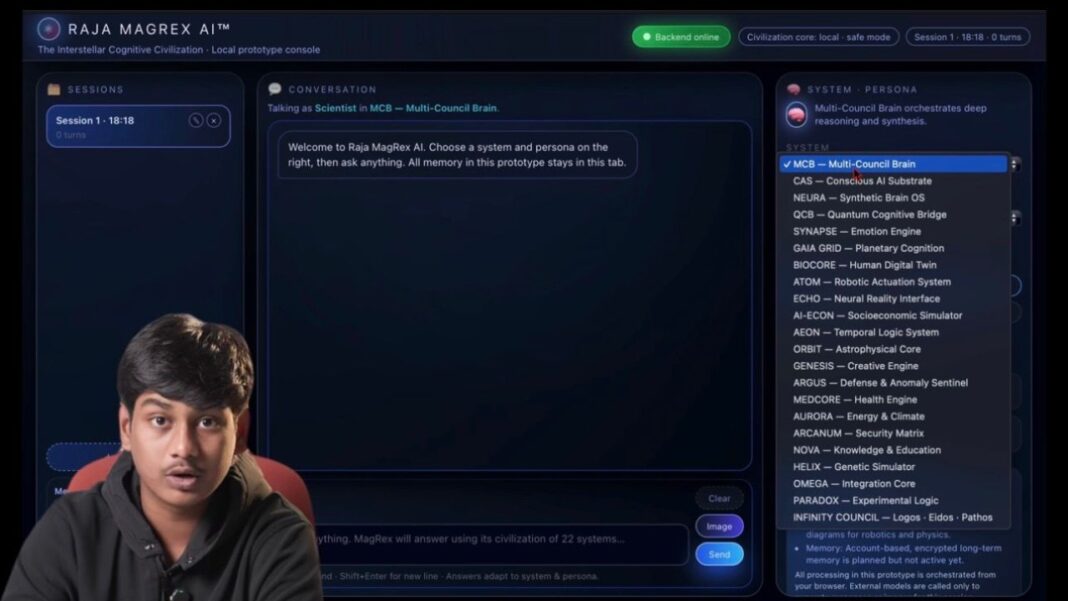
Raja MagRex AI is built with 22 cognitive systems, 87 modules, 100+ features and 108 personas.
“Each module analyses a problem from its own perspective: logical reasoning, scientific understanding, ethical evaluation, environmental analysis, or creative exploration,” he says.
He adds that, after this, an integration component combines the outputs into a single, unified answer.
The system doesn’t just generate a response; it organises reasoning, deliberates, and consolidates multiple viewpoints.
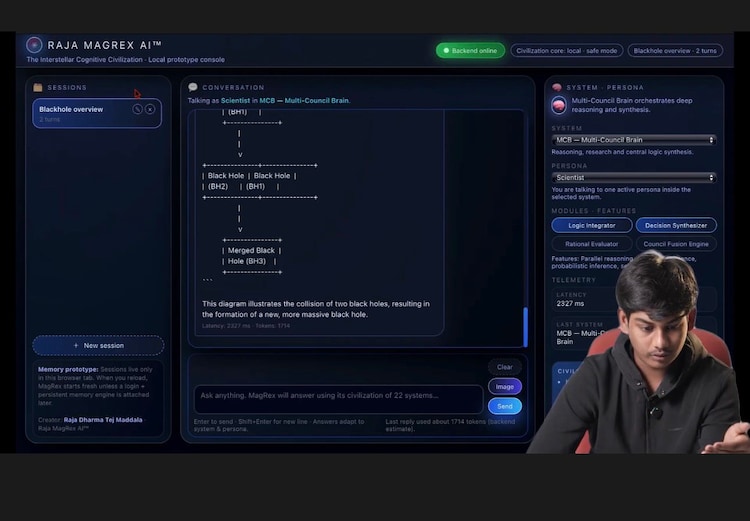
“Instead of relying on one model alone,” Raja adds, “the architecture organises multiple reasoning modules that examine the same problem from different viewpoints. The orchestration layer manages how these modules work together and combines their outputs.”
LEARNING AND CHALLENGES AT 13
Building such a complex system hasn’t been easy for a Grade 7 student.
“One of the biggest challenges was understanding and organising many complex ideas at the same time,” Raja admits.
“Designing a structured AI architecture requires learning about artificial intelligence systems, distributed computing, and how different reasoning processes can interact with each other. Balancing school responsibilities with working on the project was also tricky. Most of the development happens during evenings and weekends,” he adds.
His technical skills have been self-taught.
“I spent a lot of time reading research papers, technical articles, and documentation about AI and computer systems,” he says.
He adds that he also learnt by experimenting with small prototypes and gradually building more complex systems which helped him understand how different components of an AI architecture can work together.
FROM CLASSROOM TO REAL-WORLD IMPACT
Raja sees big possibilities for his AI beyond school projects.
“If systems like this continue to develop, they could be useful in areas where problems require analysis from multiple disciplines at the same time, like climate science, healthcare research, environmental planning, or complex engineering challenges,” he says.
He adds that these problems often involve scientific data, ethical considerations, and practical constraints together. A structured AI system could help researchers and decision-makers explore more balanced and well-informed solutions.
Currently, Raja is focused on completing the first working version of Raja MagRex AI, testing how the modules and orchestration engine collaborate.
Once Version 1 is ready, he plans to expand its capabilities and explore it as a research platform. “My long-term goal is to develop AI architectures that help humanity solve complex global problems responsibly and intelligently,” he adds.
A TEENAGER WITH VISION
At 13, Raja’s ambition, focus, and curiosity set him apart.
He is not just building an AI system; he is exploring a new way of thinking about intelligence, collaboration, and decision-making. For Raja, AI is more than coding or software, it is a tool for human-like reasoning.
“I wanted to see if AI could think like humans do,” he says. “To pause, consider, and then give a well-thought-out answer. That’s the kind of AI I want to build.”