

27.1 C
Delhi
Monday, March 2, 2026

Delhi Deploys Cloud Seeding to Combat Toxic Air Pollution

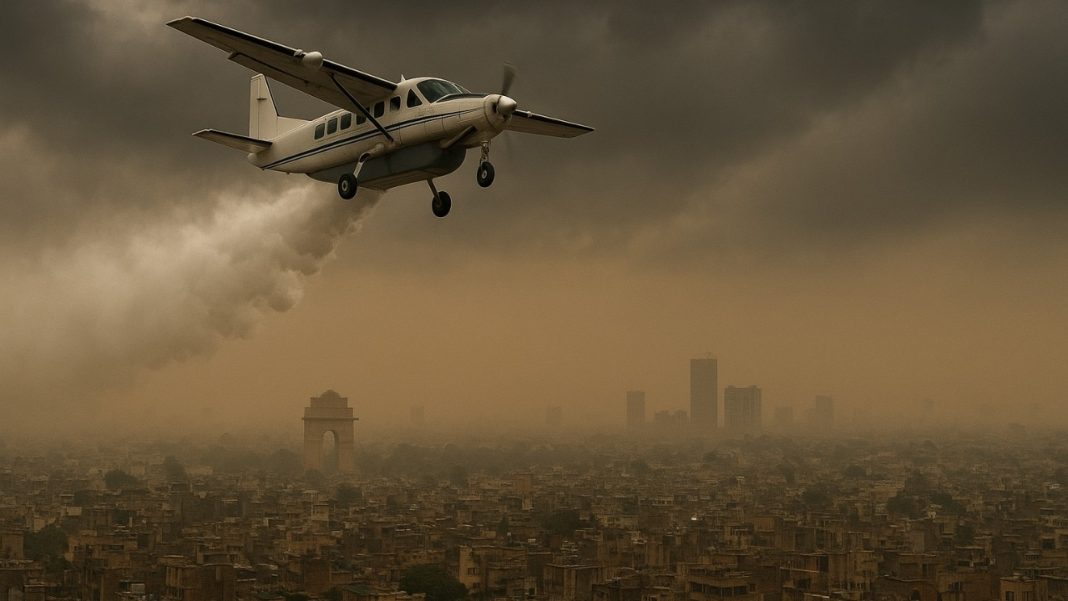
Delhi has initiated cloud seeding operations to combat its severe air pollution crisis, with IIT scientists leading the effort to induce artificial rain and clear toxic smog.

Key Takeaways

  • Delhi conducted cloud seeding to tackle hazardous air quality
  • IIT scientists developed specialized technology for Indian conditions
  • Early reports show light showers can significantly reduce pollution
  • Technique requires existing moisture-laden clouds to work

What is Cloud Seeding and How Does It Work?

Cloud seeding is a weather modification technique that stimulates rainfall by dispersing substances like silver iodide or sodium chloride into moisture-filled clouds. These particles act as nuclei around which water droplets condense, forming larger droplets that eventually fall as rain.

The process requires existing clouds with sufficient moisture – it cannot create clouds from nothing. The seeding compounds mimic ice crystals, accelerating droplet formation even in suboptimal conditions.

IIT’s Pioneering Role in Indian Cloud Seeding

Scientists from IIT Kanpur and other IITs have customized cloud seeding technology for India’s variable monsoon and post-monsoon weather patterns. Their research has focused on developing optimal formulations for Indian atmospheric conditions.

The IIT team engineered specialized aircraft payloads that atomize seeding compounds with high precision. These operations coordinate with real-time weather data, targeting clouds most likely to yield results. Sophisticated modeling helps forecast impact and maximize pollution dispersal.

Delhi’s Air Quality Crisis and Emergency Response

Delhi faces one of the world’s worst air quality situations every winter, driven by vehicular emissions, crop burning, and stagnant weather patterns that trap pollutants. Tuesday’s cloud seeding operation was specifically launched to combat hazardous smog levels.

While full impact assessment is ongoing, early indications suggest that even brief, light showers can substantially reduce fine particulate concentrations, improving visibility and providing short-term relief for residents.

Future of Pollution Control in Delhi

Cloud seeding serves as an emergency measure rather than a permanent solution for Delhi’s chronic pollution. However, with IIT’s ongoing research, the technology is becoming more precise and adaptable, promising greater reliability in future applications during critical air quality periods.


Latest

China tests World’s first airborne megawatt wind turbine, powers grid from 2,000 metres

Environment News: China has reportedly achieved a world first by successfully testing a megawatt‑class airborne wind power system that can generate electricit

Climate change adds to woes of ‘tiger widows’ of Sunderbans

Environment News: GOSABA (SUNDARBANS): Even in knee-deep murky waters, Rina Sarkar is nimble on her feet as she navigates the slippery mudbanks of Chargheri vil

Mumbai records Feb’s fifth worst AQI at 130; ‘moderate’ as per CPCB’s SAMEER app

Environment News: MUMBAI: Mumbai on Friday recorded its fifth highest Air Quality Index (AQI) of February at 130, categorised as 'moderate' by the Central Pollu

Weather Bee: Is winter over?

The average maximum in the past week was like the average maximum usual for the week ending February 26 or later.

Himalayan Tsunami Threat: IIT Study Puts 9.3 Million at Flood Risk

New IIT Roorkee research reveals rapidly expanding glacial lakes, increasing the risk of catastrophic floods for millions in the Himalayan region.

Topics

Taliban attacks Pak’s Nur Khan base in latest escalation of cross border conflict

Taliban forces reportedly launched armed drone strikes targeting Pakistan’s Command and Control Centre at Nur Khan Air Base in Rawalpindi. Taliban forces carr

Satellite images show damage across Iranian military sites after US-Israel strikes

Fresh satellite imagery shows visible damage to air, drone and naval facilities near Iran’s Konarak region amid escalating regional tensions. The visuals offe

Sensex down 1,000 points: Why is the stock market falling today?

The S&P BSE Sensex fell sharply in early trade, and the NSE Nifty50 also slipped more than 1%, as investors reacted to the fast-changing situation between the U

Qatar, UAE, Syria, Oman: Full list of places that saw attacks amid US-Iran conflict

The Middle East is engulfed in conflict as Iran retaliates against US-Israeli strikes, launching missile and drone attacks across multiple countries. 

AIIMS-trained neurologist warns against repeatedly using reheated cooking oils: ‘Risk of cancer increases manifold…’

Reusing cooking oil is a common practice in many households, but does the money it saves outweigh the health risks? Dr Sehrawat explains the health risks.

Quote of the day by Jon Bon Jovi: ‘You better stand tall when they’re calling you out, don’t bend, don’t break…’

On his birthday, we look back at one of Jon Bon Jovi's most influential quotes, which highlights the importance of standing tall in the face of criticism.

Satellite images show black smoke over Dubai as Iran continues to fire missiles, drones

Iran-US war: Dubai's skyline has dramatically changed after Iranian attacks, with smoke visible in satellite images.

Sam Altman reveals real reason why OpenAI rushed to partner with US Military after Trump banned Anthropic

OpenAI executives have given more information regarding the AI startup’s contract with the US Department of Defense after facing backlash online. The Sam Altm
spot_img

Related Articles

Popular Categories

spot_imgspot_img