The short answer to the question is that winter is almost over. However, the short answer needs a lengthy explanation as of now. Part of this is because nights are still cool enough. Another reason is that temperature trends are hardly uniform across a country as large as India. This means that while some places may still be feeling somewhat cool, others are already far ahead of usual winter temperatures.
How does one check whether winter is over or how far ahead temperatures are currently of the usual winter temperatures? By comparing it with usual winter temperatures, which the India Meteorological Department (IMD), considers as the December-February period. The IMD considers this period winter because the normal temperatures for these months – the average temperature in the 1981-2010 period – are the lowest in the year.
All Access.
One Subscription.
Get 360° coverage—from daily headlines
to 100 year archives.
Full Access to
HT App & Website
Already subscribed? Login
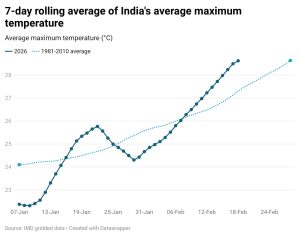
To check if winter was over, HT calculated rolling seven-day averages (this papers over small daily fluctuations) of maximum and minimum temperatures this year and compared these with the rolling seven-day averages of their respective normal. This shows that India’s average maximum temperature for the week ending February 18 – 28.62°C – is just below the average for the week ending February 28 on the normal chart. In other words, the week ending February 18 was about as warm as the last week of February considering day time temperatures, suggesting that winter is almost over.
To be sure, minimum temperatures – indicative of night temperatures – are not as warm. The average minimum for the week ending February 18 – 13.62°C – was only ahead of the average for the week ending February 20; just two days ahead of schedule. Clearly, there’s still some coolness left in this winter season.
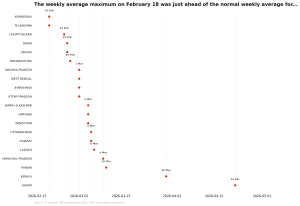
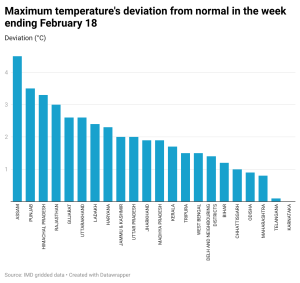
The India averages, however, hide some important regional trends. For example, the maximum in north-eastern states like Assam, Arunachal Pradesh, Manipur, Mizoram, and Nagaland is over two months ahead of schedule. Similarly, northern and western states like Gujarat, Rajasthan, Punjab, Himachal Pradesh, Uttarakhand, and Ladakh experienced maximum temperatures in the past week that is usual for the first week of March, two weeks ahead. In 22 of 30 states/UTs for which this calculation is possible, the average maximum in the past week was like the average maximum usual for the week ending February 26 or later, which is seven days ahead.
To be sure, the degree to which people find the current temperatures unusual does not just depend on how far ahead of schedule current temperatures are. This is because some places, particularly coastal regions, do not see a large variation in temperature through the year even usually. This means that even a little additional warmth can bring the temperature close to what is usual for the period several weeks ahead. For example, Kerala’s average in the week ending February 18 was like the average for the week ending March 30. However, the average for the week deviated from the normal of the week by only 1.7°C. In comparison, Punjab’s average for the week required a deviation of 3.5°C for it to feel like the week ending March 10.
The unusual warmth seen during the day, particularly in the northern half of India, isn’t present at night, however. As expected from the national average, a relatively smaller number of states/UTs – 13 – are a week ahead of schedule by average minimum temperature in the week ended February 18. Moreover, no state is a month ahead of schedule, coastal or not. As expected from this, upward deviations in minimum temperatures are also smaller than seen in maximum temperatures.
Clearly, winter is over across a large part of India in the day, but nights might still feel cool enough for the end of winter. With maximum temperatures forecast to be generally above normal for the rest of February in the northern half of India, this trend is also expected to continue in the remaining days of winter.