
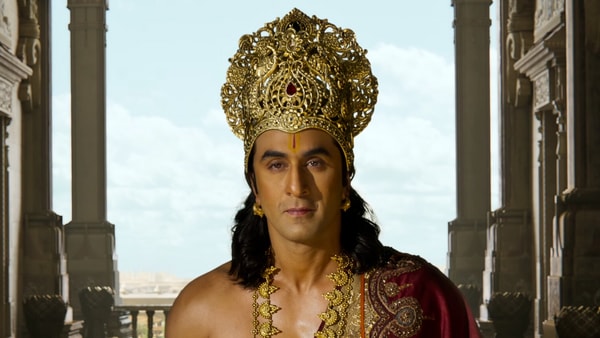
When a film gets labelled India’s answer to Avatar, the natural follow-up question is: who’s paying for it, and what exactly are they buying? The two-part Ramayana saga carries a reported total spend somewhere between ₹1,600 crore in pure production costs and ₹4,000 crore once you fold in marketing, distribution, and the global rollout — a number so large it has already triggered a wave of scepticism online.
The internet is convinced it’s a marketing gimmick. Others suspect inflated accounting. But when you break the production down piece by piece, the money — while eye-watering — starts to make a certain kind of sense.
The Part Split
First, some clarity. The production budget across both films is reported at roughly ₹1,600 crore, excluding print and publicity. Part 1, due Diwali 2026, accounts for the heavier share at around ₹900 crore, while Part 2 comes in lighter at approximately ₹700 crore. The logic is straightforward: the expensive groundwork — sets, costumes, digital assets, world-building — is largely done in Part 1.
Part 2 inherits most of that infrastructure and simply extends it. The ₹4,000 crore figure circulating in headlines almost certainly incorporates global marketing, IMAX distribution deals, and promotional campaigns across two separate release cycles — which, for a film targeting Hindi, South Indian, and international audiences simultaneously, adds up faster than anyone would expect.
The VFX Bill
The single largest line item is almost certainly visual effects. DNEG — the British-Indian studio behind the work on Interstellar, the Dune films, and Blade Runner 2049 — is handling everything, and they are not a vendor you bring on cheaply. Their involvement across two films, over what is reportedly a 600-day post-production pipeline for Part 1 alone, represents a financial commitment Indian cinema has never made before.
The key cost driver here is Virtual Production — the same pipeline used on The Mandalorian and Avatar: The Way of Water — which means constructing fully realised digital environments that actors perform within, rather than shooting on location and layering effects afterwards. Ayodhya, Lanka, the forests of exile, Ravana’s ten-headed form, the entire Vanar Sena — almost none of it exists in the physical world. Every frame must be conceived, built, lit, and rendered from scratch by an army of digital artists working across time zones. That is where crores disappear quietly and in bulk.
It’s also worth acknowledging that early public reaction to the teaser has been genuinely divided. A vocal section of viewers has drawn comparisons to generic Western fantasy — Game of Thrones giants, Lord of the Rings landscapes — questioning whether the visual ambition on screen matches the budget being cited. It’s a fair concern, though an incomplete one. A two-minute teaser is rarely where a VFX-heavy production shows its best work. The real reckoning comes when the full film unspools at Diwali.
The Music
If VFX is where the money disappears most visibly, music is where it disappears most symbolically. Hans Zimmer and AR Rahman are co-composing the score — and this is not a standard arrangement by any measure. Zimmer’s credits span Gladiator, The Dark Knight, Inception, and both Dune instalments. He operates at Hollywood pricing, not Bollywood pricing. Bringing him onto an Indian production, across two films, over a multi-year scoring process, is a budget decision that signals something deliberate: this film is being costed and positioned as a global cultural event, not a domestic release.
Rahman — himself a two-time Academy Award winner — is no less significant a hire. Together, they represent arguably the most expensive musical pairing in Indian cinema’s history. Neither composer has described the collaboration as straightforward; both have spoken openly about the pressure of scoring something so deeply twitter-tweetded in a billion people’s cultural memory. That weight, and the time it demands, carries a price.
The Cast
Star salaries are rarely confirmed publicly, but the ensemble assembled here is not modest. Ranbir Kapoor leads as Ram, with Sai Pallavi as Sita, Yash as Ravana, Sunny Deol as Hanuman, and Ravi Dubey as Lakshman forming the core. Beyond them, the supporting cast includes Amitabh Bachchan, Lara Dutta, Vivek Oberoi, Kajal Aggarwal, Rakul Preet Singh, and — in a casting decision loaded with symbolism — Arun Govil, the actor who played Ram in the beloved 1987 television series, now cast as Dasharatha, Ram’s father.
Every name on that list commands a market rate. Multiplied across two productions, the collective payroll could fund an entire mid-budget film on its own.
The IMAX Premium
Both parts have been shot for IMAX — and that phrase means considerably more than a badge on a poster. IMAX-certified production requires specialised equipment, different aspect ratios, and a bespoke post-production workflow that costs more at every stage. The format also demands higher ticket prices at the box office, which is simultaneously the justification for the spend and the mechanism for recovering it. It is both a cost and a revenue strategy — charge a premium per seat, but earn that premium first.
The Global Marketing Machine
The teaser reveal itself was a statement of intent. Rather than a standard domestic premiere, the first proper look at Ranbir Kapoor as Ram was unveiled at private screenings held in Los Angeles and New York, timed to coincide with Hanuman Jayanti. That is not how you launch a film at the Indian multiplex crowd alone. It signals a marketing campaign structured around global press, diaspora audiences, and international cultural positioning — two full cycles of it, one per film, one per Diwali.
Print and publicity for a production of this scale routinely runs to 20–25 per cent of the production budget. On top of ₹1,600 crore in production costs, that alone could plausibly push the total figure towards the ₹4,000 crore being cited.
The money is almost beside the point now. Ramayana is not competing against other films — it is competing against memory itself. Against the version that lives in every household, every childhood, every festival season. No budget, however staggering, can manufacture that kind of emotional ownership. What it can do is signal seriousness — a declaration that this story deserves the full weight of modern cinema behind it. Whether that seriousness translates into something genuinely felt, rather than merely seen, is the only question that will matter when the lights go down in November.


