
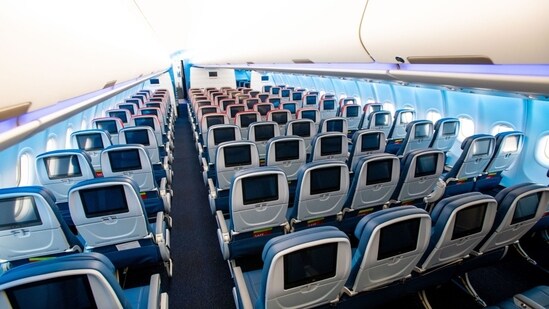
The economy cabin is losing the turf war on airplanes.
Airlines are retrofitting their passenger jets or buying new ones that have a larger share of premium seats. Their goal is to squeeze more revenue out of each seat flown, catering to travelers willing to pay up for lie-flat and extra legroom seats.
Carriers with first-class sections like Delta Air Lines and United Airlines have increased premium seating on flights over the past decade. Now, low-frills flying pioneer Southwest Airlines, and low-cost carriers like Spirit and Frontier are adding seats that give passengers perks like a few extra inches of leg space.
Since January 2020, the number of scheduled business and first-class seats on domestic flights has grown 27%, according to research from aviation data firm Visual Approach Analytics. That is nearly three times higher than scheduled economy seats, which rose just 10% over the same span.
Premium sections help airlines in a few ways. Premium economy seats can be priced at least twice as high as regular economy seats and only take up slightly more room on the plane, according to a report from Global Tourism Forum. For bigger airlines, selling more premium seats helps subsidize spots in their economy cabins at prices competitive with low-cost carriers.
Delta got more revenue in the fourth quarter from premium ticket sales, which were up 9%, than from the main cabin, where sales fell 7%. Premium revenue outgrew basic economy sales at United in 2025. Both carriers soared past their peers in profitability last year.
‘Financially great’ planes
Courting customers with cash to pay for perks has been a critical part of Delta’s business model. Executives have said that households making more than $100,000 annually accounted for 75% of all airline leisure spending as of 2024.
Earlier this year, Delta pledged to add more seats in first class and Delta One Suites, its business-class cabin on international flights with lie-flat seats. Effectively none of the company’s seat growth this year will be in the main cabin, Chief Executive Ed Bastian said.
The company has ordered at least 30 Boeing 787-10 Dreamliner jets with larger premium cabins than its previous generation of aircraft used for long-haul and international flights. The Dreamliners will help Delta phase out older Boeing 767-400s, which already have premium seats taking up more than a third of their cabins.
“The 787 is a financially great plane,” Delta Chief Commercial Officer Joe Esposito told analysts on a call earlier this year. “It’s a very powerful change and a step function improvement in [profit] margin.” In addition, newer planes are typically more fuel efficient, which helps boost the economics of operating flights.
The airline is also taking deliveries of Airbus jets such as the A330-900neo and Airbus A350-900, which have an average of 40% premium seating. They are part of a wider replacement of Delta’s Boeing 767-300ER jets that have 30% to 32% of their cabins taken up by premium seats.
United is about to roll out a version of its Boeing 787-9 Dreamliner with an “elevated interior.” Only about 40% of its seats are in the standard economy section, down from 58% on the current version of the plane. The plane has business-class, premium=economy and economy-plus sections.
American Airlines has flown more premium seats than its U.S. peers since 2020, according to data from aviation-analytics company Cirium. The carrier introduced premium economy seats on domestic flights in late 2016, and has invested in new premium-heavy jets and redesigned older planes. It has boosted the number of premium seats it offers more than 34% in the past 10 years.
“When I started in the business 28 years ago, it was only about getting from point A to point B,” said Nat Pieper, American’s chief commercial officer. “The game’s gotten considerably more complex.”
Tiered system
The retooled seat layouts are compressing the standard economy section and giving airlines a tiered system for collecting revenue that can adapt to different consumer behaviors, analysts said. Basic economy passengers can upgrade when spending is strong, while business-class travelers can trade down to premium economy when purse strings tighten.
“The view that an airline seat is an airline seat is an airline seat, we’re moving away from that,” Raymond James analyst Savanthi Syth said. “It’s not a commodity.”
Customers have noticed the shift in how airlines are selling their new seat arrangements. Luke Vanderberg will usually pay for extra legroom since, at 6 feet 3 inches tall, he has a hard time fitting into airlines’ standard economy seats. For a day flight to Europe, he will opt for a premium economy seat—or what he likes to call “the previous business class.”
The sales engineer from New Jersey usually won’t consider upgrading any further unless it is a lengthy flight where he will want to sleep. Then he gauges whether the money required to buy a nicer seat could be better spent.
“You’re like, ‘Wow, with the difference in tickets I could buy an entirely new laptop,’ ” he said. “Could I put up with 10 hours of pain and get a laptop?”
Write to Dean Seal at dean.seal@wsj.com


