
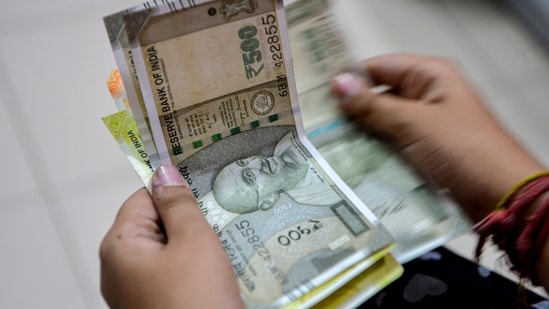
The rupee weakened past the 95/dollar mark for the first time and the ten-year bond yield rose to the highest since July 2024, despite the central bank’s most aggressive defence of the currency in more than a decade.
That, in effect, brings into question the Reserve Bank of India’s “lower-for-longer” interest rate narrative just as the new fiscal is about to begin. With brent crude oil prices showing no signs of cooling, ₹100/Dollar is no longer a distant risk but a looming reality.
The rupee opened at 93.62, a gain of 128 paise, after the RBI issued a late-Friday circular slashing the net open position (NOP) banks can hold overnight to just $100 million. The move was designed to choke off speculative bets against the local currency.
The relief lasted only hours. The rupee surrendered all gains to hit an all-time intra-day low of 95.22 before settling at 94.78.
“The move in the spot market shows that the RBI’s step on the net open position has not worked,” said Ashhish Vaidya, head of treasury at DBS Bank Ltd. in Mumbai. “Market liquidity has taken a hit, and essentially the risk appetite of market-makers is now considerably lower.”
Rates and Bonds in Turmoil
The carnage in the currency market spilled over into fixed income. The 10-year benchmark bond yield surged 9 basis points to 7.0345%, its highest level since May 2024. For the month of March, the yield has jumped 37 basis points, the sharpest monthly spike since February 2017.
The derivatives market is signaling even deeper distress. Overnight Index Swaps (OIS)—a key gauge of interest rate expectations—saw record moves:
One-year OIS: Ended at 6.24%, up 76 bps in March.
Two-year OIS: Closed at 6.48%, marking its largest-ever monthly move.
“Swaps are already pricing in 50-100 basis points of rate hikes in the next one year,” said Alok Sharma, head of treasury at ICBC in Mumbai. He noted that the RBI’s October policy assumption of $70-per-barrel oil is now obsolete, requiring a “significant revision” in the central bank’s tone.
The Macro Squeeze
For India, the world’s third-largest crude importer, the combination of a surging dollar and triple-digit oil prices is a potent threat to the current account deficit. The rupee has depreciated nearly 10% in the current fiscal year, making it the worst performer among emerging market peers.
“At the core of this weakness is the global backdrop,” said Amit Pabari, managing director at CR Forex Advisors. “When uncertainty rises, markets naturally shift towards safer assets, strengthening the dollar and weakening emerging market currencies like the rupee.”
Equity markets mirrored the gloom. The S&P BSE Sensex dived 1,635.67 points on Monday, while the NSE Nifty 50 slumped 2.1%. Foreign institutional investors remain in retreat, having offloaded a net ₹4,367.30 crore ($460 million) in equities on Friday alone.
Government Defends Fundamentals
Despite the market’s verdict, New Delhi is projecting a front of stability. Finance Minister Nirmala Sitharaman said Monday that the country’s economic fundamentals remain strong and the rupee is “absolutely going fine” relative to other emerging markets.
In a written response to lawmakers, Minister of State for Finance Pankaj Chaudhary reiterated that the rupee is market-determined and that foreign exchange reserves remain “comfortable,” sufficient to cover 11.2 months of imports.
However, economists warn that if the Middle East conflict intensifies, the cost of defending the currency may become prohibitively high.
“If the conflict escalates further, 100 per dollar is a scenario that markets will begin to worry about and even price in,” said Krishna Bhimavarapu, APAC economist at State Street Investment Management.


