
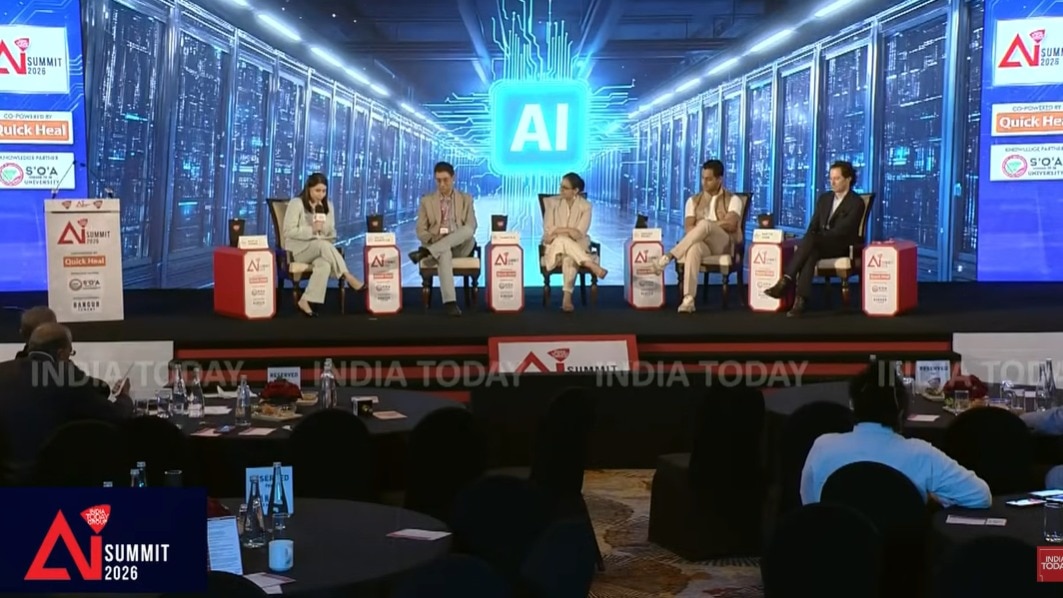
Artificial intelligence (AI) may feel like a simple app on a phone screen, but behind every smart chatbot or voice assistant lies a massive and complex infrastructure. At the India Today AI Summit 2026, technology leaders gathered to discuss what really powers AI, i.e., from advanced chips and data centres to voice tools, open-source software and climate-friendly infrastructure.
The panel featured Prith Banerjee, Senior Vice President of Innovation at Synopsys; Samhita R, CEO of Resilience AI; Keshav Reddy, Founder of Equal AI; and Martin Tisne, CEO of AI Collaborative. Together, they explored how India is preparing its AI backbone for the future.
AI CHIPS ARE GETTING TOO COMPLEX FOR HUMANS ALONE
Banerjee explained that modern AI depends heavily on advanced computer chips and the tools used to design them.
He said that AI chips are becoming so complex that human engineers alone can no longer keep pace. A chip that once took two years to design is now expected in one year, with billions more transistors packed inside. To handle this scale, companies are using AI-powered “agentic engineers,” i.e., software agents that help automate chip design and optimise systems such as power and cooling in data centres.
Banerjee also spoke about the future of “physical AI”, where machines understand real-world physics. Instead of only processing words or images, future AI systems could model how objects behave in the real world, helping design aircraft, buildings and even spacecraft with far greater accuracy.
INDIA’S AI BOOM IS OUTPACING INFRASTRUCTURE
For consumer-facing AI, infrastructure gaps remain a challenge. Keshav highlighted the explosive demand for AI tools in India, especially voice-based assistants that can handle everyday tasks.
He said many Indians still do not interact with AI regularly because most tools depend on typing and reading. Voice-based, multilingual systems are more natural and accessible, particularly in rural areas. However, delivering real-time AI services at scale requires strong computing infrastructure, including specialised processors and fast streaming systems — areas where India is still catching up.
Reddy believes the next wave of AI adoption in India will be driven by simple, speech-first tools that work seamlessly across languages.
DATA AND OPEN SOURCE ARE PART OF THE BACKBONE
Tisne urged the audience to think beyond physical infrastructure. In his view, data systems and open-source software are just as important as servers and buildings.
He said that open-source tools give people more control over how AI affects their lives. They are cheaper, more adaptable and free from many of the environmental costs linked to giant data centres. At the same time, he said the world has invested heavily in computing power but far less in improving how data is governed and protected.
India’s linguistic diversity, he added, is a major strength. Supporting many languages in AI systems can preserve culture while making technology accessible to more people. He also stressed that sensitive areas like healthcare require strong privacy safeguards so people feel safe sharing personal information.
BUILDING GREENER AND MORE RESILIENT DATA CENTRES
Samhita R focused on the environmental side of AI infrastructure. She explained that modern data centres are being built with climate resilience in mind. Site selection now considers water systems, vegetation and existing urban features to reduce environmental stress.
New facilities are also more energy efficient than those built just a few years ago. Improved architecture and sustainable materials help cut carbon emissions, even though data centres remain energy intensive.
She emphasised that human oversight must remain central, especially in high-risk areas like disaster management. Her company uses hyperlocal AI models to assess risks such as floods within minutes, but always keeps people in the decision-making loop to avoid costly errors.
AN AI FUTURE BUILT ON THREE PILLARS
Banerjee summed up the future as a blend of AI-powered software, advanced silicon chips and intelligent systems working together.
The panel agreed that India is on the brink of a major AI expansion. If infrastructure, open technology and user-friendly applications grow together, AI could become part of everyday life for hundreds of millions. The challenge now is to build systems that are powerful, accessible and responsible at the same time.


