
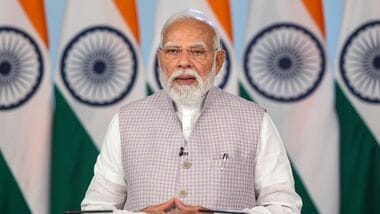
NEW DELHI: Sectors such as healthcare, education, and tourism are crucial for the foundations of a developed India, and reforms in these areas are essential for a holistic economic growth, Prime Minister Narendra Modi said on Monday.
Speaking at a webinar on the implementation of the FY27 budget announcements, Modi called for stakeholder discussions on expanding telemedicine in remote areas and enabling more youth to become caregivers in the sunrise ‘Care Economy’.
Care economy refers to the sector of the economy that provides paid and unpaid services for the care of people, such as childcare, elderly care, healthcare, and support for persons with disabilities.
A January 2026 report by Delhi-based consultancy Primus Partners said India’s care economy already employs an estimated 36 million workers. With targeted investment in skilling, certification, formalisation, and demand creation, this number can exceed 60 million jobs by 2030, creating a market value of $300 billion, the report added.
Budget support
The Union budget for FY27, presented on 1 February, proposed training programmes for 150,000 lakh caregivers to support services such as elderly care, patient assistance and allied health, aiming to generate employment while strengthening healthcare and social support systems.
Modi urged sector experts to create training models for the youth in this field. “In the coming decade, the number of senior citizens in the country will rise rapidly. Moreover, even today, many countries across the world face a huge demand for caregivers. Therefore, in the health sector, new skill-based employment opportunities are emerging for millions of youth. I urge the health sector experts present in this webinar to suggest new training models and partnerships so that the training ecosystem in the country can be further strengthened,” he said.
He also said India’s education sector reforms, particularly the New Education Policy (NEP), is aligned with current job market demands and targets new arenas such as artificial intelligence, automation, and the digital economy.
“…we must continuously modernize and upgrade our education system. The new education policy has laid the necessary foundation for this. Now, it is essential that our curriculum remains updated according to market needs. We must accelerate the process of linking our education system with the real-world economy. We need to place greater focus on subjects like AI and automation, digital economy, and design-driven manufacturing,” he said.
Modi said linking education to employment was paramount. “The country is consistently working to connect education with employment and enterprise. New models like university townships reflect this approach,” he said. He remarked that India is promoting the AVCG sector—Animation, Visual Effects, Gaming, and Comics —and moving towards an innovation-driven economy.
Tourism as job engine
He also said tourism and culture can be an enabler of job creation, and that developing new destinations beyond traditional spots boosts a city’s branding and overall development.
“Tourism and culture play a major role in creating new employment opportunities. When tourism grows in a place, the branding of that location or city also increases. This accelerates the overall development of that city,” said the prime minister.
Modi also said the government is working on creating new tourism destinations across the country. “India has no shortage of historical sites. But for a long time, tourism remained confined to a few select destinations. Now, we are focusing on developing tourist destinations across every corner of the country,” he said.
Modi also said that experts’ suggestions on trained guides, hospitality skills, digital connectivity, community participation, cleanliness, tourism and related areas would be important.
Modi’s remarks follow the FY27 budget announced by Finance Minister Nirmala Sitharaman, which earmarked ₹12.2 trillion for capital expenditure and outlined measures for sectors such as MSMEs, biopharma, semiconductors and critical minerals.
The budget also proposed the creation of five medical tourism hubs, a National Institute of Hospitality, and training for new tourist guides.
In his address a day after the International Women’ s Day, the prime minister said there needs to be further emphasis on women’s participation, especially in highly technical STEM (science, technology, engineering, mathematics) sectors. “A very important subject is STEM-science, technology, engineering, and mathematics. It is a matter of great pride that the number of daughters showing interest in STEM subjects is steadily increasing in our country. As we prepare for futuristic technologies, it is crucial that no daughter is held back due to lack of opportunities,” he said.


