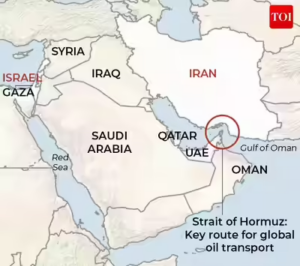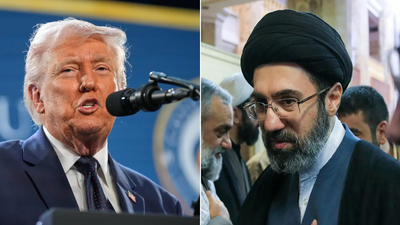
The United States is fighting Iran on the battlefield, and turning to its oil to keep the global economy afloat. As war in the Middle East chokes supplies through the Strait of Hormuz and sends prices soaring, the Donald Trump administration has begun easing restrictions on Iranian crude, allowing allies to buy the very resource that funds Tehran. For a president who came to power vowing to avoid “stupid” wars, the moment is especially fraught, a conflict he helped set in motion now risks slipping beyond his control, both on the battlefield and in its economic fallout.
The move lays bare a stark war-time paradox — in trying to weaken Iran, Washington is being forced to rely on it.
Though the move has been framed as “very temporary”, Mike Waltz, speaking at a CNN town hall, defended it as necessary to counter Iran’s strategy of driving up global energy prices.
Even the administration’s messaging has been mixed — de-escalation in rhetoric, escalation in action. Trump said he was considering “winding down” military operations in the Middle East, even as the United States deployed three more amphibious assault ships and roughly 2,500 additional Marines to the region. Moreover, it attacked Iran’s nuclear facility Natanz again, even as Tehran has clearly warned against any attacks on its energy infrastructure, else bear oil shocks.
Then what explains this sanctions shift?
World’s energy lifeline hit
Three weeks into the war with Iran, the United States is confronting a supply disruption of a scale few policymakers had anticipated. The near-total shutdown of the Strait of Hormuz has choked one of the world’s most critical oil arteries, sending shockwaves through global markets.
The crisis has been compounded by direct attacks on critical energy infrastructure across the region. Strikes on Iran’s South Pars gasfield, part of the world’s largest natural gas reserve, were followed by missile attacks on Qatar’s Ras Laffan LNG facilities, causing extensive damage to one of the world’s biggest gas export hubs. Additional targets have included refineries in Saudi Arabia, Kuwait, and the UAE, raising fears of a broader energy war. With some of these facilities expected to take three to five years to fully repair, the disruption is no longer temporary — it threatens to lock in a prolonged global supply crunch.
Brent crude, the international benchmark, has surged to around $106 per barrel, up sharply from roughly $70 before the conflict, underscoring how rapidly the crisis has escalated and how tightly global prices are tied to Middle East stability.
Inside the administration of Donald Trump, officials are scrambling for solutions that can meaningfully ease supply pressures. A newly announced pause in sanctions applies only to Iranian oil already loaded on ships and is set to expire by April 19, limiting its immediate impact.
Crucially, the move does not increase actual production, a central factor behind soaring prices, and much of Iran’s oil was already finding its way to buyers despite sanctions. That reality mirrors earlier steps, including a temporary pause on restrictions on some Russian shipments, which critics said offered only modest relief while exposing the limits of Washington’s options.
Policy levers pulled with little effect
Washington has already deployed nearly every conventional mechanism to cushion the blow. Hundreds of millions of barrels have been released from strategic reserves, sanctions on Russian oil have been partially eased, and domestic crude flows have been accelerated in an effort to boost supply.
Yet these measures have barely dented rising prices. Global benchmarks continue to surge, and US consumers are feeling the impact at the pump. Officials privately acknowledge that the tools at their disposal are either insufficient in scale or too slow to counter the immediacy of the crisis, exposing the limits of state intervention in a tightly wound global oil market.
The strain is also evident in Washington’s shifting diplomatic posture. After initially insisting the US did not need Nato’s help to secure the Strait of Hormuz, Donald Trump publicly urged allies to “step up” and help reopen the vital route. The appeal has met a muted response, with many countries reluctant to be drawn into a conflict they did not start, further complicating efforts to stabilize the situation and underlining the limits of US leverage even among its partners.
Trump has criticized Nato countries as “cowards” for refusing to assist while insisting the campaign is unfolding according to plan, even declaring the battle “militarily won.” Yet those claims sit uneasily against the reality of a defiant Iran continuing to choke off Gulf energy flows and launch missile strikes across the region, underscoring the widening gap between rhetoric and conditions on the ground.
Finally, turning to enemy’s oil
With options dwindling, the administration has turned to a controversial stopgap: allowing allies to purchase Iranian oil already at sea. The move is designed to inject roughly 140 million barrels into a market starved of supply, offering short-term relief even as the broader conflict rages on.
Officials argue that this oil would have likely been sold regardless, particularly to countries willing to bypass sanctions. Redirecting those flows to US allies, they contend, helps stabilize markets without fundamentally altering the pressure campaign against Tehran. Still, the decision lays bare an uncomfortable truth, that immediate economic needs are forcing Washington into choices that cut against its own strategic posture.
But is it enough to solve the energy crisis?
Even with Iranian barrels entering the market, the relief is expected to be fleeting. The additional supply amounts to barely a day and a half of global consumption, underscoring how limited the impact will be if disruptions persist. Energy experts warn that without a reopening of key shipping routes, the imbalance between supply and demand will continue to widen.
That leaves the administration facing a stark choice: find a way to restore passage through the Strait of Hormuz or brace for prolonged economic fallout. For now, officials appear to be managing rather than resolving the crisis, navigating a war where the battlefield extends far beyond missiles and troops, deep into the fragile mechanics of the global economy.
Will the war end?
Beyond the immediate energy crisis, the conflict is pushing Donald Trump toward a deeper strategic crossroads. Analysts say the administration now faces a narrowing set of choices under what it has called Operation Epic Fury, with no clear indication of which path it is prepared to take, Reuters reported.
One option is escalation — intensifying the offensive, potentially targeting critical infrastructure such as Iran’s oil hub at Kharg Island or expanding the US military footprint along Iran’s coast to neutralize missile threats. But such a move risks drawing Washington into a prolonged conflict, one that could face significant resistance from an American public wary of another long war in the Middle East.
The alternative is to claim victory and scale back operations. Yet that, too, carries risks. It could leave Gulf allies exposed to a weakened but still defiant Iran, capable of disrupting shipping lanes and projecting power across the region. With diplomacy stalled and neither side showing signs of backing down, the administration is left navigating a conflict where every option deepens the very uncertainty it is trying to contain.
Ready to Make a Smarter Property Decision? Build Your Legacy with TOI Homes.