
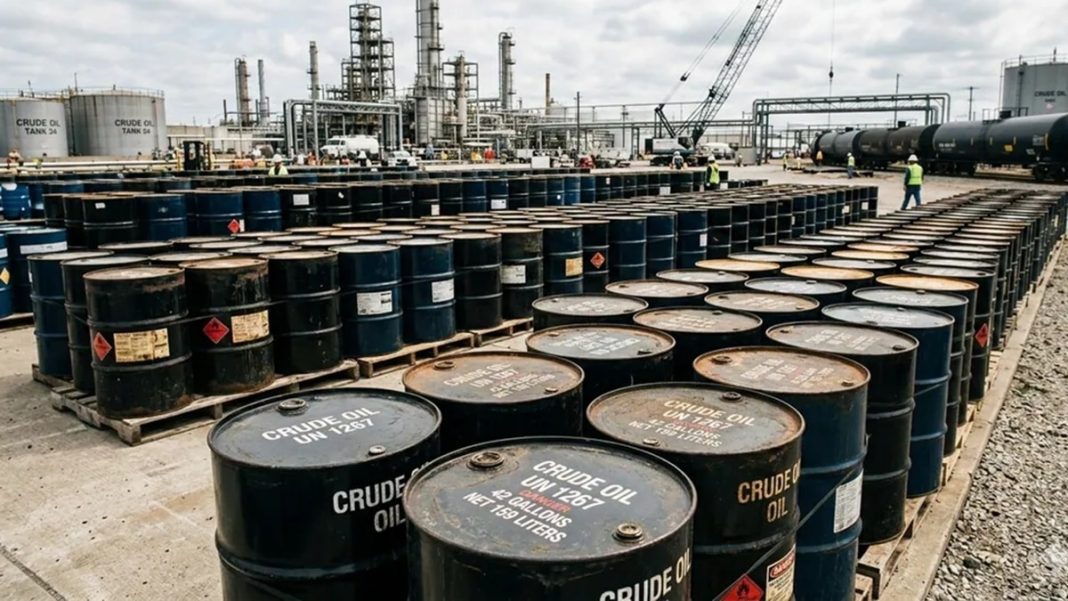
Global crude oil prices have surged sharply over the past few weeks as the conflict involving Iran, Israel and the United States spread into the Gulf region, rattling energy markets and raising fears of a global supply shock.
Crude oil, which was trading close to $70 per barrel in early February, has now climbed to around $105–$110, marking one of the fastest rallies in recent years.
The sudden jump has unsettled stock markets, pushed up inflation concerns and forced governments around the world to consider emergency measures to stabilise oil supplies.
Here is how crude prices climbed over the past few weeks.
GLOBAL OIL SHOCK
The current spike in oil prices is closely tied to the escalating conflict involving Iran, Israel and the United States, which has now spread across the Gulf region.
The confrontation intensified after military strikes and retaliatory attacks widened tensions in West Asia, raising fears that energy infrastructure and shipping routes could be targeted.
As the conflict deepened, global markets began pricing in the risk of a supply disruption from the Gulf, one of the world’s most important oil-producing regions.
A key concern for energy markets is the Strait of Hormuz, a narrow waterway between Iran and Oman.
Despite its narrow width, the strait carries around one-fifth of the world’s oil supply, making it one of the most critical energy transit routes globally.
Millions of barrels of crude from countries such as Saudi Arabia, Iraq, Kuwait and the United Arab Emirates pass through this corridor every day.
Even the possibility of disruption in this route can send oil prices soaring because the global economy relies heavily on these shipments.
GLOBAL PANIC OVER RISING OIL PRICES
Oil markets were relatively calm at the start of February.
Brent crude was trading around $70 per barrel, as supply and demand remained balanced and geopolitical risks were limited.
However, as tensions escalated in West Asia through late February and early March, traders began pricing in the risk of supply disruptions.
Prices gradually climbed through the $80 and $90 levels, before crossing $100 per barrel as the conflict deepened.
The rally accelerated as the Gulf conflict entered its second week, severely disrupting oil flows through the Strait of Hormuz, one of the world’s most critical energy chokepoints.
Tanker traffic through the narrow waterway collapsed as shipping companies suspended voyages due to security risks. The disruption effectively choked a key route that normally carries around 20% of the world’s oil supply from major producers such as Saudi Arabia, Iraq, Kuwait and the UAE.
The situation worsened after attacks on energy infrastructure and tanker routes across the Gulf, forcing several producers to cut output and exports as vessels struggled to load crude.
With global supply suddenly tightening, crude prices surged sharply and crossed $110 per barrel, marking one of the biggest oil price spikes since the pandemic-era volatility in energy markets.
FOCUS ON EMERGENCY OIL RESERVES
The rapid surge in oil prices has triggered alarm among major economies.
Governments are now exploring the possibility of releasing oil from strategic petroleum reserves, emergency stockpiles created to stabilise supply during major disruptions.
Countries such as the United States, Japan and other G7 members are discussing whether coordinated releases from these reserves may be needed if the conflict worsens.
Such moves are rare and are usually considered only during major global energy shocks.
The last major coordinated release happened during the 2022 energy crisis following the Russia-Ukraine war.
WHY THE WORLD IS WORRIED
Oil sits at the centre of the global economy. It fuels transport, powers industries and is used to manufacture a wide range of products including plastics, chemicals and fertilisers.
When crude prices rise sharply, the effects ripple across the economy. Fuel becomes more expensive, transportation costs rise and inflationary pressures build across countries.
This is why sudden oil price spikes often trigger volatility in financial markets and concerns about global economic growth.
It is worth mentioning that India is particularly sensitive to oil price movements. The country imports nearly 85% of its crude oil requirements, making it highly dependent on global energy markets.
Higher oil prices increase the country’s import bill and can put pressure on the rupee. They can also raise inflation because fuel costs affect transportation, logistics and manufacturing expenses across the economy.
WHAT NEXT?
Energy markets are now closely watching developments in the Gulf region. If tensions escalate further or shipping routes are disrupted, crude prices could rise even higher.
However, if diplomatic efforts reduce tensions or governments release emergency oil reserves, prices may stabilise. For now, the surge in crude prices highlights how quickly geopolitical tensions in the Gulf can disrupt global energy markets and ripple across economies worldwide.


