
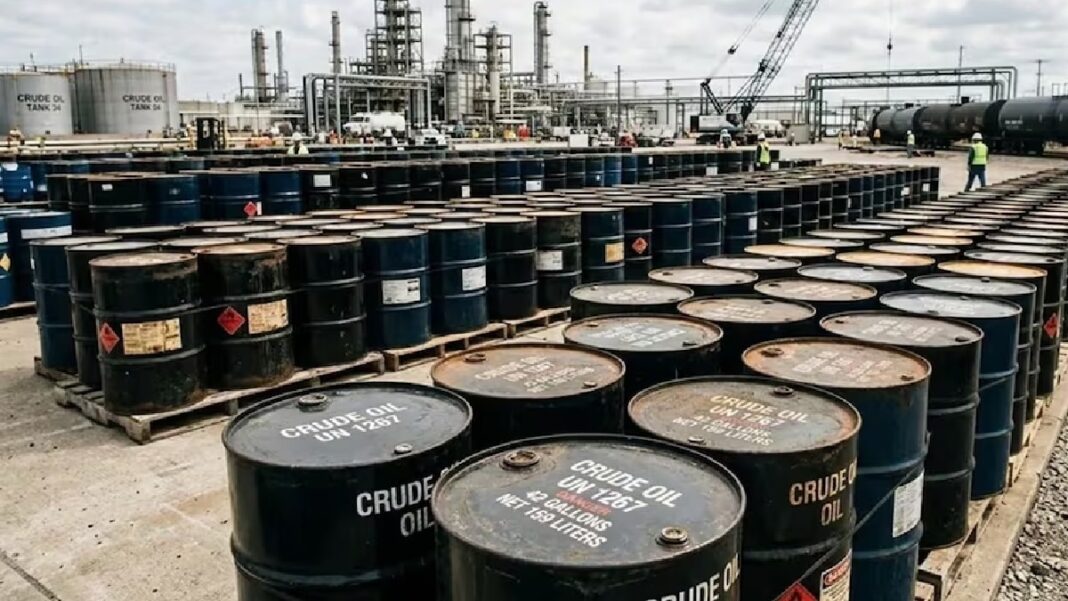
The International Energy Agency (IEA) has agreed to make 400 million barrels of oil from their emergency reserves available to the market amid the ongoing Middle East crisis. All 32 member countries of the agency unanimously agreed to the same.
The IEA, in a statement, said, “Release of strategic oil reserves would take place over a timeframe that is appropriate to the national circumstances of each member country.”
The release of oil would more than double the agency’s biggest prior release, when IEA member countries in 2022 put 182 million barrels on the market after Russia launched its full-scale invasion of Ukraine, officials said.
This comes hours after the agency recommended a coordinated release of oil from global strategic reserves as tensions linked to the Iran war raise fears of supply disruptions.
“The oil market challenges we are facing are unprecedented in scale, therefore I am very glad that IEA Member countries have responded with an emergency collective action of unprecedented size,” said IEA Executive Director Fatih Birol.
MOVE AIMED AT CALMING OIL MARKETS
The move comes as the escalating conflict involving Iran has heightened concerns about the security of oil flows from the Middle East, a region that accounts for a significant share of the world’s crude exports.
Energy markets have remained on edge amid fears that the conflict could disrupt shipping routes or production in key oil-producing countries.
Particular attention has focused on the Strait of Hormuz, one of the world’s most critical oil transit chokepoints, through which roughly 20 percent of global petroleum supply passes each day. Any disruption to tanker traffic through the narrow waterway could trigger sharp volatility in global energy markets.
A coordinated release of emergency stockpiles by IEA member countries would be intended to inject additional supply into the market and ease price volatility if geopolitical tensions begin to impact physical oil flows.
STRATEGIC RESERVES USED DURING GLOBAL CRISES
The Paris-based IEA coordinates emergency oil stock releases among its member nations during supply crises. Member countries are required to maintain emergency oil reserves equivalent to at least 90 days of net oil imports to safeguard against sudden disruptions in global supply.
In the past, the agency has organised coordinated releases during major geopolitical shocks.
In 2011, the IEA authorised the release of about 60 million barrels of oil during supply disruptions caused by the Libyan civil war.
More recently, in 2022, IEA member countries agreed to release over 240 million barrels of oil following Russia’s invasion of Ukraine in an effort to stabilise global energy markets.
Such emergency stock releases are designed to prevent supply shortages, reduce extreme price volatility and ensure that consuming countries have access to adequate energy supplies during periods of geopolitical turmoil.
IMPACT ON GLOBAL ENERGY MARKETS
Oil prices have remained volatile in recent weeks as traders assess the potential impact of the Iran conflict on global supply chains, shipping routes and production across the Middle East.
Any prolonged disruption to oil flows from the region could have far-reaching implications for global energy markets, potentially driving up fuel costs, adding to inflationary pressures and complicating economic policy decisions for governments and central banks.
Energy analysts say the IEA’s internal discussions suggest governments are preparing contingency measures to cushion global markets from a potential supply shock.
WHAT IT MEANS FOR INDIA
Developments in global oil markets are closely watched in India, the world’s third-largest oil importer, which relies heavily on crude imports to meet domestic energy demand.
Higher crude prices could widen India’s import bill and put pressure on inflation as well as the rupee.
India also maintains its own strategic petroleum reserves, with underground storage facilities located at Visakhapatnam, Mangaluru and Padur, which are intended to provide a buffer during global supply disruptions.


