
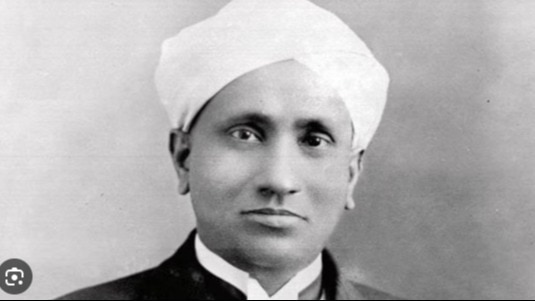
“The essence of science is independent thinking, hard work and not equipment.”
This profound line isn’t just a statement by Dr C V Raman, but a guiding philosophy echoed in laboratories and lecture halls across the world.
It captures the belief that science is powered first and foremost by the mind — by questions, observation and perseverance rather than by expensive machines.
For many young researchers and students, these words serve as a reminder that curiosity, patience and critical thinking are the true drivers of discovery.
Even when technology was far less advanced, breakthroughs were often made by those who asked the right questions and worked tirelessly to find answers.
WHO WAS DR C V RAMAN?
Sir Chandrasekhara Venkata Raman was born on November 7, 1888 in Tiruchirappalli in southern India and died on 21 November 1970 in Bangalore at the age of 82.
He was a pioneering physicist whose studies of light scattering led to the discovery of what is now known as the Raman effect, a phenomenon in which light changes its wavelength when passing through a material.
For this work, he was awarded the 1930 Nobel Prize in Physics, becoming the first Indian to win a Nobel in science.
Dr Raman was a deeply curious and independent thinker. Though trained in physics, he started his career in the Indian civil service, but continued scientific research in his spare time.
His passion for understanding nature led him to explore optics, acoustics and the physics of musical instruments. He believed in clear questions and meticulous observation, not just gathering facts.
Dr Raman also set up the Indian Journal of Physics and later founded the Indian Academy of Sciences, shaping India’s scientific culture.
EXPLAINING THE QUOTE AND ITS PHILOSOPHY
“The essence of science is independent thinking, hard work and not equipment.”
The quote champions independent thinking — the ability to question, analyse and conceive ideas without relying solely on existing tools or trends.
Dr Raman recognised that equipment, while useful, is only an extension of thought. Without a clear question, even the most advanced apparatus can yield little insight.
In his own Nobel-winning work, he famously achieved groundbreaking results with relatively simple setups, emphasising careful design and patient observation over costly investments.
This philosophy echoes in laboratories where ingenuity often outweighs infrastructure.
The idea also embodies a broader life lesson: tackling challenges with perseverance, clarity of purpose and a resilient mindset will often lead to more meaningful progress than depending on external resources alone.
MORE QUOTES BY C V RAMAN
- Success can come to you by courageous devotion to the task lying in front of you.
- Democracy without freedom for the individual is a sham and a delusion.
- I feel it is unnatural and immoral to try to teach science to children in a foreign language.
- If there is a God, we must look for him in the Universe.
In conclusion, Raman’s words remind us that science begins long before instruments come into play, it begins in the mind with curiosity, rigour and determination.
Whether in a classroom or a research lab, his philosophy continues to encourage thinkers everywhere to ask bold questions, work steadily and trust in the power of ideas.


