
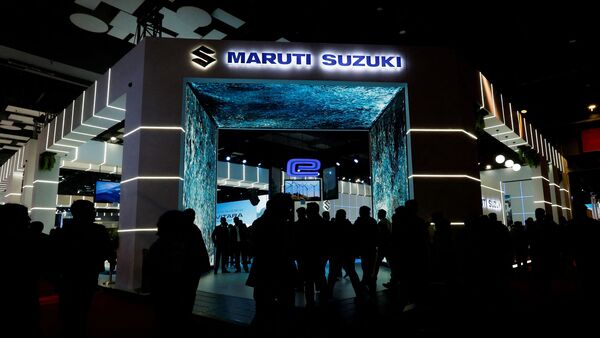
New Delhi: Maruti Suzuki India Ltd plans to make around 2,000 electric vehicles (EVs) a month for the domestic market until July as it begins sales of its flagship EV model, eVitara, while facing capacity constraints at its plants amid rising demand.
From July, the country’s largest carmaker expects to produce more than 2,000 electric vehicles (EVs) a month after completing capacity expansion at its plants, a top company executive said.
“We are calibrating because we have ensured that no model should have a longer waiting period,” Partho Banerjee, senior executive officer – marketing and sales at Maruti Suzuki, said during a press conference in New Delhi on Friday.
“After the launch of the product (eVitara), we are receiving close to 2,000 to 2,500 enquiries per day. We are trying to give the test drive. Each of our showrooms, we have got a test-drive vehicle,” he said.
Maruti’s EVs are being manufactured at its Hansalpur, Gujarat, facility which has a capacity of 750,000 units per annum. At this plant, Banerjee said that eVitara is being made on a production line that has a capacity of 100,000 units per annum which needs to cater to some other models, including Maruti Fronx, and exports.
In the next financial year starting April, Maruti will add a 250,000-unit production line at its Hansalpur plant which will make EVs.
A late entrant to the EV market, Maruti is looking to catch up with rivals Tata Motors Passenger Vehicles (PV), which sells 6,000-8,000 units a months, and Mahindra and Mahindra, which sells 4,000-5,000 units, buoyed by multiple models.
Monthly production volumes are typically an indicator of demand a company expects for a particular product.
More than 176,000 EV four-wheelers were sold in India in 2025 with a year-on-year growth of 77%, according to the Federation of Automobile Dealers Associations data. This was about 4% of the total 4.5 million passenger vehicles sold in the country.
Tata Motors PV commands about 40% of the electric four-wheeler market in India, followed by JSW MG Motor and Mahindra and Mahindra.
Maruti’s eVitara competes with several flagship EV models of competitors, including Tata Curvv, MG Windsor, Mahindra BE 6, among others. Earlier this month, Maruti announced the price of its latest eVitara starting at ₹15.99 lakh (ex-showroom). Under the battery-as-a-service model, the EV is priced at ₹10.99 lakh, with battery EMIs translating to about ₹3.99 per kilometre.
Banerjee noted that the company is currently ensuring that customers have a home charging facility and are slowly ramping up sales.
“We are not in a hurry because we don’t have so many vehicles to sell. We want the customer to really experience the whole of the sales process which we have created for the EV charging,” Banerjee said.
He was speaking at an event to announce that the company has opened 200 premium dealership outlets—Nexa Studio—targeted for smaller cities.
The company sells some of its prized models like Grand Vitara, and Fronx through the Nexa dealership channel, which focuses on premium experience.
According to Maruti’ calculations, premium dealership outlets in smaller towns can help in its EV sales as well, with around 10% of overall EV sales of the industry coming from emerging markets (defined as those outside of top 100 cities).
Maruti has installed EV chargers at these outlets across the country, and plans to expand to 600-700 such Nexa Studio outlets over the next five years.
When asked whether Maruti can target a higher share of EV sales in emerging markets within the country, Banerjee said that it will depend on ability to give consumers the confidence that EV ecosystem is present.
“If you are able to give the confidence to the customer that someone is there to support you, even if you are travelling intercity, a good service backup is there. Obviously, the product has to be the show-stopper. I think the electric vehicle penetration can start increasing in the emerging markets also,” Banerjee said.
The company plans to install around 100,000 EV chargers by 2030, as it looks to expand its EV lineup in the country.


