Peer into The Economist’s decision-making processes with Edward Carr, our deputy editor, who explains how we select and design our front cover. Cover Story shares preliminary sketches and documents the—often spirited— debates that lead each week to a design seen by millions of people.
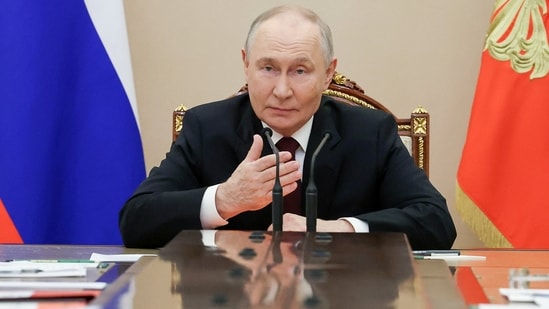
We have two covers this week. In Europe, on the eve of the fourth anniversary of Russia’s full-scale invasion of Ukraine, we ask why Vladimir Putin fights on in a war he cannot win. In the rest of the world we look at how the modern state has become a machine for redistribution, one in which the taxman is less like the Sheriff of Nottingham than Robin Hood.
All Access.
One Subscription.
Get 360° coverage—from daily headlines
to 100 year archives.
Full Access to
HT App & Website
Already subscribed? Login
Our coverage of Russia tries to get inside the head of its president. Here’s what we found:
One design is a matryoshka of mortars—a mortryoshka?—each primed to cause death and destruction in Ukraine’s freezing cities. The other is a Putryoshka of presidents, each yearning to be ranked among history’s greatest tsars.
Mr Putin is caught in a vice of his own making. The chances are waning that his armies in Ukraine will produce something he can call victory. Meanwhile, the aftershocks of peace inside Russia would risk economic and political instability. His one hope—it does not merit being called a strategy—is that President Donald Trump will impose such an unfavourable deal on Ukraine that Russia can claim to have prevailed.
Because it is hard for journalists to report from Russia, life there feels distant. How about using a photograph to create a sense of immediacy? That would also help promote our briefing, which gives a rare flavour of Putin’s kingdom.
We liked this picture because the gun-barrels are ominous and concealed—like the “special military operation” itself. Inside Russia, war is ever-present even as Mr Putin gives people implicit permission not to think about it.
This captures the contradiction that is eating away at Russia. On the right you have the heroic image of a Russian soldier, evidence for Mr Putin’s claim that victory is inevitable and that everything is going according to plan.
On the left the balconied woman says that this is propaganda. Russia has suffered something like 1.2m casualties. Its troops are poorly trained, morale is low and desertion rates are higher than ever. As Alexandra Prokopenko explains in our By Invitation column, the economy is cannibalising itself, as it diverts resources from things for improving people’s lives towards things for waging war.
We chose a third picture, of an exhausted soldier sleeping as a startled woman hurries by. Mr Putin’s readiness to carry on fighting depends on the pain he is willing to inflict. But the more pain there is, the clearer it will be to Russians that he is bringing down ruin upon them.
In 1980 the top 1% of Americans commanded 9% of pre-tax income, rising to 16% by 2022. Much less noticed is how tax codes have become more progressive, outweighing the growth in inequality in much of the rich world, and almost keeping pace with it even in America.
Our cover could illustrate this as a trawler turning the seabed into a desert. One reason taxing the rich will not work is that even they do not have enough money to pay the bills for everyone else. California is proposing a “one time” 5% levy on billionaires’ wealth, but it would raise only about 2% of the state’s annual output—not much for a place with one of the world’s greatest concentrations of billionaires.
Or how about the peasants’ revolt? Taxing the rich has obvious appeal.
Yet excessive taxes on the rich harm everyone else, too. Recent research finds that facing a one-percentage-point higher income-tax rate reduces the likelihood that someone will file a patent in the following three years by 0.6 percentage points. This loss of entrepreneurial effort hurts society more than it hurts innovators, who by one estimate capture just 2% of the value they generate.
These images are fine, but we wanted to make the most of our correspondent’s wonderful metaphor: the Robin Hood state.
This is more like it. Poor Benjamin Franklin has been skewered. The trouble is that a single arrow connotes William Tell rather than the longbow-wielding Loxley. For the final cover, we picked a wallet and sheaf of arrows.
Robin Hood is supposed to right wrongs. But fairness in taxation is not just about narrowing the gap between rich and poor. A fair system would also respect property rights, be reasonably predictable and allow people to reap the rewards of their efforts and risk-taking. Emulating Robin Hood and his merry men might look tempting. But it is a trap.