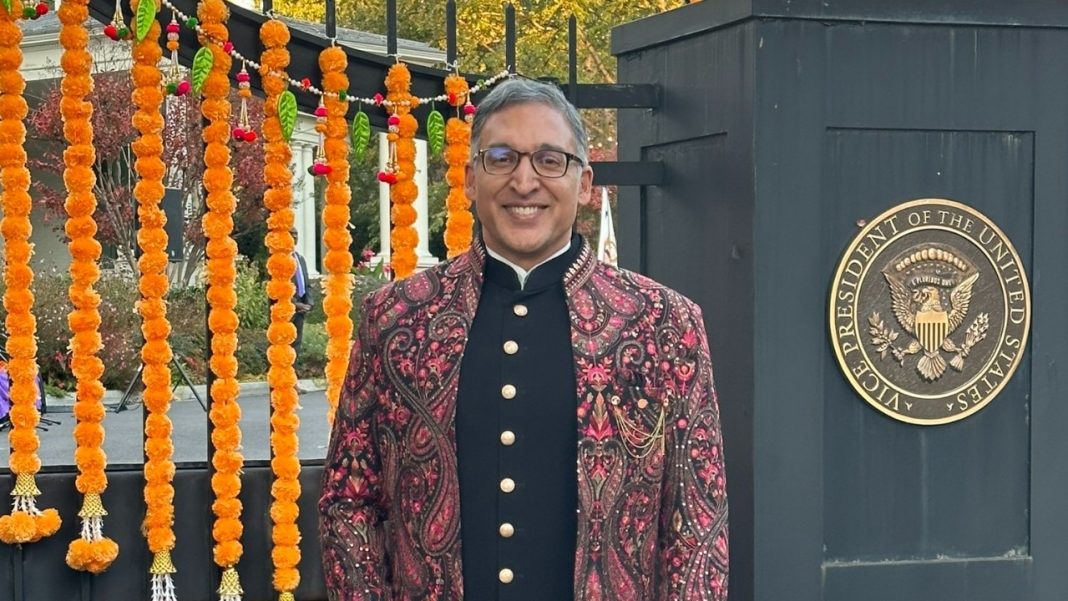
The Indian-origin lawyer who successfully argued against the Donald Trump administration’s sweeping global tariffs before the US Supreme Court has claimed that the statute used by the President to effectively defy the court’s recent ruling lacks legal teeth in the specific scenario and that the same has been acknowledged by the federal government itself.
Neal Katyal, who represented small businesses in the consequential tariff case and won, said Trump’s own Department of Justice (DOJ) had admitted before the Supreme Court that Section 122 of the Trade Act of 1974 does not have any ‘obvious application’ in dealing with ’emergency arise from trade deficits’.
Posting on X, the lawyer wrote, “Seems hard for the President to rely on the 15 percent statute (sec 122) when his DOJ in our case told the Court the opposite.”
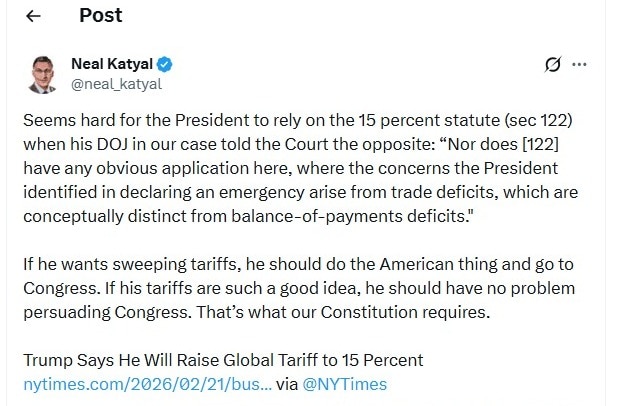
Quoting a purported submission by the DOJ, he wrote, “Nor does [122] have any obvious application here, where the concerns the President identified in declaring an emergency arise from trade deficits, which are conceptually distinct from balance-of-payments deficits (sic).”
He further dared Trump to get his sweeping tariffs regime passed through Congress. “If his tariffs are such a good idea, he should have no problem persuading Congress. That’s what our Constitution requires,” Katyal said in his post.
Tariffs have been one of the only areas where the Republican-controlled Congress has been at odds with Trump.
TRUMP TARIFFS SHOWDOWN: BRIEF GLIMPSE
Katyal’s post came as the US President announced that he would be raising a temporary tariff on all imports to the US from 10 per cent to 15 per cent.
The 10 per cent levy was announced on Friday, shortly after the US Supreme Court struck down a significant portion of President Trump’s global tariff regime, ruling that the power to impose taxes lies with Congress.
On Saturday, the US President said he’d raise that new tariff from 10 per cent to 15 per cent. He’s doing so under a law that restricts the tariffs to 150 days and has never been invoked this way before.
While announcing the revised rate of levy, Trump said that during the 150-day period, his administration will work on issuing new and “legally permissible” tariffs.
WHAT IS SECTION 122?
Section 122 of the Trade Act of 1974 allows a president to impose tariffs of up to 15 per cent for a maximum of 150 days to address what the law calls large and serious United States balance-of-payments deficits, in simple terms, when imports far exceed exports.
(With inputs from Associated Press)