
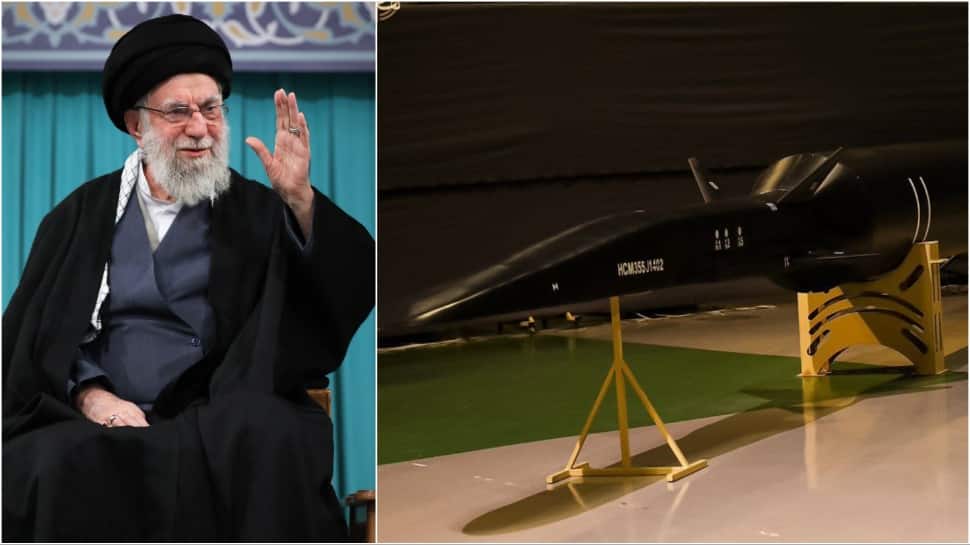
In a provocative escalation of rhetoric, Iranian Supreme Leader Ayatollah Ali Khamenei issued a stern warning to Washington on February 17. He claimed that Iran has the “weapon” needed to send US aircraft carriers to the “bottom of the sea.” These remarks followed reports of the US Navy deploying the USS Abraham Lincoln and USS Gerald R. Ford carrier strike groups near Iran. While Khamenei did not specify a particular platform, military analysts believed his message highlights Iran’s “Anti-Access/Area Denial” (A2/AD) strategy, which aims to control the Strait of Hormuz.
The hypersonic threat: Fattah-1 and Fattah-2
The strongest candidate for the “carrier killer” role in Iran’s arsenal is the Fattah class of hypersonic missiles. Developed by the Islamic Revolutionary Guard Corps (IRGC), these weapons mark a significant shift in Tehran’s missile technology.
Fattah-1: Unveiled in June 2023, this medium-range ballistic missile (MRBM) has a reported range of 1,400 km and speeds between Mach 13 and Mach 15. It uses a Maneuverable Re-entry Vehicle (MaRV) with thrust vector controls to avoid Aegis-class missile defenses in its final phase.
Fattah-2: This newer version incorporates a Hypersonic Glide Vehicle (HGV) design. Unlike traditional ballistic paths, HGVs fly along unpredictable routes, making them extremely hard for radar systems to track and intercept. Reports indicated that several Fattah class missiles were tested in combat for the first time during Iran’s October 2024 strike against Israel.
The backbone of denial: Anti-ship cruise missiles
While hypersonics attract attention, the International Institute for Strategic Studies (IISS) noted that Iran has a large stockpile of 1,000 to 1,200 Anti-Ship Cruise Missiles (ASCM). These systems form the “asymmetric” core of Iranian naval power:
Missile class, reported range, key features:
– Abu Mahdi, 1,000 km, Long-range, precision strike capability
– Ra’ad, 350 km, Based on the Chinese ‘Silkworm’ design
– Ghadir, 300 km, Sea-skimming capability to avoid detection
– Qader/Noor, 120-200 km, Upgraded Chinese C-802 derivatives
– Nasr-1, 35 km, Short-range, high-mobility coastal defense
The shield: US Navy defence capabilities
Despite Tehran’s claims, sinking a US Carrier Battle Group is a significant military challenge. US warships rely on a multi-layered defense system. This included the Aegis Combat System, SM-3 and SM-6 interceptors, and the Phalanx CIWS for close-in threats.
Recent conflicts serve as examples:
– The Red Sea crisis: US warships in Operation Prosperity Guardian successfully neutralised hundreds of Houthi-launched drones and missiles, many of Iranian origin, without taking any hits.
– The “Swarm” factor: Experts cautioned that while a single missile is unlikely to breach a carrier’s defenses, Iran’s ability to launch a coordinated “swarm” of missiles, torpedoes, and suicide drones at the same time remains a major concern for US naval planners.


