At 8 am in Delhi’s Mukherjee Nagar, the shutters of coaching centres roll up almost in sync. By 8:30, every seat inside the narrow study halls is occupied. Laptops are open, but not for coding. Thick files labelled “Polity Notes – 2026 Attempt” are stacked neatly on wooden desks. A young man in a faded college sweatshirt scrolls through current affairs on his phone. His LinkedIn profile still reads “Software Engineer (2023–2024).”
Two years ago, he sat for campus placements. Today, he is preparing for the UPSC Civil Services Examination.
Across the aisle sits a commerce graduate who once aimed for corporate banking but now splits her preparation between the Staff Selection Commission Combined Graduate Level Examination and the IBPS Probationary Officer Exam. “You cannot depend on one exam,” she says. “Everyone prepares for at least three.”
These are not isolated stories. They represent a measurable national shift.
Over the past five years, data and field reports show a clear upward trend in graduates, especially engineers, turning toward competitive government recruitment exams, both in participation and final selections.
This is not a fad. It is structural.
THE DATA: A CLEAR YEAR-ON-YEAR CLIMB
Government data tabled in Parliament reveals a steady rise in bachelor’s degree holders clearing the UPSC Civil Services Examination in recent years.
Year Bachelor’s Degree Holders in Final UPSC List
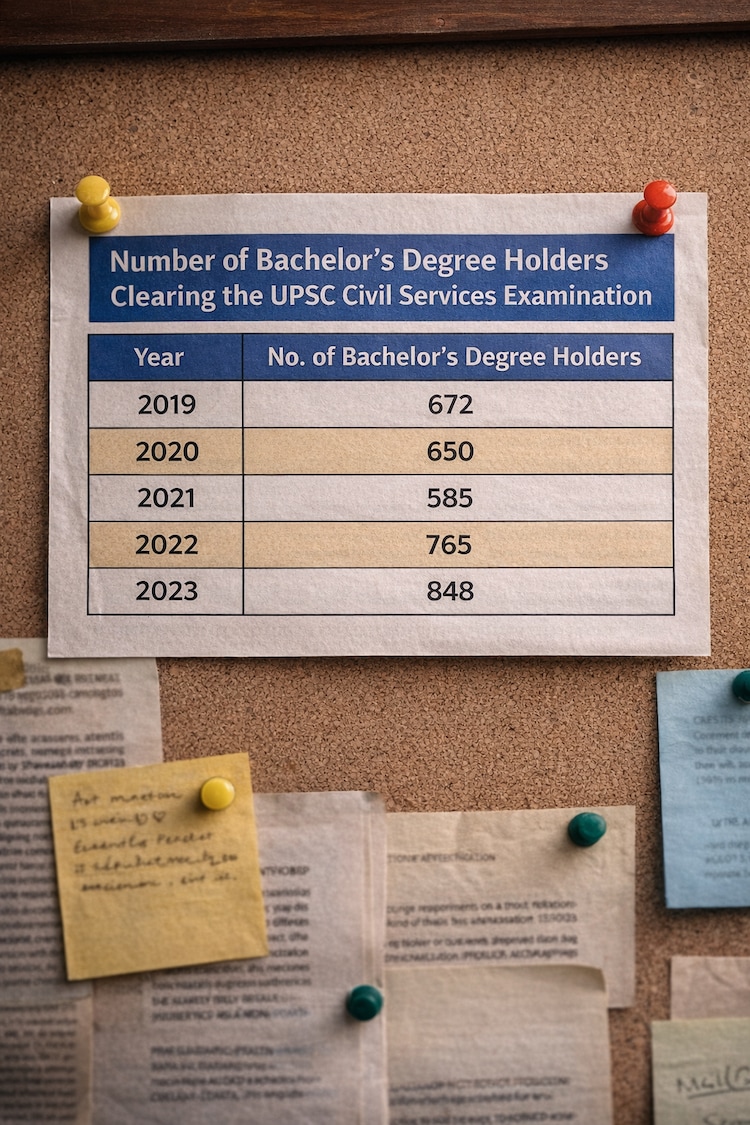
While 2020 and 2021 saw disruptions due to the pandemic, the rebound has been sharp. From 585 in 2021 to 848 in 2023 represents a 45% jump in just two years.
Engineering graduates continue to form the largest single academic category among successful candidates. However, humanities and science graduates have also shown strong growth, indicating that the surge is broad-based rather than confined to one stream.
The upward movement since 2022 signals something deeper than post-pandemic backlog effects. Coaching enrolments across major hubs confirm rising graduate participation.
INDIA’S GRADUATE EXPLOSION: THE SUPPLY SIDE STORY
According to the All India Survey on Higher Education (AISHE), India’s gross enrolment ratio in higher education has steadily climbed over the past decade. India now produces over 10 lakh engineering graduates annually, alongside millions more in arts, science, and commerce streams.
But job absorption has not kept pace proportionally.
The India Skills Report and other employability surveys over the last decade show gradual improvement in employability percentages — rising from roughly one-third of graduates being job-ready a decade ago to over half in recent years. Yet, employability does not automatically translate into stable or high-quality employment.
Many Tier-2 and Tier-3 institutions report average salary packages between 3–5 lakh per annum modest returns considering private engineering fees often range between 8–15 lakh for four years.
The mismatch between expectations and outcomes has widened.
THE PLACEMENT ILLUSION VS JOB SECURITY ANXIETY
For years, engineering was positioned as the most secure career pathway. But over the past five years:
- Hiring cycles in the tech sector have become volatile.
- Entry-level coding roles are increasingly automated or contractual.
- Layoffs in global firms have amplified insecurity among young employees.
- While elite institutes continue to command strong placement figures, the median graduate’s experience is far more uneven.
- This environment has altered risk perception.
- A government job once seen as conservative now appears economically rational.
THE MULTI-EXAM STRATEGY: A NEW NORMAL
What is different about this generation is not just that graduates are preparing for government jobs it is that they are preparing for multiple exams simultaneously.
Aspirants frequently combine preparation for:
- UPSC Civil Services Examination
- RRB NTPC Examination
- Staff Selection Commission Combined Graduate Level Examination
- IBPS Probationary Officer Exam
This diversification reflects heightened uncertainty. The “single dream exam” model is being replaced by a portfolio approach to career risk.
GENDER TRENDS: A NOTABLE RISE
Another structural shift is the rising representation of women in competitive exam success lists. Over the past five years, women’s share in UPSC selections has climbed significantly from roughly one-fourth to over one-third in recent cycles.
This indicates expanding access and aspiration, adding to overall participation pressure.
THE COACHING ECONOMY AS PARALLEL EDUCATION
Cities like Delhi, Prayagraj, Jaipur and Hyderabad now operate as full-fledged competitive exam ecosystems.
Hostels, libraries, photocopy centres, mentorship networks and peer study groups create an infrastructure that makes long-term preparation sustainable. Engineering graduates, accustomed to competitive exam cycles since JEE days, adapt seamlessly to this culture.
The journey often looks like this:
- Class 11–12: JEE preparation
- College Years: Placement preparation
- Post Graduation: UPSC/SSC/Banking preparation
- The exam pipeline never truly ends.
IS ENGINEERING BECOMING A GENERAL DEGREE?
One of the most debated questions in policy circles is whether India is overproducing engineers relative to market demand.
When a significant proportion of engineering graduates aim for non-technical government roles, it signals a possible misalignment between higher education output and labour market absorption.
The upward trend in graduate participation in government recruitment exams may reflect:
- Degree inflation
- Underemployment
- Security prioritisation over entrepreneurship
- Cultural prestige attached to state service
- It also raises deeper systemic questions about curriculum reform and skilling alignment.
ECONOMIC RATIONALITY VS ASPIRATIONAL NARRATIVES
For many middle-class families, a government job offers:
- Predictable salary progression
- Pension-linked security
- Transfer policies
- Social respect
In uncertain economic times, stability becomes aspirational.
Unlike corporate roles, which may fluctuate with market cycles, government employment is perceived as insulated from global volatility.
THE PSYCHOLOGICAL LAYER
- Beyond economics lies psychology.
- Graduates today are navigating:
- High parental investment in education
- Rising cost of living in urban centres
- Competitive peer environments
- Social media comparison culture
The prestige associated with clearing the UPSC Civil Services Examination remains unmatched. It represents not just employment, but symbolic achievement.
A FIVE-YEAR PATTERN, NOT A PASSING PHASE
The consistent rise in bachelor’s degree holders in final UPSC lists since 2022, alongside broader graduate participation in SSC, Railways, and banking exams, points to an enduring trend.
Even as employability metrics improve on paper, behavioural data rising exam applications, growing coaching enrolments, multi-exam preparation suggests that graduates are recalibrating their risk appetite.
This is not a retreat from ambition. It is a redefinition of ambition.
WHAT POLICYMAKERS MUST CONSIDER
If this upward trajectory continues, it will demand reflection at multiple levels:
1. Higher education capacity planning
2 . Curriculum relevance to emerging industries
3 . Graduate employability beyond metrics
4. Public sector recruitment capacity
If lakhs of highly trained engineers aspire to administrative or clerical government roles, the conversation cannot remain confined to individual choice. It becomes a systemic question.
THE QUIET PIVOT
Back in Mukherjee Nagar, the library empties briefly at lunch hour. Conversations revolve around cut-offs, optional subjects and attempted strategies.
For many of these graduates, engineering was never wasted. It was preparation just not for the path they initially imagined.
Degrees are no longer destinations. They are stepping stones.
And as the data shows, year after year, more graduates are stepping toward government corridors not out of nostalgia, but out of calculated realism.