
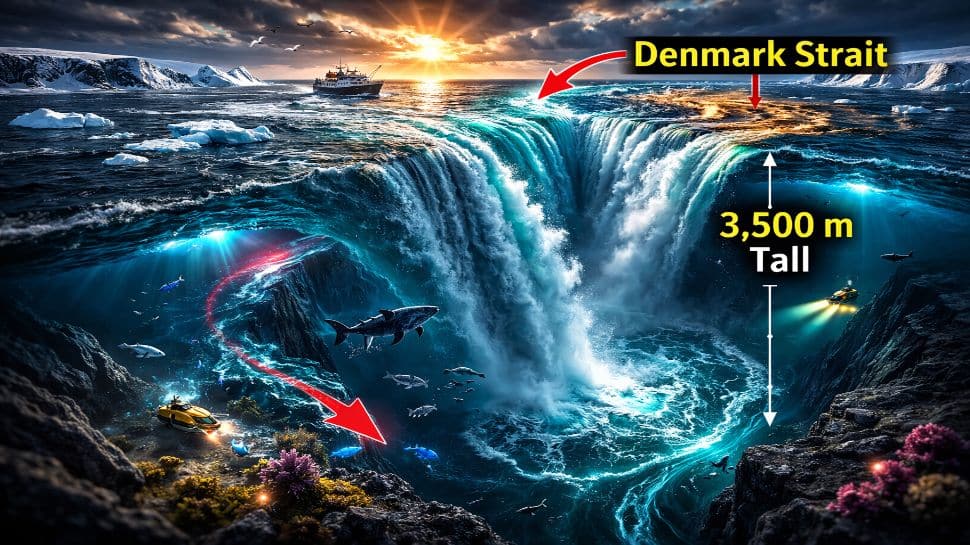
New Delhi: When people think of the world’s largest waterfall, they often imagine towering cascades like Niagara or Victoria Falls. However, the biggest waterfall on earth is not on land. It is hidden deep beneath the ocean surface. This natural phenomenon is known as the Denmark Strait Cataract.
It lies between Greenland and Iceland in the narrow passage known as the Denmark Strait. Unlike traditional waterfalls, this one flows underwater. There is no dramatic curtain of water visible from above. The entire process takes place thousands of metres below the ocean’s surface.
The waterfall is formed due to differences in water temperature and density. Extremely cold, dense water from the Greenland Sea flows southward. As it reaches an underwater ridge in the Denmark Strait, it plunges downward into the warmer and lighter waters of the Atlantic Ocean. The drop is about 3,500 metres deep. This makes it much taller than any waterfall on land.
In terms of scale, the Denmark Strait Cataract is enormous. It stretches nearly 480 kilometres in width. Scientists estimate that millions of cubic metres of water fall downward every second. Its flow rate is several times greater than that of the largest visible waterfalls on earth. That is why it is regarded as the most powerful waterfall in the world.
This underwater cascade plays an important role in the global ocean circulation system. It forms part of the thermohaline circulation, which is often described as the planet’s “global conveyor belt”. This circulation system helps regulate earth’s climate by distributing heat across oceans. The Denmark Strait Cataract contributes to the movement of cold and warm water masses that influences weather patterns, particularly in Europe.
The feature was studied and charted during 20th-century oceanographic research missions. Scientists used sonar technology and deep-sea instruments to measure the depth and flow. Since the waterfall occurs entirely underwater, it cannot be seen with the naked eye. Its existence is known through scientific exploration and data collection.
The Denmark Strait Cataract shows that some of the earth’s most powerful natural forces work deep below the surface, where we cannot see them. Though invisible to humans standing on the shore, it is the largest waterfall on the planet that helps control ocean currents and influence the global climate.


