
Over 20 Heads of State, 60 Ministers, 500 Global AI Leaders, thousands of visitors, and delegates from across the world, this is the scale of the AI Summit 2026 at Bharat Mandapam in Delhi. From IITs to start-ups to companies like TCS, the halls are filled with India’s technological ambitions. In Hall No. 8, IIT Madras, IIT Kanpur and IIT Bombay are displaying innovations built by students and researchers.
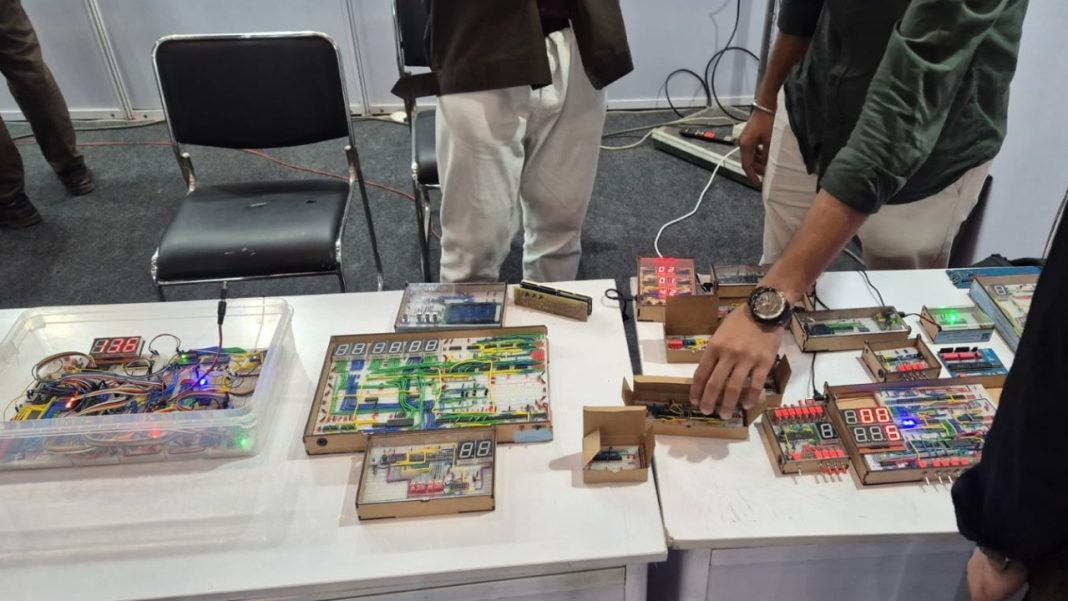
But in one quiet corner, IIT Gandhinagar is showing something that looks less complete than the rest, a set of bare semiconductor prototypes, wires exposed, circuits visible, waiting to be assembled.
These machines are not products. They are lessons.
And soon, they may reach schools.
For years, Indian education has excelled at explaining technology. Students learn formulas, logic and theory. But they rarely touch the machines they study. The IIT Gandhinagar project begins with a simple question: what if students build computers before they only learn about them?
“We propose to build a transformative, multi-level curriculum designed to build national capacity in semiconductor design and hardware systems, while evangelising indigenous processors like Vega as a part of curriculum design,” says Manu Awasthi, PhD Associate Professor of Practice Department of Computer Science and Engineering, IIT Gandhinagar.
TEACHING SEMICONDUCTORS BY PUTTING THEM IN STUDENTS’ HANDS
The institute has developed hardware learning kits that allow students to assemble working electronic systems from scratch. Each kit contains integrated circuits, breadboards, switches and connectors, the same basic elements that form larger computing systems.
Using these, students can build devices like digital clocks or calculators. As they move forward, they learn how circuits connect, how signals travel, and how electronic systems are designed.
They also learn how printed circuit boards are created, how components are placed, connected and turned into functional machines.
The programme follows a layered approach. Students begin with basic logic and gradually move towards more complex hardware. The kits have been designed for high school students, polytechnic learners and first-year engineering students.
It took nearly a year to develop the first prototypes. The curriculum that will accompany them is now being prepared. A proposal has also been submitted to the Ministry of Electronics and Information Technology to support rollout in schools and teacher training.
The goal is not to teach artificial intelligence directly.
The goal is to teach the hardware that makes artificial intelligence possible.
“We have written a proposal to Meity which is under consideration for funding under the capacity building initiatives of meity. As a result of that funding, if received, we will develop courses and kits and partner with schools to run pilots and run training programs for teachers,” added Awasthi.
Without processors, circuits and chip design, AI cannot exist. Students who understand hardware early can later design faster, more efficient systems.
THE LESSON INDIA CAN TAKE FROM CHINA’S CLASSROOM-TO-CHIP JOURNEY
India’s push into semiconductors has accelerated in recent years. Government programmes now support chip manufacturing, design and research. But factories and funding alone cannot create capability. That begins with people.
China recognised this earlier.
Over the past two decades, China invested heavily in practical technical education. Electronics labs became common in schools. Polytechnic institutes focused on hardware skills. Students were trained not only to use technology, but to build it.
Over time, this created a workforce capable of designing and manufacturing chips, devices and communication systems.
Today, China is one of the world’s largest electronics producers.
“AI is not integrated into these kits at all. The goal is to make the students (at all levels) understand the general principles of hardware design. Once they understand how computer systems work, they can use this to understanding to feed the decisions to build high performance, low energy hardware for AI (like GPUs),” told Awasthi to India Today.
The shift began long before factories, it began in classrooms.
India’s education system has strong theoretical depth. But practical hardware learning often arrives late. Many students complete school without assembling even a simple electronic system. By the time they encounter hardware, career choices are already shaped.
The IIT Gandhinagar initiative attempts to change that starting point.
When a student connects circuits and sees a system come alive, learning becomes real. Technology stops being abstract. It becomes something they understand, control and create.
The Centre for Creative Learning at IIT Gandhinagar, which is leading the project, has already worked with schools on hands-on science education. This experience is now being extended to semiconductor learning.
If introduced widely, these kits could create early familiarity with the foundations of computing. At the AI Summit, surrounded by finished machines and advanced platforms, the IIT Gandhinagar prototypes appear incomplete. But their purpose lies in their incompleteness.
They are designed to be finished by students. Because India’s semiconductor future may not begin in a fabrication plant. It may begin on a school desk, with a student assembling their first circuit.


