
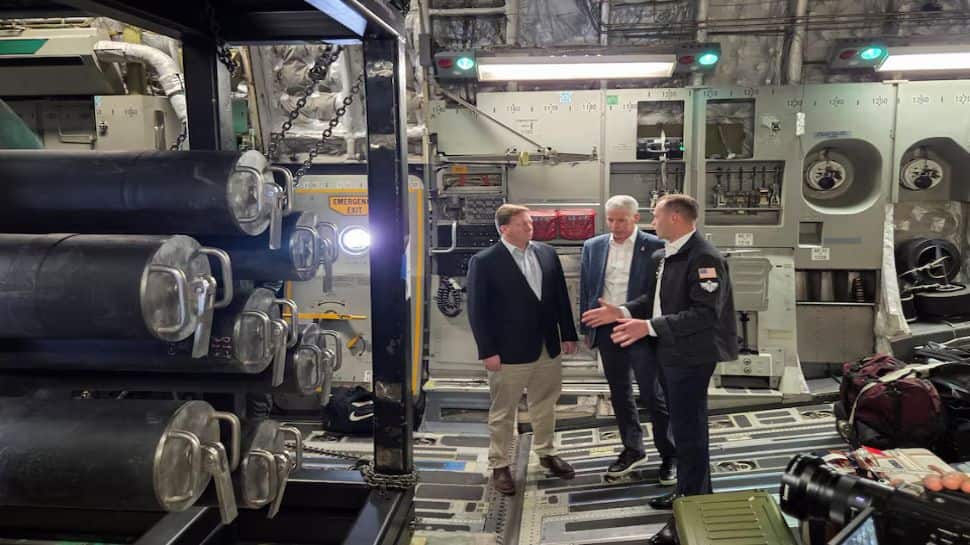
Washington: The United States has carried out an operation that has drawn global attention in the field of advanced energy technology. A nuclear reactor moved through the sky. The mission challenged long-held assumptions about how atomic infrastructure functions. Nuclear reactors have always been seen as fixed installations. They are anchored to one location for their entire operational life. But the latest exercise changed that perception.
The reactor involved was Ward 250, which belongs to a new class of compact microreactors. The airlift formed part of a military logistics demonstration. The reactor travelled in modular form. Eight separate modules formed the transport package. Heavy-lift aircraft moved the system from one American military installation to another.
Three C-17 Globemaster transport aircraft handled the transfer. The modules departed from March Air Reserve Base in California. The destination lay hundreds of kilometres away at Hill Air Force Base in Utah. The mission unfolded under an operation known within defence circles for testing rapid deployment capability.
The reactor carried no nuclear fuel during the flight. Safety protocols governed every stage of movement.
The Ward 250 microreactor came from American developer Velar Atomics. Engineers designed the system for mobility from the outset. Its physical footprint is compact. The reactor stands roughly the size of a large commercial van. Full output reaches about five megawatts of electricity. That level of generation can power nearly five thousand homes.
Initial activation will begin at a lower threshold. Early operations will start near one hundred kilowatts. Gradual scaling will follow. Output will climb step by step. The reactor will eventually approach its designed production ceiling. This phased activation supports performance testing and systems validation.
Design architecture sets this microreactor apart from traditional nuclear plants. The system uses TRISO fuel, which contains uranium particles sealed within multiple ceramic layers. Each particle forms its own containment barrier. The structure improves heat tolerance. It reduces the risk of material failure. Cooling occurs through helium gas rather than water. Gas cooling allows higher operating temperatures. The design enhances passive safety features. Mechanical complexity stays limited. Maintenance demands are lower.
Defence planners view mobility as an advantage. A transportable reactor can reach locations where grid infrastructure does not exist. Power generation begins near the point of need. No permanent plant construction becomes necessary. Deployment timelines shrink drastically.
This capability holds strategic relevance for countries with demanding terrain profiles such as India. The country spans mountains, deserts, dense forests and marshland. Extending conventional power grids across such geography requires heavy investment. Transmission losses rise over distance. Weather and terrain disrupt infrastructure projects.
A microreactor bypasses those barriers. It operates as a self-contained power source. Installation can occur in remote valleys or high-altitude plateaus. Desert outposts can receive continuous electricity. Island territories gain stable supply. Refuelling frequency is low. Logistics chains stay minimal.
Military applications stand out with equal importance. Forward bases often rely on diesel convoys. Fuel supply lines stretch across vulnerable routes. Enemy surveillance can track those movements. Portable nuclear power reduces that exposure. Bases receive energy without constant fuel transport. Radar systems, surveillance grids and communications arrays run without interruption.
Energy security planners see additional civilian value. Disaster zones can regain electricity through rapid deployment. Temporary industrial corridors can operate off-grid. Research stations in extreme climates can function year-round. The technology supports resilience planning.
The airborne transfer of the Ward 250 reactor marked more than a technical milestone. It demonstrated a new model of nuclear flexibility. Power generation no longer is tied to immovable concrete domes. Mobility entered the atomic sector.
Experts are still studying what this means. Portable nuclear systems could change how armies get power in remote areas. Electricity may reach far-off places faster than before. Regions once seen as too difficult may now get reliable energy. The airlift showed that nuclear technology is entering a new phase.


