
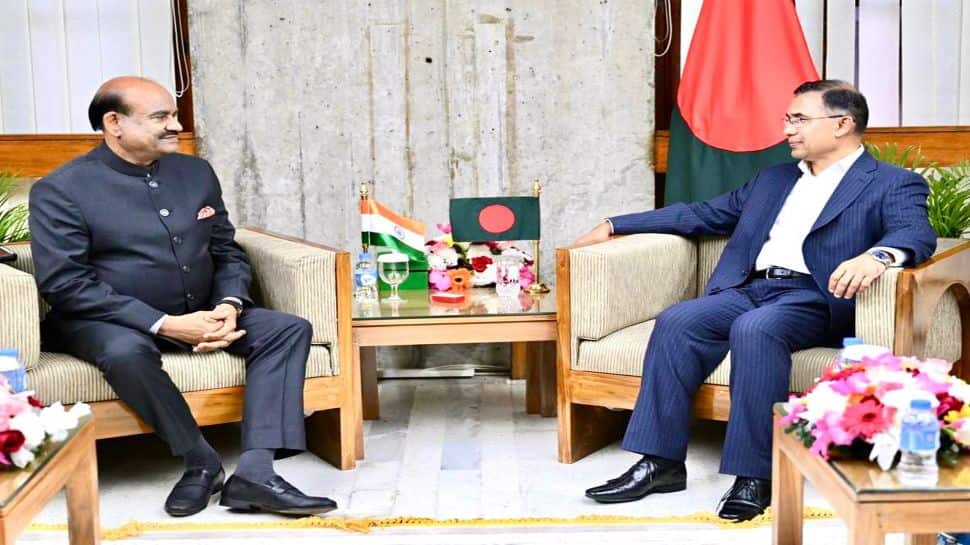
New Delhi: Prime Minister Narendra Modi chose not to attend the swearing‑in ceremony of Bangladesh’s newly elected prime minister that was held on February 17 in Dhaka. Instead, Lok Sabha Speaker Om Birla travelled to Bangladesh’s capital to represent New Delhi and deliver congratulatory messages to the new leadership. What does this mean?
The oath‑taking of Tarique Rahman followed a decisive victory by his Bangladesh Nationalist Party (BNP) in the country’s 13th national election.
Bangladesh had invited PM Modi to attend the ceremony, but he did not go because of scheduled engagements, including meetings with visiting French President Emmanuel Macron. Officials said the prime minister’s prior commitment in Mumbai made it difficult for him to travel to Dhaka.
The Ministry of External Affairs (MEA) issued a statement highlighting the decision to be represented by the Lok Sabha speaker as a reaffirmation of the strong historical and cultural links that bind the two neighbours. The statement said India “welcomes Bangladesh’s transition to an elected government” and highlighted the value placed on democratic continuity and shared values.
“As neighbours united by a shared history, culture and mutual respect, India welcomes Bangladesh’s transition to an elected government under the leadership of Tarique Rahman, whose vision and values have received an overwhelming mandate of the people,” the MEA said.
Analysts tracking South Asia’s diplomatic currents say India’s approach shows strategic caution rather than indifference to Dhaka’s political changes. While there have been problems in relations in recent years, especially during the tenure of the previous interim administration led by Nobel laureate Muhammad Yunus, New Delhi has shown interest in improving ties with Bangladesh. PM Modi’s congratulatory tweet to Rahman soon after the BNP registered a landslide victory and support for Bangladesh’s democratic process were seen as pragmatic steps in that direction.
BNP chief Tarique Rahman’s adviser Humayun Kabir too said Bangladesh wants to revive ties with India.
The BNP has not historically been viewed as closely aligned with New Delhi, especially compared with its rival party (the Awami League-led by ousted Prime Minister Sheikh Hasina) that governed Bangladesh for much of the past decade. From 2001 to 2006, when the BNP-Jamaat-e-Islami government was in power, the relations between the two nations were cold and distant.
Former Indian High Commissioner to Dhaka, Pinak Ranjan Chakravarty, said that the Awami League government was highly sensitive about India engaging with the BNP. “This sensitivity was a major reason why direct contact with the BNP did not develop as expected,” he explained.
Despite the historically tense relationship with the BNP, India welcomed Rahman’s recent statements. “Though his ‘Bangladesh First’ policy stresses national sovereignty, he has noticeably avoided the anti-India rhetoric that marked his earlier years. This change might have led PM Modi to congratulate Rahman as the ‘future prime minister’, extending warm wishes and expressing confidence in his leadership,” he said.
Scholars of regional affairs suggest that by sending the Lok Sabha speaker, India is recognising the electoral outcome while managing its broader diplomatic agenda.
Observers outside India have interpreted the gesture in different ways. Commentators in Dhaka have described Om Birla’s presence as a sign of “respect for the democratic process” and a stabilising diplomatic signal at a moment of political transition.
Some diplomatic circles see it as India treading carefully, balancing respect for Bangladesh’s sovereign choices with its own geopolitical priorities.
Political analysts in South Asia say that this period presents opportunities and challenges for both countries. India’s response shows a combination of respect for democratic norms, ongoing cooperation on shared regional concerns and a realistic assessment of Bangladesh’s policies under Rahman’s leadership.
As both governments move forward, attention now turns to how bilateral dialogue will continue on trade, security and cultural ties, and how new leadership in Dhaka influences India’s approach in the months and years ahead.


