
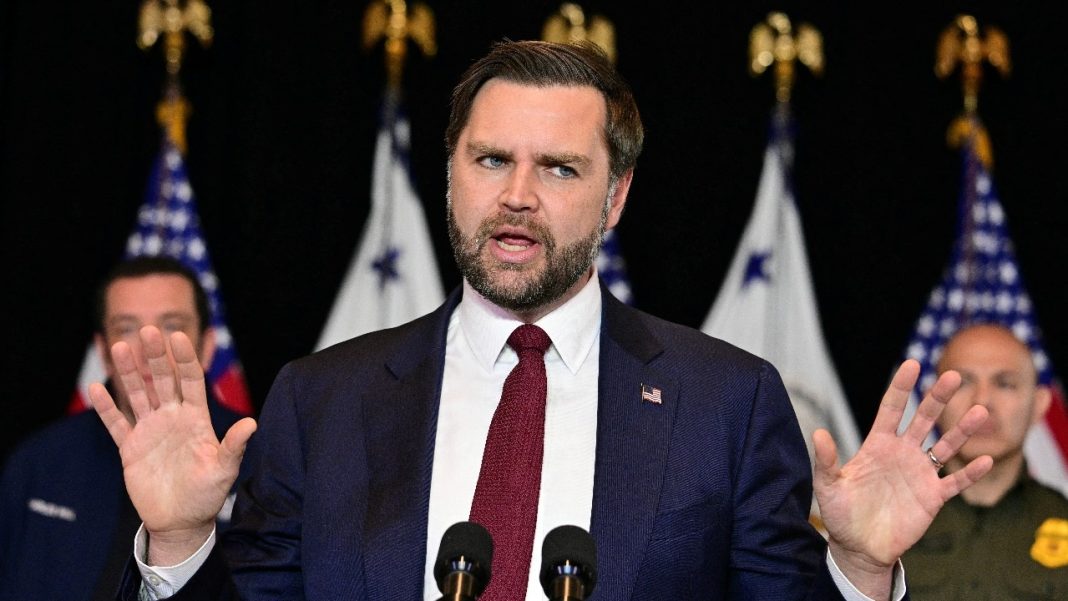
The United States and Iran remain at odds even after a new round of talks in Geneva, with US Vice President JD Vance saying Tehran has yet to accept key conditions laid out by President Donald Trump for a diplomatic breakthrough.
Speaking in a Fox News interview after Tuesday’s meetings, Vance said negotiations produced mixed results.
“In some ways, it went well; they agreed to meet afterwards,” Vance said on The Story with Martha MacCallum. “But in other ways, it was very clear that the President has set some red lines that the Iranians are not yet willing to actually acknowledge and work through.”
The comments underscore the fragile state of diplomacy as tensions simmer over Iran’s nuclear programme. Trump has warned that military force remains an option if Tehran refuses to meet US demands.
Vance stressed that Washington still prefers a negotiated solution.
“Now, we would very much like, as the President has said, to resolve this through a conversation in a diplomatic negotiation, but the President has all options on the table,” he said.
Vance made it clear that the ultimate decision on how long to pursue talks rests with Trump.
“We’re going to keep on working it. But of course, the President reserves the ability to say when he thinks that diplomacy has reached its natural end,” the Vice President said. “We hope we don’t get to that point, but if we do that will be the president’s call.”
US officials described the Geneva discussions as making some progress but acknowledged that significant gaps remain. Washington expects Iran to submit more detailed proposals within the next two weeks to clarify its positions and narrow the differences.
The talks come at a sensitive moment. Trump has framed Iran’s nuclear programme as a central concern and has repeatedly warned of consequences if Tehran does not agree to strict limits.
TEHRAN SEES ‘NEW WINDOW’ FOR DEAL
Iran’s Foreign Minister Abbas Araghchi has expressed optimism about the talks while saying “a new window has opened” for reaching an agreement.
“We are hopeful that negotiations will lead to a sustainable and negotiated solution which can serve the interests of relevant parties and the broader region,” he told a UN disarmament conference after leading the Iranian delegation at the talks held in Geneva.
He added that Iran “remains fully prepared to defend itself against any threat or act of aggression,” and that the consequences of any attack on Iran would not be confined to its borders.
Trump, who scrapped an earlier nuclear agreement with Iran during his first term, has repeatedly threatened to use force to compel Iran to agree to constrain its nuclear program. Tehran has said it would respond with an attack of its own. Trump has also threatened Iran over the killing of protesters.
Trump’s envoys, Steve Witkoff and Jared Kushner, led the US delegation at the latest indirect talks, held inside the residence of Oman’s envoy to the UN. Oman, a longtime regional mediator, had hosted an earlier round on February 6.
There was progress in the talks, but many details remained to be discussed, according to a US official. The Iranian delegation said they would present more detailed proposals in the next two weeks to narrow gaps, the official said.
(With inputs from Associated Press)


