
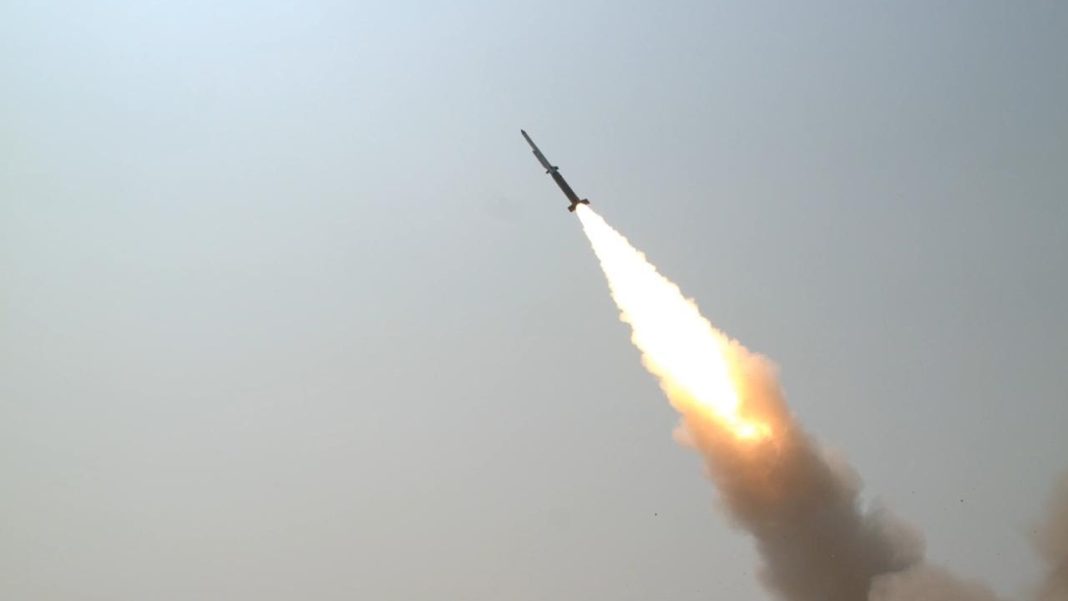
DRDO Successfully Tests Critical Ramjet Missile Booster
The Defence Research and Development Organisation (DRDO) has successfully flight-tested an indigenously developed Solid Fuel Ducted Ramjet (SFDR) booster, marking a major leap in India’s quest for self-reliant, long-range air combat capabilities.
Key Takeaways
- Test Date: February 3, 2026, off the Odisha coast.
- Technology: Solid Fuel Ducted Ramjet (SFDR) booster.
- Significance: Enables future long-range, supersonic air-to-air missiles for Indian fighter jets.
- Developer: DRDO’s Hyderabad lab (DRDL) in collaboration with other facilities.
- Goal: Reduce dependence on foreign missile imports like the Russian R-77 and French MICA.
What This Successful Test Means
The SFDR propulsion system allows a missile to intercept aerial threats at very long ranges while maintaining supersonic speeds. The Ministry of Defence stated the test provides a “technological advantage” for developing next-generation missiles.
In a realistic deployment scenario, the system was released from an aircraft and tracked by multiple monitoring systems. The core innovation is a nozzle-less booster—a key ramjet component that uses the missile’s own high speed to compress air for combustion, making the engine lightweight and highly efficient.
Boosting Atmanirbhar Bharat in Defence
This test is a cornerstone of India’s initiative. The indigenous SFDR system is destined for integration into future air-to-air missiles, significantly enhancing the strike capabilities of the Indian Air Force and Navy.
“The successful demonstration of SFDR technology & its performance has provided DRDO with a technological advantage which will enable it to develop long-range air-to-air missiles,” the Ministry of Defence said.
Understanding Ramjet Technology
Ramjets are air-breathing engines ideal for sustained high-speed flight within the atmosphere. Unlike rockets that carry both fuel and oxidizer, ramjets use the vehicle’s forward motion to compress incoming air, which is then mixed with onboard fuel for combustion.
The DRDO’s SFDR variant uses solid fuel, which is safer and easier to store than liquid fuel, making it perfectly suited for missile applications. This latest test in 2026 builds on successful trials conducted in 2018, 2019, and 2021, validating the technology’s readiness for weaponization.
The development positions India to join a select group of nations mastering this advanced propulsion technology, a critical step toward strategic self-reliance.


