
Budget 2026: Trade Deficit Growth Slowed After 2014
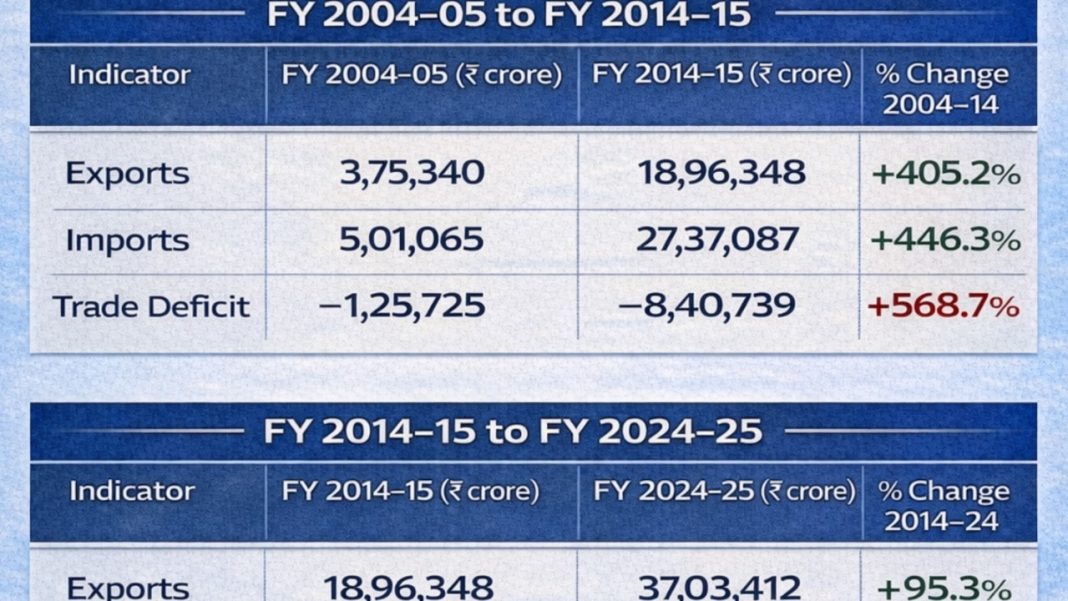
India’s trade deficit has expanded under successive governments, but its growth rate has moderated significantly since 2014, as revealed by data in the Interim Budget 2026-27.
Key Takeaways
- Trade deficit grew from $38B (2004-05) to $240.2B (2023-24).
- Annual growth rate slowed from 15.4% (UPA era) to 6.3% (post-2014).
- Exports showed resilience, crossing $450 billion in 2023-24.
- Government focusing on PLI schemes and logistics to boost exports.
Deficit Trends: UPA vs NDA
The trade deficit—the gap between imports and exports—remains a key economic challenge. During the UPA government’s tenure (2004-05 to 2013-14), it surged from $38 billion to $137.7 billion.
Under the NDA government (2014-15 to 2023-24), the deficit increased further to $240.2 billion. However, the pace of growth dropped sharply. The average annual growth rate fell from 15.4% during the UPA years to 6.3% in the subsequent period.
Export Resilience and Policy Focus
Despite global challenges, India’s merchandise exports demonstrated strength, surpassing $450 billion in 2023-24.
Presenting the budget, Finance Minister Nirmala Sitharaman stated the government’s focus is on transforming India into a global manufacturing hub. Initiatives like the (Production Linked Incentive) schemes aim to boost exports over the long term.
The budget also outlines measures to improve ease of doing business and cut logistics costs, enhancing the competitiveness of Indian goods abroad.
Economists’ View
Economists acknowledge that while the trade deficit is still high, the slower growth rate is a positive indicator that current policies are having an effect. They emphasize, however, that sustained efforts are crucial to substantially narrow the gap.


